The short answer
eBay’s Shipping Service Standard Policy is not a simple “upload a tracking number and you are done” rule.
For transactions that fall within the policy’s scope, eBay measures the Acceptance Scan Rate: the percentage of the seller’s transactions for which a valid carrier acceptance scan, or A-Scan, has been uploaded. To meet the stated standard, every evaluated transaction must have an A-Scan.
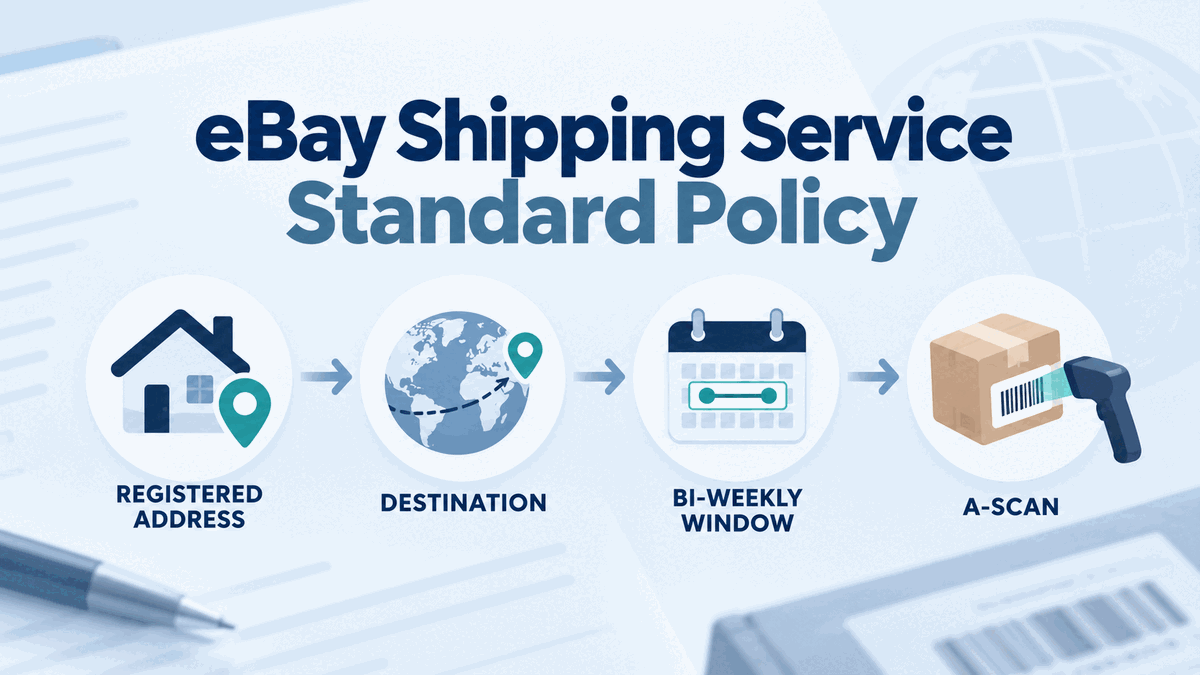
The correct order of review is therefore: confirm the seller’s registered address and the destination, remove the stated exclusions, place each included transaction into the correct review period using its promised handling due date, and then check whether the transaction has a valid A-Scan.
The policy says it is effective August 31, 2026. It concerns shipping visibility and seller performance for a defined cross-border transaction scope; it is not a universal rule for every eBay order.
Who and which transactions are in scope?
Seller registration address
eBay says that only sellers with a registered address in HiPO, India, Singapore, Thailand, Malaysia, Vietnam, the Philippines, or Indonesia will be evaluated.
Destination country
The transaction must be shipped to the United States, the United Kingdom, or Germany.
Excluded transactions
The policy excludes items listed under the local pickup category and items delivered virtually by the seller.
These conditions should be read together. A seller having shipping orders on eBay does not mean that every order is automatically part of this 100% calculation. The policy page does not limit the rule to one product category, but it does define the registered-address scope, destination scope, and transaction exclusions.
Tracking information is not the same as an A-Scan
The policy defines an A-Scan as a valid carrier acceptance scan. That is the evidence used for the Acceptance Scan Rate.
Uploading a tracking number provides tracking information, but it does not by itself prove that the carrier has produced a valid acceptance scan recognized for the policy. Later transit updates or delivery status are also not substitutes for the acceptance scan named by the policy.
This article does not add a carrier list, a scan-code list, or an account-specific recognition rule. The official page directs sellers to the Seller Dashboard for further details about their actual results.
How the bi-weekly evaluation window works
eBay says the evaluation takes place every other Wednesday. For each evaluation, eBay reviews transactions whose promised handling due date falls within the relevant two-week review period.
The date used for the window is therefore not simply the date on which a seller checks the dashboard, and it is not necessarily the transaction date or the date on which tracking was uploaded.
The policy’s illustration says that when the evaluation date is Wednesday, June 24, the review period covers promised handling due dates from Sunday, May 31 through Saturday, June 13. The review period ends on the Saturday that is two weeks before the evaluation date. For an internal review, the practical sequence is to read the promised handling due date, assign the transaction to the relevant two-week window, and then check the A-Scan evidence.
What does a result below 100% mean?
eBay describes 100% as Compliant. When the rate is below 100%, the policy distinguishes among different outcomes.
Non-Compliant: the rate is below 100%, but eBay may not take action because the account is already restricted under another policy or because of other mitigating reasons.
Warning: the rate is below 100% and eBay sends a warning encouraging the seller to improve shipping service and the buyer experience. If the seller does not take the recommended action, eBay may take action against the account.
Action Taken: the rate is below 100% and eBay decides to take one of the actions listed in the policy.
The possible actions listed by eBay include administratively ending or removing listings, holding payouts, adjusting selling limits, enforcing buying or selling restrictions, and suspending or permanently blocking the relevant account or accounts.
That list should not be rewritten as “every seller below 100% is automatically banned.” The policy distinguishes result types and says that possible actions depend on the account context. It also says that a risk-level indicator reflects historical shipping-service-standard performance; frequent recent non-compliance may raise the risk level, and a higher risk level indicates that more severe restrictions may apply after escalation. A grace period is mentioned only where one is granted. The seller’s actual status must be checked in the Seller Dashboard.
What sellers can check in practice
First: filter for the registered-address and destination conditions, and remove local pickup and virtual-delivery transactions.
Second: group included transactions by promised handling due date and the corresponding two-week review period.
Third: check for a valid carrier acceptance scan on each included transaction. Do not treat the presence of a tracking number alone as proof of an A-Scan.
Fourth: review the Seller Dashboard result—Non-Compliant, Warning, or Action Taken—and read it together with the account’s actual history and risk information.
eBay’s Best Practices or Recommendations also mention setting realistic handling times, dispatching within the promised handling time, using reliable trackable services, uploading tracking as early as possible, and reviewing non-compliant cases. Those are the page’s operational recommendations. They should not be expanded into an unsupported carrier whitelist, an additional percentage threshold, or a fixed enforcement countdown.
What the official page does not establish
The official page establishes the effective date, scope, exclusions, metric definition, evaluation frequency, window logic, result categories, and possible actions. It does not establish:
a universal A-Scan recognition table for every carrier;
one enforcement clock that applies identically to every seller below 100%;
the current risk level or actual action for a particular account; or
a rule that equates uploading tracking with having a valid A-Scan.
Those account-specific details need to be checked against the seller’s own Seller Dashboard and transaction records.