
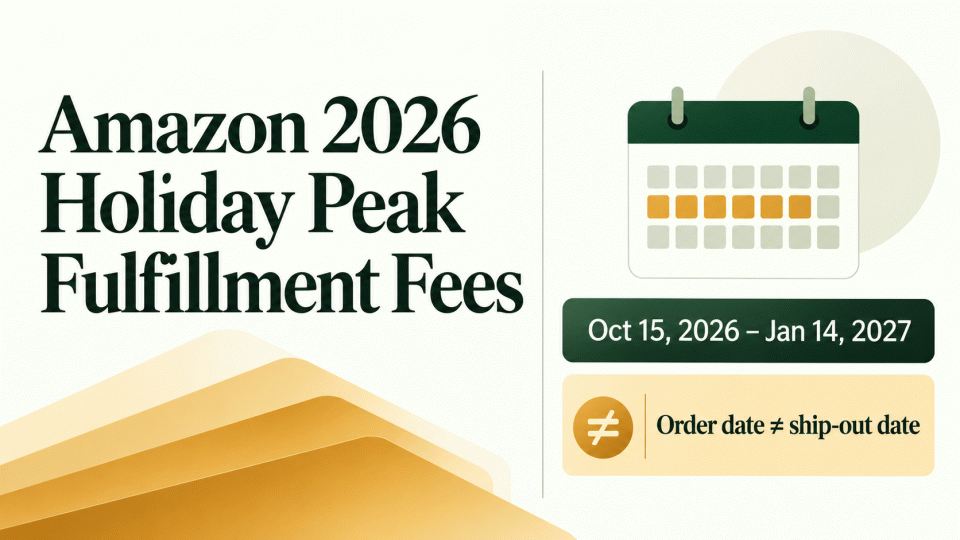
Amazon’s 2026 holiday peak fulfillment-fee period runs from October 15, 2026 through January 14, 2027. The key issue is not simply whether “holiday fees are higher.” Sellers need to keep the peak-fee window, the additional 3.5% fuel and logistics-related surcharge, and event-specific inbound deadlines on separate lines.
Core judgment: an order placed before October 15 is not automatically protected from peak fulfillment fees. In the cross-date case expressly described on Amazon’s official US FBA help page, an item ordered before October 15 but shipped from the fulfillment center on or after October 15 is charged the peak fulfillment fee that starts on October 15.
Scope and source context
This page is based on Amazon’s official Seller Forums announcement, the Seller Central help page titled 2026 US FBA fulfillment fee changes, and related fee-rate pages. The cross-date example must remain in its source context: the help page is a US FBA fee page. It should not be turned into a universal rule for every Amazon marketplace, service, or country.
What changes on October 15?
Amazon’s official announcement defines the holiday peak-fee window as October 15, 2026 to January 14, 2027. It names:
- Fulfillment by Amazon (FBA)
- Remote Fulfillment with FBA
- Multi-Channel Fulfillment (MCF)
- Buy with Prime
This list does not create one global Amazon logistics fee table. Each service still needs to be checked against its own fee card and account context.
The announcement describes an average increase of approximately $0.32 per unit compared with non-peak rates. “Average” matters: it does not mean that every SKU receives a fixed $0.32 increase. The actual amount can depend on dimensions, weight, price band, fulfillment service, delivery speed, other applicable charges, and the settlement event.
The 3.5% surcharge is a separate layer
Amazon also states that a 3.5% fuel and logistics-related surcharge is added on top of the holiday peak fulfillment fee. A cost review should therefore separate the peak base fulfillment fee, the 3.5% surcharge and its displayed calculation basis, and other applicable charges such as storage, removal, or labeling fees.
The average $0.32 description is an average difference between peak and non-peak fulfillment rates. It is not a substitute for the 3.5% surcharge and is not a fixed total increase for each SKU. A calculation based on an average cannot support a promise of savings, profit improvement, or sales impact.
Four dates that should not be merged
Customer order date
This records when the order was placed. In the US FBA cross-date case described by Amazon, it is not the only date that determines fee treatment.
Inbound date
This records when inventory or a shipment enters the fulfillment process. It is not automatically the date on which the item leaves the fulfillment center.
Fulfillment-center ship date
The US FBA help page expressly states that an item ordered before October 15 but shipped from the fulfillment center on or after October 15 is subject to the peak fulfillment fee that begins on October 15. For cross-date orders, retain the actual ship event and the applicable rate context.
Event inbound deadline
The holiday announcement also lists deadlines for different events and inbound methods. These dates support event preparation or Prime-badge eligibility; they are not the start date for the peak fulfillment-fee window. October 15 should not be described as the inbound deadline for every event.
A practical way to review a cross-date order
For an order that crosses the October 15 boundary, record the following fields separately before drawing a cost conclusion:
1. Customer order date: when the customer placed the order.
2. Inventory or shipment inbound date: when inventory or a shipment entered the fulfillment process.
3. Fulfillment-center ship date: the actual date the item left the fulfillment center.
4. Service type: FBA, Remote Fulfillment with FBA, MCF, Buy with Prime, or another applicable service.
5. Marketplace and fee-rate context: the marketplace, rate card, and fee page that apply to the order.
6. Peak base fulfillment fee: the applicable peak-season fulfillment charge for the SKU and service.
7. 3.5% surcharge and displayed calculation basis: keep this layer separate from the average $0.32 difference.
8. Other applicable charges: storage, removal, labeling, or other charges that are not part of the peak base fee.
This is a review structure, not a new Amazon-mandated form. It prevents the order date, the inbound date, the ship event, and an event deadline from being placed in one ambiguous “holiday date” field.
A practical review sequence
1. Identify the actual service type.
2. Confirm the marketplace and fee-page context.
3. Check the SKU’s dimensions, weight, price band, delivery service, and order status.
4. Review the peak base fee and the 3.5% surcharge as separate layers.
5. For cross-date orders, verify the fulfillment-center ship event and retain the relevant preview or report.
This is a review structure, not a new Amazon-mandated form. It prevents the order date, inbound date, ship event, and event deadline from being placed in one ambiguous “holiday date” field.
Use Amazon’s tools for the SKU, not the average
Amazon’s announcement points sellers to the Revenue Calculator, Profit Analytics dashboard, and Fee and Economics Preview Report for fee comparison. These tools can help compare the current SKU and fulfillment scenario; they do not guarantee savings, profit, Prime eligibility, Deal placement, traffic, or sales.
Amazon’s official pages do not provide a single, complete country-by-country list in the announcement itself. The final treatment of split shipments, split orders, and special fulfillment paths should therefore be taken from the seller account’s fee tools and billing records rather than inferred from this page.
Scope and limits
The announcement names FBA, Remote Fulfillment with FBA, MCF, and Buy with Prime, but it does not establish one identical amount for all marketplaces. The US FBA help page supplies the specific cross-date example used above. This page does not extend that example to all global stores or all orders.
Peak fulfillment fees are a platform pricing rule. They are not, by themselves, a statutory certification requirement, product-safety obligation, tax obligation, or guarantee of platform approval in the United States or any other market.
The reader action is to identify the service, marketplace, SKU rate tier, and actual fulfillment-center ship event, then compare the account-specific result in Amazon’s official tools. Keep the peak base fee, the 3.5% surcharge, and event inbound deadlines separate. Do not treat the comparison tools as a promise of lower cost, higher profit, Prime, Deal, traffic, or sales.
Official sources
1. Amazon Seller Forums, Holiday 2026: Same fees, same eligibility, earlier deadlines, published July 7, 2026: official announcement
2. Amazon Seller Central, 2026 US FBA fulfillment fee changes, US FBA help page: official help page
3. Amazon Seller Central, FBA fee rates: official rate entry
4. Amazon Seller Central, MCF rates: official rate entry


