
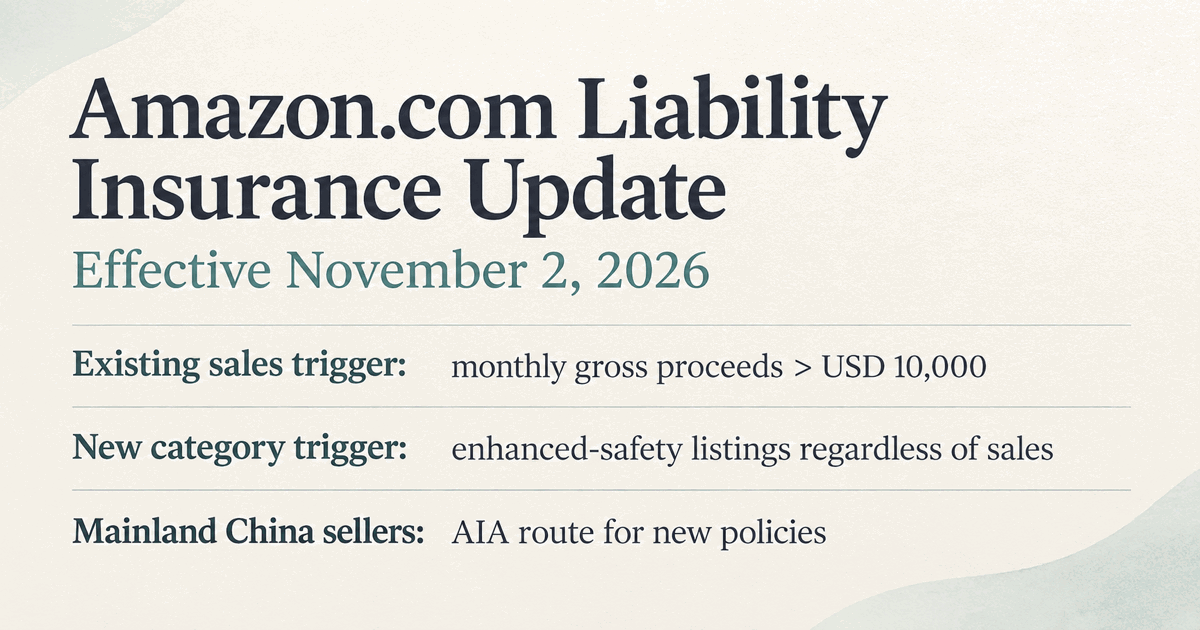
An Amazon.com seller with less than USD 10,000 in monthly sales may still need commercial liability insurance from November 2, 2026. The reason is a new product-category trigger, not the removal of Amazon's existing sales threshold. Sellers based in Mainland China must also consider a separate change to the route through which they obtain insurance and submit a new policy.
Amazon announced these changes on September 3, 2026. The announcement is not a new notice issued today. Its effective date gives sellers a reason to check their products and existing policies now, while keeping three questions separate: What triggers the insurance requirement? Where is the seller based? Was an existing third-party policy already submitted and does it still qualify?
The existing Amazon.com sales threshold remains
According to Amazon's official seller announcement, the existing policy requires sellers whose gross proceeds from Amazon.com sales exceed USD 10,000 in any month to obtain and maintain commercial liability insurance within 30 days. Coverage must be at least USD 1 million per occurrence and USD 1 million in the aggregate.
The measure is gross proceeds in a particular month, not annual revenue or profit. The November change adds another way for the requirement to apply; it does not replace or newly introduce this sales threshold.
Enhanced-safety categories add a separate trigger
From November 2, sellers with products listed in categories with enhanced safety listing requirements must maintain commercial liability insurance covering those products, with the same USD 1 million minimum per occurrence and in the aggregate. This applies whether or not they meet the USD 10,000 monthly gross-proceeds threshold. It covers both new and existing listings.
That distinction matters for a smaller seller. Being below the sales threshold only answers the question posed by the original rule. It does not answer whether the product-category rule applies. Conversely, the category rule should not be read as a requirement for every seller below the threshold.
Amazon gives children's products, cosmetic and ingestible products, and lithium battery products as examples, using non-exhaustive wording. Those examples are not a complete category list and do not, by themselves, classify every ASIN with a similar description. Sellers should check the enhanced safety listing requirements and relevant product information available in their own Seller Central account. The publicly accessible announcement does not provide enough detail to decide every product's status from outside the account.
Mainland China changes the route for obtaining insurance
The announcement's second new requirement applies to sellers based in Mainland China. They must obtain insurance through the Amazon Insurance Accelerator (AIA) program. Starting November 2, Amazon says it will reject newly submitted policies that were not obtained through AIA for those sellers. Amazon describes AIA as a network of pre-vetted insurers; the announcement does not establish a single mandated insurer or promise a particular premium, approval time, or claim outcome.
This is a route requirement. It is distinct from the question of whether a given seller must hold insurance under the sales or product-category trigger. The phrase “based in Mainland China” should not be broadened into a rule for every seller of Chinese nationality, an entity based in Hong Kong, or every Amazon marketplace.
Existing third-party policies have a conditional transition
November 2 is not a blanket expiry date for every third-party policy already on file. Amazon says a seller may continue using a third-party policy until its expiry if it was submitted to Amazon before November 2, remains valid, and meets the coverage requirements. Once that policy expires, a seller based in Mainland China must obtain insurance through AIA.
All three conditions matter. Buying a policy before the date is not the same as submitting it to Amazon before the date. A submission record does not establish that the policy is valid and meets the required coverage. Nor does permission to use a qualifying policy until expiry amount to permission to renew indefinitely through the old route.
A practical way to review an account
For Amazon.com products already listed or planned for listing, examine the monthly gross-proceeds trigger and the enhanced-safety category trigger separately. Then identify whether the seller entity is based in Mainland China. If it is, review the acquisition route of a new policy and, for an existing third-party policy, its submission date, current validity, conformity with the coverage requirements, and expiry date. This sequence is a practical reading of Amazon's announcement, not an additional platform procedure.
Keep product safety documentation separate from commercial liability insurance. A test report or certification document does not stand in for a policy covering the affected products; holding an insurance policy does not, by itself, satisfy separate product-listing documentation requirements. The notice concerns Amazon's seller insurance rules, not a universal insurance mandate under US law for all merchants.
Amazon links to an updated insurance requirements page, a page on enhanced safety listing categories, and a Business Insurance FAQ. Those details require Seller Central access, so this article does not assert a complete category inventory, prescribe unverified policy forms, or predict Amazon's decision on an individual ASIN or policy. Sellers should check the current pages and notices applicable to their own account.
Primary source: Amazon Seller Forums, News_Amazon, “New Commercial Liability Insurance Requirements effective November 2, 2026”, published September 3, 2026; reviewed October 13, 2026.
Prepared by 绿色方舟(深圳)认证有限公司.


