
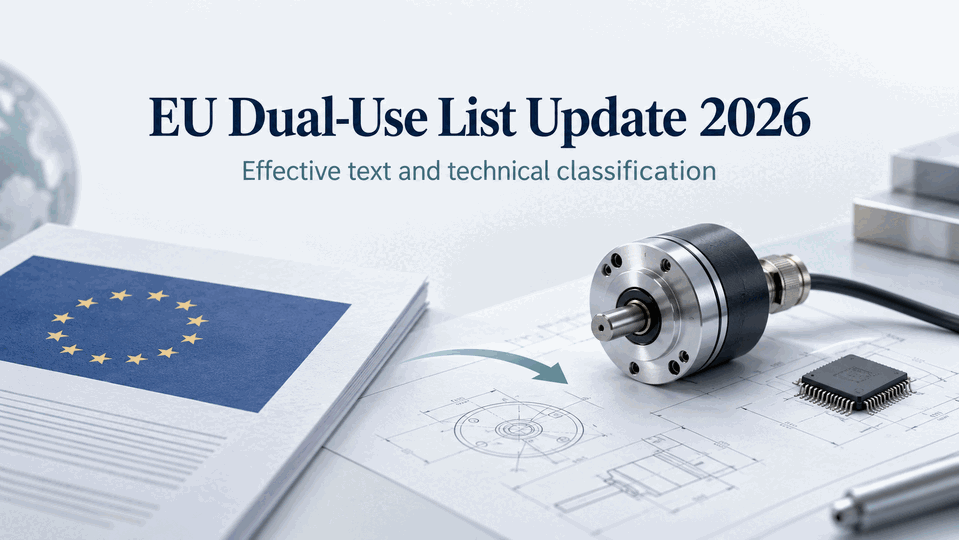
The European Commission adopted a delegated regulation on 14 September 2026 to update Annex I to Regulation (EU) 2021/821, the EU common control list for dual-use items. Its announcement names several emerging technologies. For an exporter, the key question is not whether the company works in one of the named industries. It is which version of Annex I is in force for the transaction and whether the actual item meets the technical description and parameters of a specific entry.
Adoption is not the effective date
The Commission states that the updated list enters into force when it is published in the Official Journal, after the usual two-month scrutiny period for the Council and European Parliament. The adoption announcement is therefore a signal to prepare, not by itself a final effective text. Businesses should keep using the currently applicable list for current decisions and check the published amendment when it takes effect. Treating the announcement date as the legal start date would blur two separate events.
The EU list sits in Annex I to the Dual-Use Regulation, Regulation (EU) 2021/821. The Commission says the 2026 update reflects decisions under multilateral export control arrangements in 2025 and certain Member State commitments. Its news summary does not assign a control entry to any particular company's product.
The examples are a screening map
The announcement mentions semiconductor manufacturing and testing equipment and materials, including atomic layer deposition equipment for molybdenum and ruthenium, equipment for developing and inspecting EUV masks and reticles, and single-wafer cleaning equipment. It also names advanced computing ICs and electronic assemblies containing digital processing units; mullite-reinforced ceramic matrix composites for high temperatures; inductive rotary encoders; additive manufacturing equipment for energetic materials; chemical vapour deposition equipment for silicon carbide fibres; and technology for axial compressors of gas turbine engines. Some control parameters, technical definitions and descriptions are also revised.
Those examples span equipment, materials, components and technology. They cannot be converted into a blanket conclusion that every semiconductor machine, composite or encoder has the same control status. A meaningful classification needs the relevant technical features, performance parameters and exact Annex I wording. Equally, an item should not be dismissed solely because it was designed for a civilian market: the list concerns dual-use capabilities.
Two records make a decision traceable
First, retain the legal-version record: which Annex I text was effective when the transaction or transfer was evaluated, and whether a later Official Journal publication requires a fresh review. Second, retain the product record: the specific model and revision, engineering specifications, data source and the reasons a particular entry does or does not match. A quotation-stage model may differ from the shipped hardware or delivered technology. A classification copied from an older specification may therefore be stale even when the legal text has not changed.
An exporter can screen potentially affected product lines now, request missing specifications from engineering teams and suppliers, and flag decisions for rechecking after publication. Whether a given item is controlled and what authorisation may be required depends on the operative text, the transaction and the relevant authorities' requirements. The Commission's sector examples alone do not settle either question.
Sources checked 1 October 2026: European Commission DG TRADE, 14 September 2026; Regulation (EU) 2021/821.
绿色方舟(深圳)认证有限公司


