
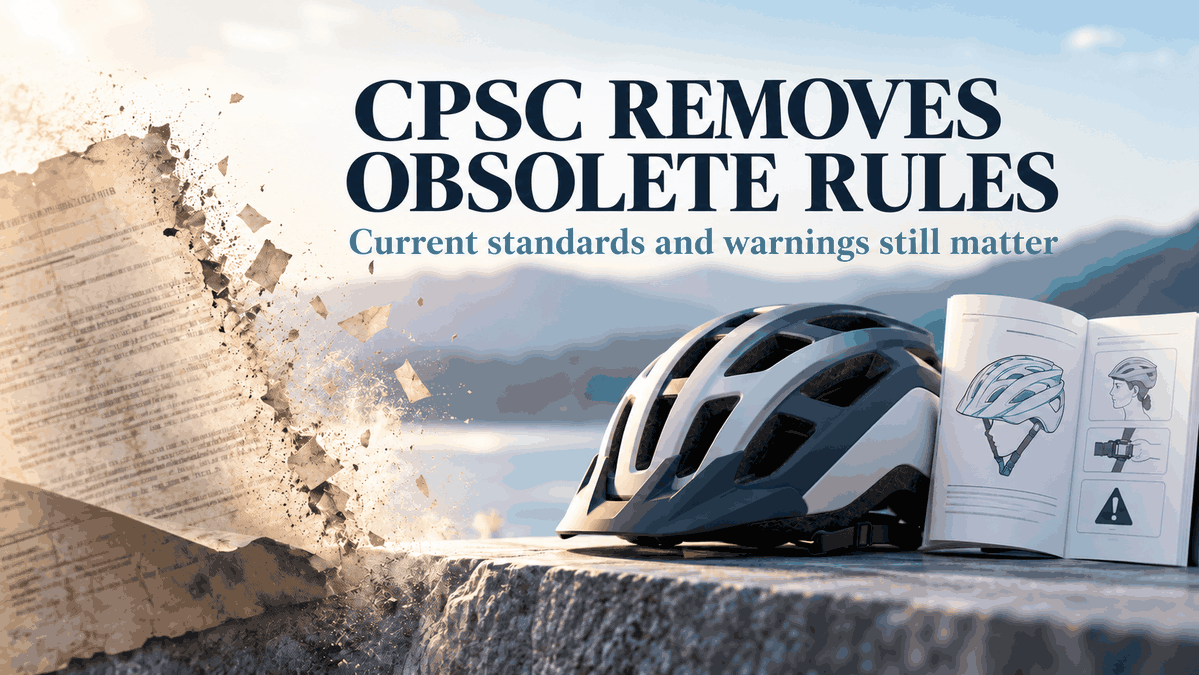
The U.S. Consumer Product Safety Commission (CPSC) announced on 21 September 2026 that several obsolete regulatory provisions had been removed. A manufacturer reading only the headline could mistakenly treat the action as a general release from product safety requirements. The direct final rule, published on 23 July under Docket CPSC-2026-0364, is narrower: it addresses particular historical standards and routine filing duties in 16 CFR Parts 1203, 1401, 1402 and 1406. It does not erase the permanent bicycle helmet standard or applicable information for consumers.
A historical helmet standard is not the current helmet standard
One deleted provision was an interim standard for bicycle helmets manufactured between March 1995 and March 1999. CPSC expressly says that the permanent bicycle helmet safety standard, in effect since 1999, is unchanged and continues to apply to helmets manufactured today. A company updating its regulatory references should therefore remove an obsolete historical citation where relevant, rather than conclude that current helmet testing or compliance evidence is no longer needed.
The manufacturing dates are the reason this distinction is clear. The repealed text referred to an older production window. It did not define the requirements for a new helmet being placed on the market now.
The aerosol change is limited to a particular old warning
CPSC also removed a 1977 point-of-purchase warning requirement for self-pressurised products containing chlorofluorocarbons, or CFCs. The agency explains that CFCs have long been subject to Environmental Protection Agency regulation and that the relevant products have effectively disappeared from the market. This action should not be read as a general exemption for aerosol products or as a conclusion about every other warning that may apply to a different product. The specific formulation and its applicable rules still matter.
Filing a copy and warning the consumer are different acts
For CB and TV antennas and coal- and wood-burning appliances, the rule removes a requirement for manufacturers and importers to routinely submit copies of labels, warnings and instructions to CPSC. The agency says it retains the authority to request those materials when needed. It also says that applicable safety warnings and instructions provided to consumers remain required.
Those statements separate three types of work that may be combined in an old compliance checklist: evidence that the product satisfies an applicable safety standard, information supplied to the consumer, and a copy routinely sent to the regulator. The last of those is what changes for the listed categories. A company should identify which item a particular document served before deleting it or revising packaging. This three-part review is a practical document-control suggestion, not a new CPSC form.
A careful update for affected products
CPSC reports that it received no significant adverse comments on the direct final rule and that the changes took effect on 21 September 2026. For an affected product, first map the SKU to the precise provision and its time or product scope. Then update the obsolete citation or routine submission process while preserving current standards, consumer-facing warnings and information that CPSC can still request. Products outside the named categories cannot be assumed to receive any relief from this announcement.
The accurate business conclusion is limited but useful: a few old regulatory steps have been cleared away, while the agency's underlying consumer protection expectations described in the same announcement continue. Marketing language should not turn a narrow housekeeping rule into a claim that a product category no longer needs safety evidence or warnings.
Sources: CPSC announcement of 21 September 2026 and the direct final rule published on 23 July 2026.


