

Source check: September 27, 2026. On 4 February 2026, ECHA added n-hexane and 4,4'-[2,2,2-trifluoro-1-(trifluoromethyl)ethylidene]diphenol and its salts to the Candidate List. This article focuses on how those two entries change supplier searches and version checks. It is not a legal conclusion for a specific material, role or product.
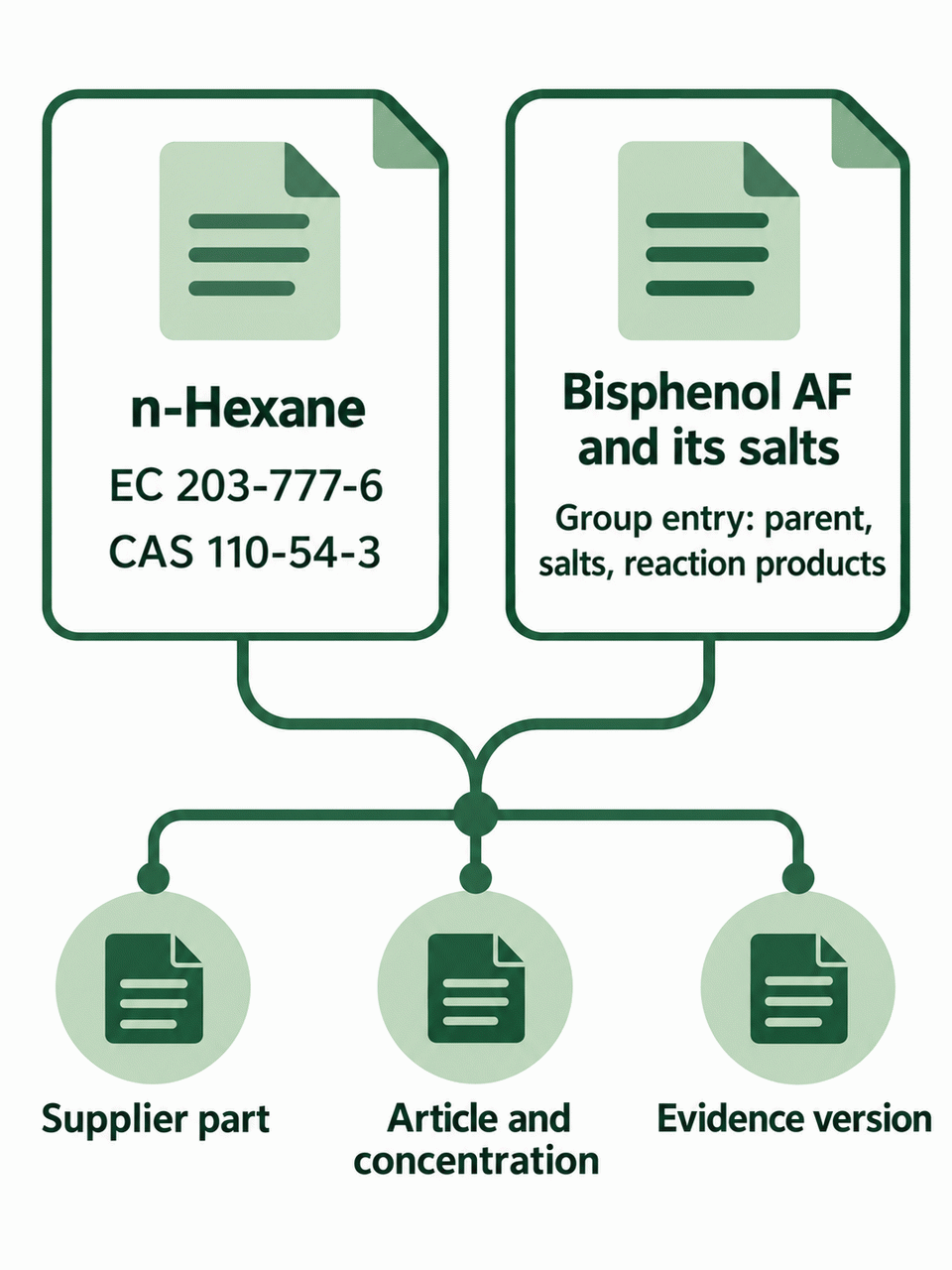
The update is easy to misread as two more keywords. In fact, the entries have different identification structures. N-hexane is presented with a direct EC and CAS number. The Bisphenol AF entry is a group entry that expands to multiple salts, reaction products and identifiers.
A supplier search that uses only one common name or one CAS number can therefore produce an incomplete answer. The practical task is to convert each entry into an explicit search scope, then connect the response to the current supplier part, component and BOM revision.
Read the two new entries differently
N-hexane: one substance, several search terms
The current ECHA entry identifies n-hexane as EC 203-777-6 and CAS 110-54-3, with an inclusion date of 4 February 2026. ECHA records the reason as specific target organ toxicity after repeated exposure and identification under Article 57(f) for human-health effects of equivalent concern.
A supplier request should use n-hexane, relevant local-language names, EC 203-777-6 and CAS 110-54-3 together. It should also ask whether the answer concerns a formulation input, process use, residual presence in an article, or a named component. A generic document without the supplier part number, revision and scope does not establish coverage for the current SKU.
Bisphenol AF and its salts: a group entry
ECHA lists 4,4'-[2,2,2-trifluoro-1-(trifluoromethyl)ethylidene]diphenol and its salts as toxic for reproduction under Article 57(c), also included on 4 February 2026. Expanding the entry reveals Bisphenol AF itself as well as multiple salts, reaction products and identifiers.
Searching only “Bisphenol AF” or CAS 1478-61-1 does not prove that the supplier reviewed the full entry. The request should preserve the official group name and identify which listed substance identities are relevant to the supplied material. The supplier should state what its conclusion covers rather than return an unqualified yes-or-no answer.
Keep three decisions separate
Article 33 communication
ECHA explains that a supplier of an article containing a Candidate List substance above 0.1% weight by weight must provide recipients with sufficient information to allow safe use of the article. At a minimum, the substance name must be communicated. A consumer may request similar information, which the supplier must provide free of charge within 45 days. This is a product and supply-chain information duty; it is not triggered or satisfied merely by placing a phrase on a public product page.
Article 7(2) notification
The ECHA notification summary sets out two cumulative conditions for producers and importers: the Candidate List substance is present in the relevant articles above 0.1% weight by weight, and the substance is present in those articles in quantities totalling more than one tonne per producer or importer per year. The notification is due no later than six months after inclusion in the Candidate List. ECHA also describes exemptions, including cases where the substance has already been registered for that use or where exposure can be excluded under normal or reasonably foreseeable conditions, including disposal. Those exemptions require an evidence-based assessment; they should not be treated as a default.
SCIP information
ECHA's Candidate List obligations summary separately identifies the Waste Framework Directive duty for EU suppliers placing articles containing a Candidate List substance above 0.1% weight by weight on the EU market to submit information to the SCIP database. This is not the same as an Article 7(2) notification. The one-tonne annual threshold should not be imported into the SCIP decision, and a generic supplier declaration should not be assumed to cover both processes.
Map both additions to the current SKU
The purpose of this review is not to rebuild a generic REACH register. It is to confirm whether existing supplier evidence actually includes the two entries added on 4 February 2026. A “REACH compliant” statement may be a lead, but it is not a version-specific conclusion for the finished SKU.
Product identity: record the model, variant, batch, BOM revision and review date. Similar-looking variants can use different cables, adhesives, coatings, plasticisers or flame-retardant systems.
Article and component scope: identify the constituent article covered by each statement or test. A broad label such as “plastic” is not enough if it cannot be connected to a housing, connector, film or other component.
Substance and concentration: retain the substance identity, relevant identifiers, Candidate List status, concentration basis, sample scope and evidence date. “Not detected” and “not declared” are different findings.
Supplier-document version: link declarations, test reports, safety data sheets or material specifications to the exact supplier part number and effective period. A statement carrying only a company name may not cover every material that company sells.
EU role and flow: establish who is the producer, importer, supplier or distributor, how the product enters the EU, and what quantities and recipients are involved. The same material evidence can lead to a different action depending on the company's role.
Why an older supplier declaration may no longer answer the question
Consider a portable electronic product with textile, polymer, metal, battery and circuit-board components. Each supplier issued a Candidate List statement in 2025, but none lists the reviewed substances or promises a new assessment when ECHA changes the list.
Those statements do not show that the 4 February 2026 additions were assessed. The company should send targeted requests to suppliers of potentially relevant formulations, process materials, polymers, coatings, adhesives or other materials without assuming that either new substance is present. The conclusion must come from the current part number, composition and supplier response.
For n-hexane, the request can use the direct identifiers and distinguish process use from presence in the article or component. For Bisphenol AF and its salts, the request should state that the Candidate List entry is a group and ask what member, salt or reaction-product scope was searched. Only then should the team move to Article 33, notification, SCIP or page-action analysis.
When a product page actually needs to change
A Candidate List update does not automatically require every page to display the substance name. Nor does it make every existing REACH statement safe to keep. Page action should be derived from the evidence conclusion.
The claim is broader than the evidence. If the page says that an entire range is free from Candidate List substances but the file covers only one component or an earlier BOM revision, narrow or pause the claim.
The page conflicts with supply-chain information. If supplier or test evidence confirms the presence of a relevant substance, customer documents, consumer responses and page statements should use the same traceable facts.
The page makes no chemical claim. That does not remove Article 33, notification or SCIP analysis. Public marketing and regulatory supply-chain duties are separate workstreams.
The evidence is incomplete. Record the gap and request component-specific information. Do not convert “not found in the file” or “not provided by the supplier” into a statement that the substance is absent.
A practical starting point is two targeted supplier-search tasks: one built around the direct n-hexane identifiers, and one built around the full Bisphenol AF-and-salts group scope. Connect both to model → constituent article → supplier part → evidence version → concentration → company role → required action.
Official sources
ECHA, Candidate List: https://echa.europa.eu/candidate-list-table
ECHA, Two hazardous chemicals added on 4 February 2026: https://echa.europa.eu/-/echa-adds-two-hazardous-chemicals-to-the-candidate-list-1
ECHA, Candidate List substances in articles: https://echa.europa.eu/regulations/reach/candidate-list-substances-in-articles
ECHA, Notification of substances in articles: https://echa.europa.eu/regulations/reach/candidate-list-substances-in-articles/notification-of-substances-in-articles
ECHA, Communication in the supply chain: https://echa.europa.eu/en-GB/regulations/reach/candidate-list-substances-in-articles/communication-in-the-supply-chain
GreenArk (Shenzhen) Certification Co., Ltd.
Email: sui@greenark-sz.com
Website: www.greenark-sz.com
Phone: +86 184 0755 9004


