
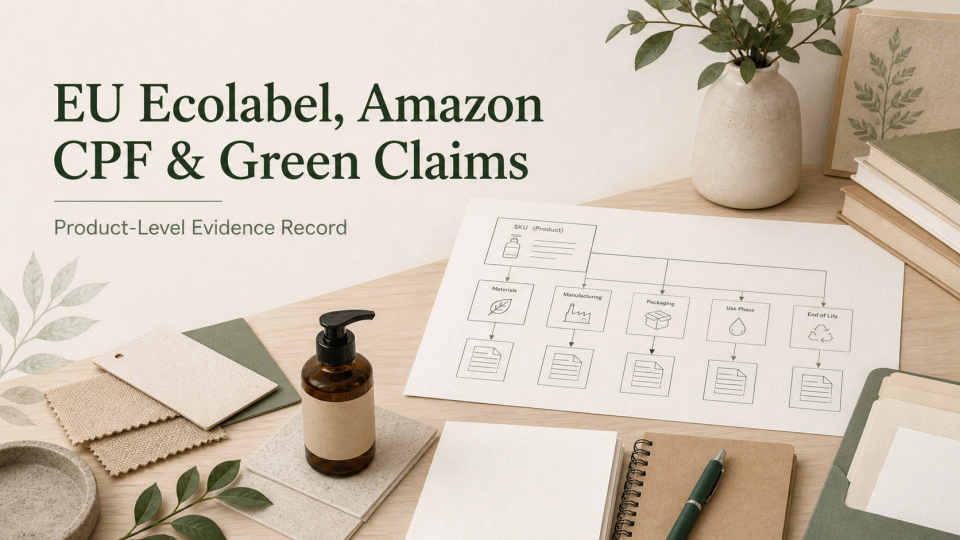
EU Ecolabel, Amazon Climate Pledge Friendly (CPF), and an environmental claim on a product page are three different questions. EU Ecolabel is a voluntary, product-group-based label with defined criteria. CPF is an Amazon program for highlighting products that meet its current program conditions. A green claim is marketing language that must stay within the evidence and consumer-protection rules of the target market. Treating a certificate, a platform submission, and a marketing conclusion as the same thing is the fastest way to lose the evidence trail.
Based on materials available from the European Commission, EUR-Lex, Amazon, and the U.S. Federal Trade Commission as checked on 21 August 2026, this article provides a product-level record structure. It does not conclude that a particular SKU will receive a label, pass an Amazon review, or satisfy every legal obligation in a market.
1. Separate the three objects before collecting evidence
| Object | Question it answers | Record these items |
|---|---|---|
| EU Ecolabel | Does the product fall within an existing product group and can it be assessed against that group’s current criteria? | Product group, Commission Decision, licence, holder, covered products, and current status. |
| Amazon CPF | Does this product use a certification or program route recognized by the current Amazon workflow for the target marketplace? | Marketplace, ASIN, recognized certification list, certificate scope, Seller Central submission, and status. |
| Environmental claim | Is each statement on the page clear, specific, supportable, and within the rules of the relevant market? | Exact wording, product attribute, evidence, market, page version, and review date. |
2. EU Ecolabel: identify the product group before the evidence pack
The European Commission explains that EU Ecolabel criteria are developed for different product groups. An application route exists only where the product belongs to an established product group with criteria that are still valid. The criteria address relevant environmental impacts over the product life cycle together with performance requirements, and they differ by product group. Start by matching the product’s name, form, use, formulation or material composition to the official scope instead of writing a generic “eco-friendly product” description.
Keep four evidence layers:
- The official product-group page and applicable Commission Decision, including version, scope, and criteria validity.
- Applicant, manufacturing, and market information, together with the user manual for the relevant product group.
- The declarations, data sheets, test results, supplier information, and other technical evidence required by that product group. Do not turn a time limit from one category into a universal testing rule.
- Licence number, licence holder, covered product or model list, current status, and the version used on the page. Rebuild the link when the product, criteria, or licence changes.
EU Ecolabel is a voluntary, multi-criteria, third-party environmental label organized by product group. It can support an environmental statement that matches the licensed products and criteria, but it does not automatically cover every product, ASIN, brand claim, or market statement connected with the same company.
3. Amazon CPF: certification is not an automatic badge
Amazon describes CPF as a program that works with third-party certifications and highlights products that meet the program’s conditions. Amazon’s creative guidance also states that the CPF label qualifies a single product, not a brand as a whole. Sellers should use the Sustainability Solutions Hub in the target marketplace’s Seller Central account to check the current recognized certifications, category limits, submission route, and product status; the account workflow controls where it differs from historical articles.
A reviewable CPF record should contain: target marketplace and account, ASIN or product identifier, certification relied upon, certificate number and source link, covered product, certificate holder, current status, submission date, Amazon response, and the related page version. If a supplier certificate is used, record the authorization or supply-chain relationship rather than copying the supplier name into the seller or brand field.
Whether EU Ecolabel is accepted in a particular CPF workflow must be checked against Amazon’s current recognized list or the account process for that marketplace. Do not infer it from an old article or from another marketplace. Even where a certification is listed, confirm that it covers the finished product rather than packaging, a component, or another model, and retain the submission and response record.
4. Green claims: define the meaning before assigning evidence
The U.S. FTC Green Guides help marketers evaluate how consumers may interpret environmental claims, what evidence may substantiate them, and how to avoid deception. Broad, unqualified claims such as “green” or “eco-friendly” should not be treated as automatically supported by one certificate or one recyclable component. The page should state which attribute is being claimed, which products are covered, and which market is addressed.
In the EU, the Green Claims Directive should currently be described as a proposal and an ongoing legislative procedure, not as a fully effective law that has already banned every green term. A live page still needs review against applicable consumer-protection rules, product-specific legislation, Member State requirements, and platform policy. Preparing a better record for a proposed rule is useful; turning a proposal into a current mandatory date is not.
Close every page statement with four questions:
- Does it concern a material, package, formulation, manufacturing step, use phase, or the full life cycle?
- Which SKU, model, set composition, batch, or certification scope does it identify?
- Does the evidence come from the applicable certification criteria, testing, supply-chain records, or scientific data rather than a supplier’s verbal assurance?
- Does the wording expand “meets a defined standard” into “overall green,” “risk-free,” “valid in every market,” or a promise about a platform outcome?
5. Build one product-level evidence index
| Field | How to complete it |
|---|---|
| Product identity | SKU, model, ASIN, variation, set composition, product image, or specification version. |
| Exact claim | Save the wording in the title, bullets, A+ content, Brand Store, and advertising; do not record only keywords. |
| Basis and scope | Certification or standard, number, holder, covered product, validity, tests, and technical-file location. |
| Market and platform | Target country or region, Amazon marketplace, account workflow, submission record, and platform response. |
| Version control | Page or HTML version, evidence refresh date, reviewer, reason for change, and next review trigger. |
A practical order is: lock the product and target market; confirm the EU Ecolabel product group or other certification scope; check the current Amazon CPF workflow; then review every page claim against the evidence it actually supports. A change to style, material, formulation, factory, certificate holder, standard, or marketplace should trigger a new review.
6. Service boundary and sources
Greenark (Shenzhen) Certification Co., Ltd. can help organize the evidence index and gap list connecting a product, certificate, page, and platform fields. It cannot replace the competent body, certification body, Amazon, or qualified counsel in deciding whether a label is awarded, a platform badge is shown, or a legal conclusion applies.
Sources checked for this article:
- European Commission — About the EU Ecolabel
- European Commission — EU Ecolabel Product Groups and Criteria
- Amazon — Sustainability Solutions Hub and Amazon Ads — Climate Pledge Friendly Creative Guidelines
- U.S. FTC — Green Guides; European Commission — Green Claims; and EUR-Lex — Green Claims Directive legislative procedure


