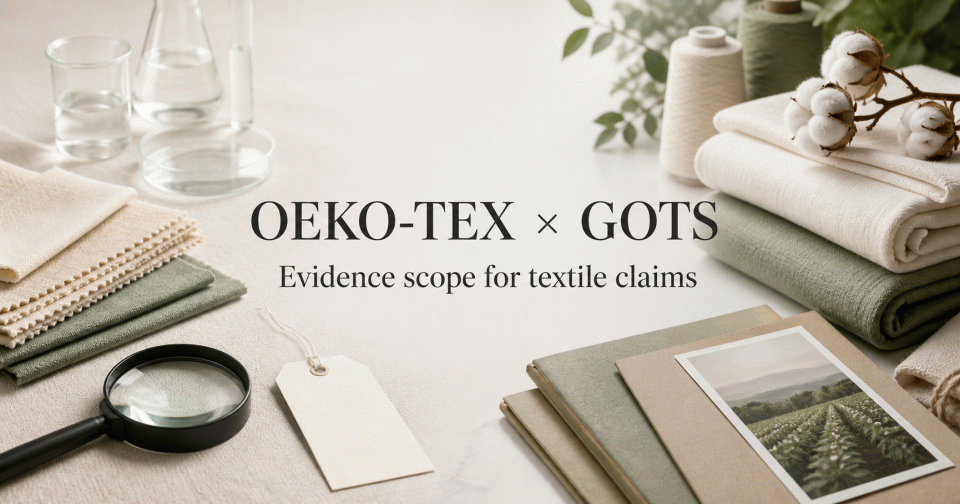
OEKO-TEX STANDARD 100 and GOTS may appear in the same textile file, but they answer different questions. STANDARD 100 focuses on harmful-substance testing according to the intended use of a textile product. GOTS addresses requirements for processing, manufacturing and trading textiles made with certified organic fibres, together with relevant supply-chain criteria. Based on official OEKO-TEX and GOTS materials, this article separates certificates, Scope Certificates (SCs), Transaction Certificates (TCs) and page claims. It does not promise certification, platform display or a market outcome.
1. Separate product records from supply-chain records
For each SKU, record the product name, model or variant, fibre composition, colour and processing stage. Then record the supplier, facilities, certificate holder, certificate number, product description and validity period. A product test file does not automatically prove fibre origin; a supply-chain file does not automatically prove that the finished product passed a harmful-substance test.
Keep three kinds of facts separate: testing or certification of the product, the certified scope of a supplier or processing entity, and transaction documents for a particular order or shipment. Mark any field that cannot be matched to the SKU, supplier, shipment and intended claim as pending verification.
2. OEKO-TEX STANDARD 100: check harmful-substance testing by intended use
OEKO-TEX describes STANDARD 100 as a harmful-substance testing and certification system for textile raw materials, intermediate and finished products, and accessories. Product classes are based on intended use and skin contact: Product Class 1 covers articles for babies and young children; Class 2 covers products with direct skin contact; Class 3 covers products without direct skin contact; and Class 4 covers home and decoration materials. The applicable class, limits and test scope must be checked against the current standard and certificate.
When checking a certificate, review the holder, product description, product class, certificate number, validity and label information. OEKO-TEX provides Label Check for verification using the QR code or certificate number on the label. Do not describe STANDARD 100 as proof of organic fibre origin, supply-chain environmental management or GOTS certification.
3. GOTS: check certified scope and transaction evidence
GOTS is a voluntary standard for processing, manufacturing and trading textiles made with certified organic fibres. It includes product and processing requirements together with environmental and social criteria. The GOTS label grade “organic” generally corresponds to at least 95% certified organic fibres, while “made with organic” corresponds to at least 70% and less than 95%. Actual labels and claims must follow the current GOTS labelling rules; a supplier’s verbal description is not enough.
A GOTS Scope Certificate (SC) shows that a certified entity is qualified within the product categories, activities and facilities listed on the certificate. An SC alone does not prove that a particular shipment is certified GOTS goods. A Transaction Certificate (TC) is issued by an approved certification body for relevant certified goods and shipment details. Match the SC, TC, product description, quantities, seller or buyer and shipment information.
4. The evidence sets are not interchangeable
An OEKO-TEX STANDARD 100 certificate does not prove organic fibre content or GOTS supply-chain conformity. GOTS documents do not by themselves prove that STANDARD 100 testing has been completed. The two evidence sets have different scopes, criteria, product classes and claim rules. Any additional testing or buyer documentation must be checked for the specific product, destination, customer and current requirement.
Do not reduce the conclusion to “the supplier has a certificate.” Review the products and facilities in the certificate appendices, subcontracted processing information and shipment documents. For blends, accessories, printing, dyeing, finishing or packaging, limit the page claim to the part supported by the evidence.
5. Build the page wording from an evidence register
For each SKU, record the product and variant, fibre composition, OEKO-TEX product class, STANDARD 100 certificate and Label Check result, GOTS SC product and facility scope, relevant TC, shipment and quantity, intended claim, labelling basis, document date and open verification points.
The title should make clear whether the page explains STANDARD 100, GOTS or the difference between them. Do not replace a defined scope with broad phrases such as “eco certification” or “safety certification.” Do not show invented certificate numbers, official-agency graphic marks, pass rates, fixed processing times or guaranteed outcomes. Do not describe the services of GreenArk (Shenzhen) Certification Co., Ltd. as a certification body’s decision.
6. Perform a manual review before use
Before publication, compare the copy with the official OEKO-TEX STANDARD 100, Label Check and labelling materials, and with current GOTS standard, certification-scope, SC/TC and labelling materials. Confirm that the English page is localized rather than a Chinese template, and that both languages keep the same boundary between certificate scope, shipment evidence and page claims. Rules, versions and supplier status can change, so recheck the official source and document date before use.
Sources: official OEKO-TEX STANDARD 100, product-class, Label Check and labelling materials; and Global Organic Textile Standard materials on certification, GOTS standards, Scope Certificates, Transaction Certificates and labelling. This is an evidence-organisation reference, not a product- or supply-chain-specific certification or legal assessment.