
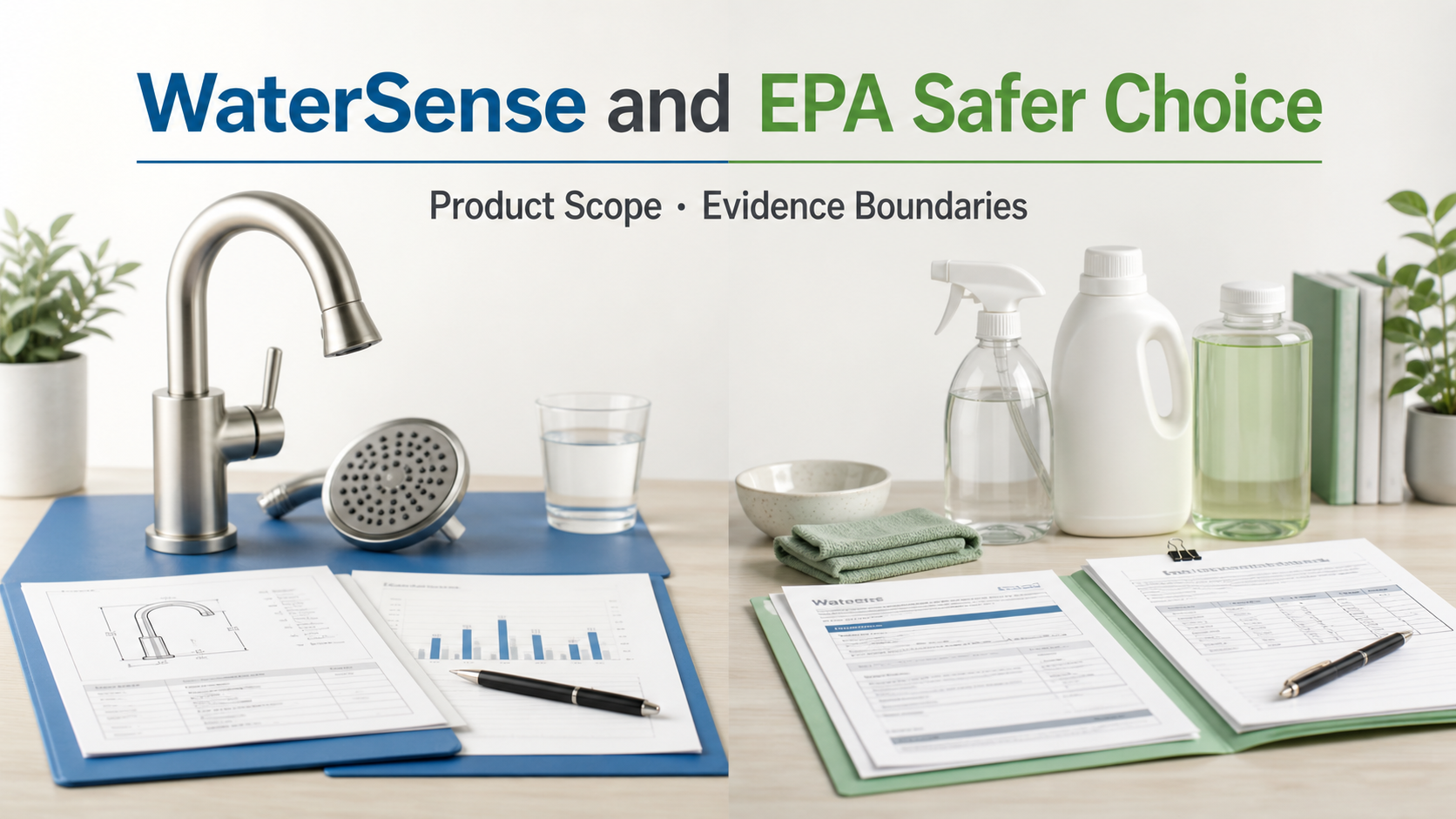
This reference is based on EPA’s public WaterSense specifications and product certification system, the Safer Choice Standard, and EPA product-search materials. It does not mean that a particular product has earned a label, has been accepted by Amazon Climate Pledge Friendly (CPF), or will receive any approval.
Start by separating the two programs
WaterSense is an EPA water-efficiency labeling program. Eligibility begins with the product category and the EPA specification that applies to that category. If a category is not listed among WaterSense products, a general “water-saving” statement is not enough to infer eligibility.
Safer Choice is an EPA pollution-prevention program for products and ingredients that meet its requirements. Its review can cover ingredient criteria, product performance, packaging, pH, VOCs, and product-class requirements. Finding an ingredient on the Safer Chemical Ingredients List (SCIL) does not by itself authorize a finished product to use the label.
WaterSense: build the record around the specification
WaterSense-labeled products must be certified by an EPA-licensed independent third-party product certifying body and meet the applicable WaterSense specification. Fix the model, category, and sales configuration first, then retain the relevant specification, certifying body, certification decision or product-notification record, and the mapping between the model, packaging, and listing.
Do not extend one faucet, showerhead, or other water-product record to a different model. Do not replace the applicable specification with a generic “low-flow” statement. Technical thresholds must come from the specification for the actual category, not from one universal number.
Safer Choice: review the formulation and finished product
Safer Choice evaluates formulation ingredients by functional class and considers human-health and environmental characteristics. Some product classes have additional criteria. The evidence file should connect the full formulation, ingredient functions, identity and purity information, product performance, packaging, and applicable product-class requirements.
SCIL is a research and screening resource, not automatic authorization for a finished product. Match ingredient names, CAS information, concentrations, fragrances, impurities, packaging, and intended use to the actual formulation. Changes should trigger a new review of the label and program record.
Keep CPF wording within the evidence
CPF is a marketplace program. Its current eligible labels, application route, and submission materials should be checked separately. A WaterSense record does not prove Safer Choice formulation compliance; Safer Choice files do not prove WaterSense eligibility; neither program automatically proves compliance with another country’s mandatory rules.
Use wording tied to the evidence: the specific model, formulation, program name, and record actually reviewed. Until the program review is complete, avoid outcome wording such as “certified,” “compliant,” or “eligible for the green badge.”
Six manual checks before a listing update
Confirm the product category and target market; identify the WaterSense product path or Safer Choice formulation path; match the model, formulation version, brand entity, and SKU; save the EPA source and record date; review each sentence for overstatement; and, if CPF is involved, check Amazon’s current submission and display requirements separately.
绿色方舟(深圳)认证有限公司 can help organize the product–document–listing mapping. Program eligibility, label use, and marketplace decisions remain subject to the current rules and case-specific records of EPA, the relevant certifying body, and the marketplace.


