
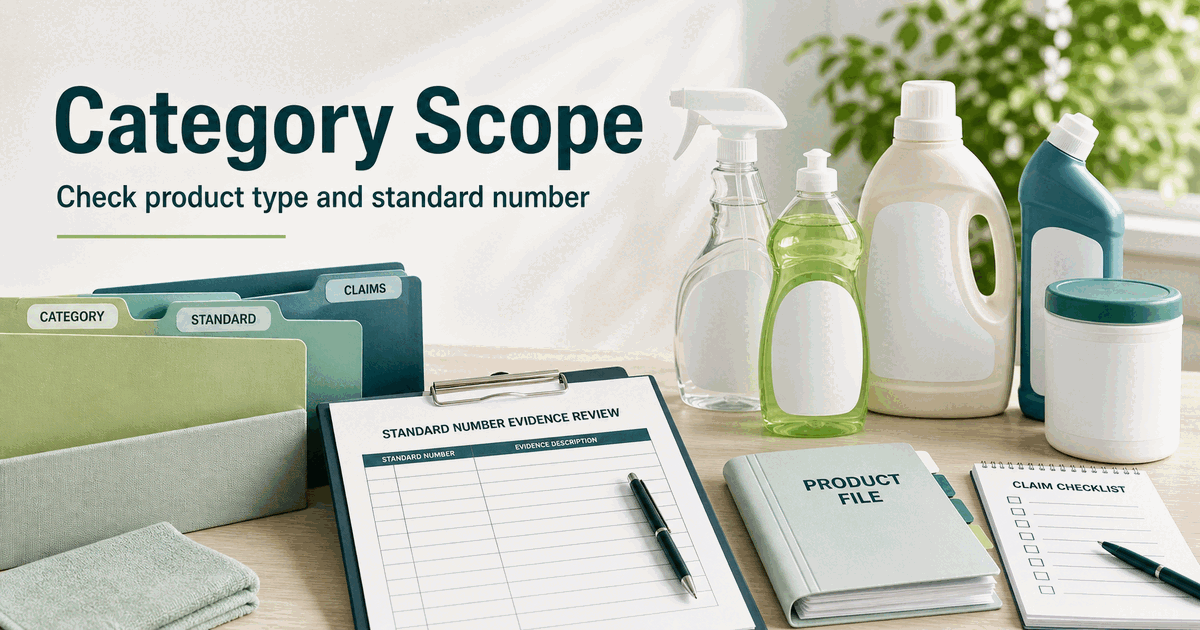
This reference page explains how to check a product or service against Green Seal’s published standards and how to keep the related evidence separate from Amazon Climate Pledge Friendly (CPF) listing questions. Green Seal certification, a CPF designation, and other environmental claims are different matters. The applicable standard, version, product identity, and current platform requirements must be checked for the specific item.
Review date: August 23, 2026. This page does not promise certification, CPF display, platform approval, market access, or any other outcome.
1. Start with the applicable Green Seal standard
Green Seal is not one universal certificate for every product. Its standards library separates products, services, and properties. Examples include GS-1 for sanitary paper products, GS-7 for printing and writing paper, GS-8 for household cleaning products, GS-11 for paints and coatings, GS-33 for hotels and lodging properties, GS-40 for floor-care products, GS-41 for hand cleaners and sanitizers, GS-50 for personal care and cosmetic products, and GS-60 for plastic trash bags and can liners. The current standard name, edition, scope, and exclusions should be checked in Green Seal’s library.
Do not classify an item from its marketing name alone. Record its function, use setting, formula or materials, packaging, manufacturer, and proposed standard, then compare those facts with the standard’s scope and representative products. A service or lodging property should not be reviewed as if it were a product.
2. Build evidence around the selected standard
Requirements vary by standard, so one category’s checklist should not be treated as a universal threshold. Green Seal’s public materials describe a combination of health, environmental, performance, lifecycle, manufacturing, packaging, and claim considerations; the controlling requirements remain those in the applicable standard and edition.
A practical SKU record can include the product name and model, manufacturer and brand entity, standard and edition, formula or BOM, SDS and label, key material or fiber information, packaging records, performance evidence, manufacturing or supply-chain information, certified-directory entry, certificate or verification document, and proposed page wording. Each statement should point to a document or official record rather than a broad “green” description.
3. Relate the certification process to the product file
Green Seal describes a process that starts with selecting a standard and submitting product or service information, followed by review, site verification where applicable, and a certification decision. Its FAQ also explains that manufacturers report product and portfolio updates after certification. The evidence file should therefore identify the same product, manufacturer, and applicable standard edition; a certificate image without product scope is not a substitute for that check.
If the file is a verification letter, a private-label arrangement, or supplier material, confirm the document type, authorization scope, and product identity. Verification, certification, and a supplier’s own statement are not interchangeable.
4. Review the CPF question separately
Green Seal describes Climate Pledge Friendly as an opportunity for qualifying Amazon product listings. That does not make CPF part of the Green Seal certificate, and it does not mean that every ASIN will display the designation. Separately check Amazon’s current qualifying programs, the relationship between the product and the certification record, the brand or manufacturer identity, the ASIN, and the proposed claim. A historical screenshot is not a substitute for a current platform check.
A page may accurately state that a product is Green Seal certified within the documented scope when the file supports that wording. It should not imply that Green Seal covers every product, equals another certification, or guarantees CPF display, platform approval, or sales performance.
5. Keep a SKU evidence map before publishing
For each SKU, connect four items: product or model, applicable Green Seal standard and edition, supporting file or official directory record, and proposed page wording. If one certificate covers multiple products, check each product name, formula or specification, and brand relationship. If the formula, supplier, packaging, or label changes, reassess whether the existing evidence still covers the current version.
Conclusion: Green Seal review starts with product scope and the standard number. CPF review starts separately with the platform’s current qualifying rules and the link between the product and its evidence. The final page wording should be reviewed only after both evidence paths are clear.
Sources and limits
This review used Green Seal’s Standards List, Certification/Get Started pages, FAQ, and certification page describing Climate Pledge Friendly. Green Seal standards can change, and Amazon’s qualifying programs and submission requirements can change; check the current official pages before use.
绿色方舟(深圳)认证有限公司 can help organize the relationship between product records, evidence, and page wording, but it does not replace a certification or platform decision by Green Seal or Amazon.


