
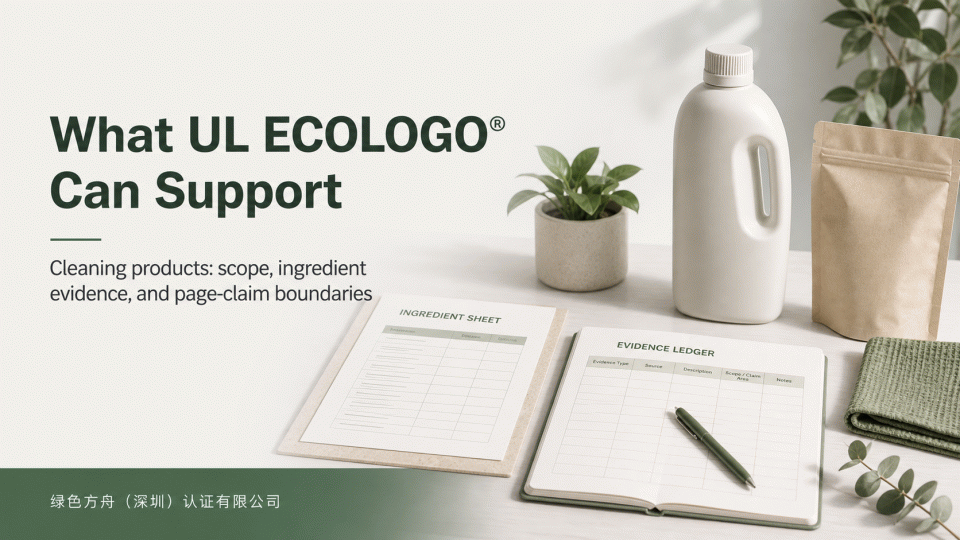
UL ECOLOGO® is a voluntary, multi-attribute, life-cycle-based environmental certification program built around specific standards. It can support a scoped, evidence-backed product statement; it should not be treated as an unrestricted claim that a product is simply “green.”
Start with the product and the applicable standard
UL Solutions describes ECOLOGO® standards as addressing, depending on the product category, attributes such as materials, energy, manufacturing and operations, human and environmental health, product performance and use, packaging, and product stewardship. The applicable standard differs by category. For cleaning products, confirm the product type, formulation, and intended standard version; UL 2700 addresses human-health and environmental criteria for industrial, institutional, and consumer cleaners. A familiar program name does not by itself establish scope.
- Product: product name, model or variant, formulation or key materials, and packaging levels.
- Standard: standard number, edition, product category, and evaluated attributes.
- Market: destination market, importer or responsible entity, and any customer or marketplace requirements.
Keep these layers separate. ECOLOGO® is a voluntary environmental certification program; it does not automatically replace mandatory market rules, transport requirements, labeling obligations, or marketplace policies.
For cleaners, map ingredients, product evidence, and claims
A practical evidence map can use four columns: requirement or metric, product scope, supporting record, and the exact page sentence it supports. Do not write a broad environmental claim first and then search for one document that appears to cover everything.
| Evidence area | Scope to record | Typical evidence direction |
|---|---|---|
| Formulation and ingredients | Formula version, ingredient identity, concentration or restrictions | Formula sheet, supplier records, ingredient and hazard information |
| Product and performance | Model, use method, intended use, and performance metric | Product specification, performance test, instructions for use |
| Packaging and labeling | Packaging components, materials, label and instructions | Packaging list, label artwork, material records |
| Supply chain and manufacturing | Manufacturing site, suppliers, batches, and changes | Supplier declarations, purchasing or batch records, change log |
The review should answer four questions: Which product and version does the record cover? Which standard requirement does it address? Is it still within scope? Which page sentence does it support? If a record covers only one ingredient, packaging component, or site, do not expand it into an unrestricted conclusion about the whole product.
Separate certification facts from environmental-benefit claims
More supportable wording identifies the program, applicable standard, product scope, and the relationship between the product record and the certification or directory record. If a page also says “reduced impact,” “safer,” “sustainable,” or describes another environmental benefit, review that sentence against the relevant standard, product scope, and evidence. A limited attribute should not be enlarged into an unqualified overall environmental benefit.
The U.S. Federal Trade Commission’s Green Guides state that environmental marketing claims need a reasonable basis. Broad, unqualified claims such as “green” or “eco-friendly” are difficult to substantiate, and qualifications should be clear, prominent, and specific. Advertising and consumer-protection rules still need to be checked for each market; one page sentence should not be copied across every storefront.
Four checks before a page goes live
- Freeze the product version: confirm formulation, model, packaging, and target market.
- Check the standard scope: record the standard number, edition, category, and covered attributes.
- Map each claim: retain the evidence source for the title, bullets, detail page, and packaging language.
- Review changes: reassess applicability when the formula, supplier, factory, packaging, or page wording changes.
Sources and boundaries
This article uses UL Solutions’ ECOLOGO® Certification Program, ECOLOGO® Certification, and Cleaning Products materials. Claim wording boundaries are informed by the U.S. Federal Trade Commission’s Green Guides and Environmental Claims summary. Use the issuing organization’s current standard text and program records to confirm applicability. 绿色方舟(深圳)认证有限公司 provides a framework for organizing scope, evidence, and page wording; it does not replace the final determinations of the standards owner, regulator, marketplace, or customer.


