
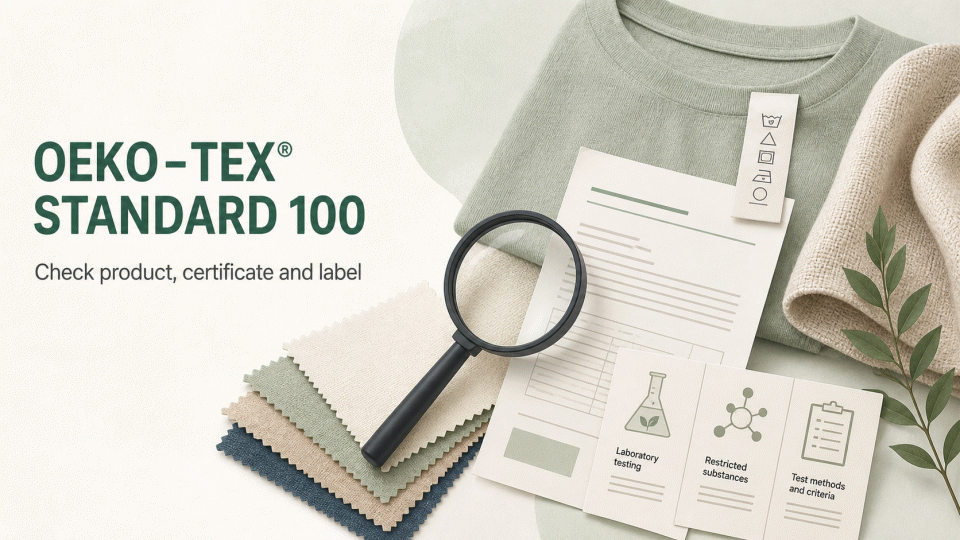
OEKO-TEX® STANDARD 100 is an independent testing and certification system for harmful substances in textiles and textile components. A certificate should not be treated as automatic coverage for every style, component, product line or market requirement. A defensible file maps the specific product to the certificate scope, certificate number, label use and wording shown on the product page.
1. Confirm the Product and Components First
Break each SKU into reviewable fields: product name, style or model, fibre composition, colour and prints, coatings or fillings, zips, buttons and other accessories, certified entity and production site. The testing scope depends on the product, material composition, requested product class and manufacturing information. A supplier certificate for another product does not automatically cover the SKU being sold.
OEKO-TEX® describes four product classes based on intended use: products for babies and young children, products with direct skin contact, products without direct skin contact, and decoration materials or other accessories. The requirements become stricter as skin contact and sensitivity increase. Compare the class on the certificate with the actual use, product description and composition.
2. Build a Certificate Record for Each SKU
At minimum, record the certificate or label number, certificate holder, issuing or testing institute, status and validity information, product class, covered products/materials/components, related sample or report reference, production entity, label or QR-code location, verification date and reviewer. If a certificate covers a material or component only, preserve that limitation in the product page and sales file instead of extending it to the finished product or the whole brand.
Supporting records may include the certificate, testing or certification records, the product BOM and written supplier confirmations. The legal entity, product description, composition and version should align across the records. If a name, model, colour, component or production site differs, ask the certificate holder or institute to clarify rather than filling the gap by assumption.
3. Verify the Certificate and Label Through the Official Tool
Read the number on the certificate or label, then use the OEKO-TEX® Label Check to enter the number or scan the QR code. Confirm that the result matches the certificate holder, product and status. Keep the verification date and a screenshot or exported record tied to the SKU. If no result appears, do not infer validity or invalidity; ask the relevant testing or certification institute for clarification.
Label use requires a separate check. A certificate does not authorize changing the label design, replacing its number or placing the STANDARD 100 mark on products outside the certified scope. The standard name, number, QR code, product description and certificate scope should agree across the page, packaging and hangtag. Do not use an OEKO-TEX® graphic mark without the applicable authorization.
4. Keep Product-Page Wording Within Scope
Where the certificate and label authorization support it, a page may state that a specified product or material was tested or certified under the applicable OEKO-TEX® STANDARD 100 conditions, with the product scope and certificate number identified. Do not turn “tested for harmful substances” into “non-toxic,” “absolutely safe” or “harmless to the environment,” and do not use STANDARD 100 as evidence of organic, recycled, carbon-neutral, zero-emission or social-responsibility outcomes.
If a page also discusses GOTS, GRS, RCS, ECO PASSPORT or MADE IN GREEN, list each programme, certificate or label, scope and source separately. One STANDARD 100 certificate cannot substitute for evidence required by another programme. Any additional legal, marketplace or buyer document request must be checked on its own terms; this article does not make a universal determination for those requirements.
5. Five Checks Before a Claim Goes Live
(1) Lock the SKU, intended use, materials and components; (2) record the certificate number, holder, product class and validity information; (3) compare the certificate scope with the BOM, sample, production entity and page images; (4) verify the number through OEKO-TEX® Label Check or the relevant institute and retain the record; and (5) publish only wording consistent with the certificate and label authorization. Pause the claim when the scope is unclear, the number does not match or the status cannot be confirmed.
Sources and Verification Links
This reference is based on the official OEKO-TEX® STANDARD 100 description, Label Check and Labelling Guide. In a live case, use the current certificate, applicable version and documents supplied by the testing or certification institute: official STANDARD 100 page, Label Check and Labelling Guide.


