
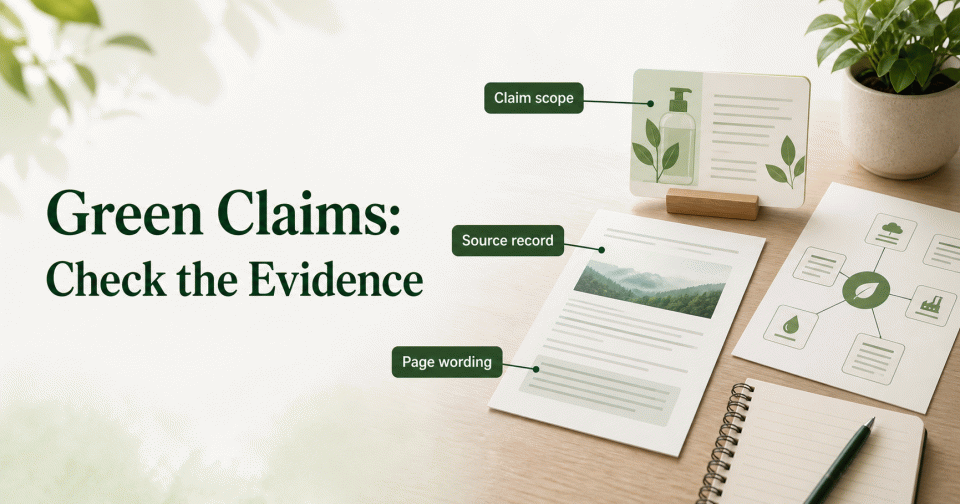
A green claim should not begin with a list of attractive words. It should begin with four questions: what does the claim describe, what does it cover, which records support it, and how will a customer read it on the page? This reference page helps teams build a traceable claim–evidence–wording map. It is not a product-specific legal conclusion.
1. Define the claim object and scope
State whether the claim concerns the whole product, a component, the packaging, or a production process. Then record the model, version, production site, target market, language, and any time or use conditions. A supplier’s statement about one input should not automatically become an environmental conclusion about the finished product. A single attribute should not be presented as an unqualified overall benefit.
For cross-border work, the same SKU may use different page, packaging, or advertising language in different markets. Review each version by market, claim scope, language, and responsible business role. If those boundaries are not confirmed, keep the item open for verification instead of filling the gap with broad wording.
2. Link every sentence to traceable evidence
Use five fields for each claim: the exact wording, the object and scope, the data or document source, the model/batch/version covered, and the reviewer/date. Depending on the claim, records may include a bill of materials, formulation, supplier declaration, purchasing or production record, test or assessment report, packaging and label version, life-cycle calculation, or applicable certification and label rules. A file name is not enough; the record must connect to the product and the specific statement.
For terms such as recyclable, recycled content, biodegradable, carbon footprint, or offsets, record the method, conditions, facilities, calculation boundary, and relevant limitations. If the available record cannot support the wording, narrow the statement to a verifiable fact or keep it off the customer-facing page.
3. Keep page wording on the same version
Create a three-way link between the claim register, the evidence file, and the page version. Each claim should point to a file and page reference; each file should identify the relevant SKU or batch; and each page statement should point back to the register. Titles, bullets, images, packaging, and advertising should use the same approved wording. A broader phrase in one location requires a fresh scope review.
Before publication, check whether the object is clear, qualifications are adjacent and readable, a limited attribute has become an overall benefit, icons or colour create an extra environmental impression, and the Chinese and English versions describe the same scope. Do not use checkmarks, seals, or approval-style graphics as a substitute for evidence.
4. Review the market and claim type separately
For the United States, the FTC Green Guides explain that broad, unqualified terms such as green or eco-friendly are difficult to substantiate and should be tied to a specific environmental benefit supported by competent and reliable scientific evidence. The European Commission’s green-claims materials describe the need for robust, science-based and verifiable methods. ISO 14021:2026 addresses terms, qualifications, documentation, and methods for self-declared environmental claims. These are review references; they do not mean that a particular product automatically meets a law or has obtained an approval.
Claims involving certification marks, official labels, carbon offsets, recycling infrastructure, or mandatory market rules need a separate check of authorization, conditions, and current text. A supplier document, laboratory report, or old page does not by itself prove that the same claim can be used for the current SKU, market, and page version.
5. Close the review with one release checklist
- State the claim object, model, market, language, and responsible role.
- Keep the source, method, document version, and covered scope for each claim.
- Match names, specifications, batches, or formulations in the evidence to the product page.
- Remove overall, absolute, or outcome wording that the records cannot support.
- Have content, product, and evidence owners reconcile the page, packaging, and asset versions.
Sources: European Commission: Green claims; FTC: Environmental Claims — Summary of the Green Guides; ISO 14021:2026. These sources explain evidence and wording boundaries; applicability still depends on the product, market, and claim version.


