
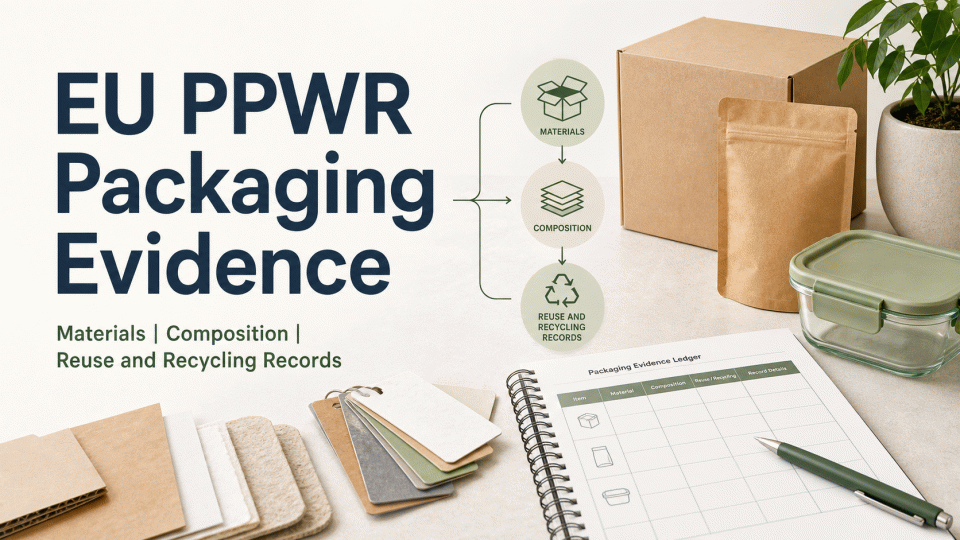
This reference page uses Regulation (EU) 2025/40 on packaging and packaging waste (PPWR) to structure a packaging evidence review. It focuses on packaging composition, material and design records, reuse or recycling information, and responsibility boundaries. It is not a legal conclusion for a specific product or packaging format.
1. Confirm scope and the status of the rules
PPWR applies to packaging and packaging waste made from any material and covers industry, manufacturing, retail, distribution, services and households. It entered into force on 11 February 2025, and the European Commission states that it generally applies from 12 August 2026. The exact obligation still needs to be checked against the relevant provision and implementation material. Do not treat entry into force, the application date of an individual obligation, national arrangements or a buyer requirement as the same event.
Start with a packaging-unit inventory: sales packaging, grouped packaging, transport packaging and other packaging delivered with the product. For each unit, record the product link, format, materials, mass or volume, contact-sensitive use where relevant, destination Member State and responsible economic operator. Micro-enterprises may receive lighter treatment for some rules; that does not establish a blanket exemption.
2. Build composition and design evidence
Keep drawings or specifications for each packaging format, including the material and mass of each component. Note composite structures, coatings, inks, adhesives and labels where they affect classification or recycling. Where packaging minimisation is relevant, retain the functional assessment for protection, transport, hygiene, safety, information and product use; a statement that the design is “already minimal” is not a record of the assessment.
PPWR requirements can address recyclability, recycled plastic content, reuse systems, restrictions on certain single-use plastic formats, labelling and information. Record a metric only when the corresponding provision and packaging scenario apply. A rule for one material, format or use should not be presented as a universal conclusion for all packaging.
3. Link materials, suppliers and claims
A practical file can include the packaging format and version, materials and components, supplier and production batch, mass or formulation basis, recycled-material information where relevant, food-contact or other safety documentation where relevant, recyclability or reuse design evidence, labels and accompanying information, applicable provisions and file locations. A supplier statement supports only the scope it actually covers; it does not automatically establish every obligation for finished packaging or the market-placing entity.
Link packaging versions to the product SKU, supplier or site, document dates and change records. Reassess the evidence after a change to material, structure, supplier, production site or format. EPR registration, food-contact materials, dangerous-goods transport and private buyer standards may be governed by separate instruments; cross-references should preserve their separate sources and responsibilities.
4. Review labels, digital information and reuse records
Where information or labelling is required, record the symbol, material identification, sorting instruction, language version, medium and applicable date, using Article 12 and related implementation material as the reference. Internal material codes, general environmental wording or a third-party mark should not be presented as a statutory PPWR label without a source.
For reusable packaging, retain the reuse-system arrangements, circulation or return process, covered formats and relevant quantity records. For recycled-content or recycling claims, retain the underlying material data and calculation basis. Web and customer documents should distinguish material records, design targets, verified facts and open questions.
5. Pre-delivery checklist and boundaries
Before delivery, check that the packaging inventory is complete; material and mass data are traceable to a version; the statement owner, product and format correspond; provisions and dates come from official text; label and web languages match the sales arrangement; changes trigger reassessment; and separate laws or buyer requirements have not been rewritten as PPWR duties.
Sources: Regulation (EU) 2025/40, the European Commission packaging-waste overview, and the 2026 PPWR guidance. Official pages and implementation materials may change. This page does not promise a platform, customs, regulatory or certification outcome, and document preparation is not itself such an outcome.


