
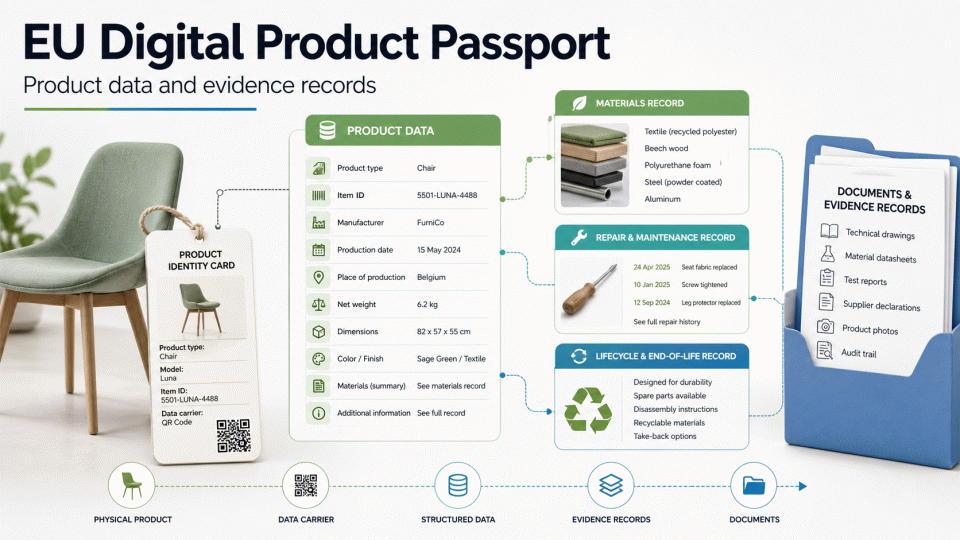
A Digital Product Passport (DPP) is a digital information container associated with a product, component or material. It is intended to support access to information on sustainability, circularity and relevant legal requirements. The required data depends on the applicable EU rules, product group and product-specific requirements; it is not one universal checklist for every product.
1. Confirm whether the DPP applies to the product
The DPP framework is established by Regulation (EU) 2024/1781, the Ecodesign for Sustainable Products Regulation (ESPR). It provides the framework for setting ecodesign requirements and includes essential DPP requirements. A business should build a DPP for a product when an applicable product-specific requirement calls for one. Start by identifying the product group, target market, applicable product rules and relevant implementation timetable.
Batteries, textiles, iron and steel, furniture, tyres, ICT products and energy-related products may be subject to different information rules. A DPP may also interact with specialised legislation for batteries, packaging, construction products or other sectors. Do not merge DPP with PPWR, EUDR, CBAM, product-safety rules or marketplace document requests: their scope, responsible parties and evidence should be assessed separately.
2. Build the minimum record around product, data carrier and data
Product identity: Keep the product name, model or batch identifier, manufacturer and relevant economic-operator information for each model or SKU. Link the record to the actual product, version and change history. Do not let one record silently cover different formulations, structures, materials or manufacturers.
Data carrier: DPP information must be accessible through an appropriate data carrier, such as a QR code or another identifiable carrier. The carrier is not a certification mark and does not, by itself, show that all applicable requirements have been met. Record the relationship between the carrier and product identifier, and test access permissions, link continuity and version updates.
Data fields: Depending on the applicable product requirements, collect information on composition, durability, reparability, spare parts, recycling or dismantling. If a product rule requires environmental, compliance or supply-chain data, use that rule’s fields and definitions. For every field, record the source, data version, owner and scope; do not fill gaps with assumptions.
3. Connect documents to page claims
Create an index with five columns: field, source, evidence, responsible operator and covered product. Specifications, BOMs or material declarations, test or calculation records, repair instructions, supplier files and internal change records should state the model, batch, period and responsible party they cover. A third-party document supports a field only when its entity, product scope, method and version match; a supplier file does not automatically support a whole product line or marketplace account.
A page can accurately explain which DPP fields are provided, what records support them and under what conditions information is updated. Do not describe a QR code, an uploaded file or a data page as certification, approval or proof that the product may be sold in every market. A DPP record also does not replace separate checks for product safety, chemicals, labelling, packaging, recycling or marketplace requirements.
4. Manual pre-release checklist
Check each item: the product identifier is unique and matches the page model; the data carrier opens the correct version; manufacturer and other economic-operator information matches the transaction and product files; material, repair, recycling and environmental fields have sources; access permissions are appropriate; files retain versions and change history; and page wording stays within the evidence. Where the product-specific requirement is not yet confirmed, record it as “to be confirmed” instead of substituting a generic compliance template.
5. Boundary note
This article is a working reference for organising records and wording pages. It is not legal advice on a specific product and does not mean that any product has been registered, certified, approved or cleared for market access. Confirm fields, data carriers, access rights and responsibilities against the applicable EU rules, product-specific requirements and current official documents.
Sources
Primary references: the European Commission Digital Product Passport pages and Regulation (EU) 2024/1781 concerning the ESPR and DPP. Use the current official text and the applicable product-specific requirements for a live assessment.


