
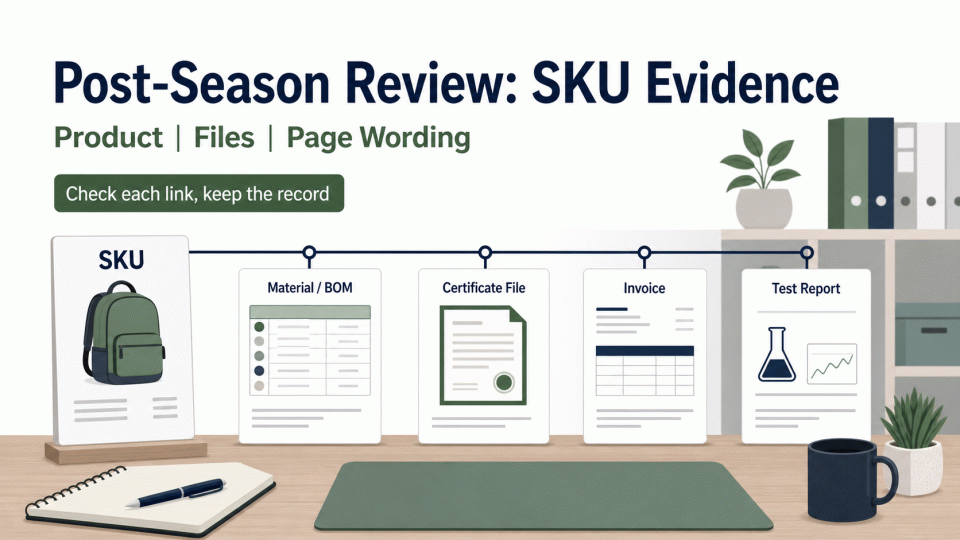
Use case: After a major sales or promotion period, sellers, brand owners, and procurement teams can use this page to review one SKU’s product records, supplier files, and customer-facing wording. It explains documentation discipline and claim boundaries; it does not determine whether a product has received a platform designation or replace market-specific legal advice.
Working principle: Treat “one SKU + one version/material + one market” as the smallest review unit. Keep the product identity, source file, scope, and page sentence in the same record so that mismatches, version drift, and unsupported wording are visible.
1. Separate laws, platform programs, and buyer requirements
Amazon Climate Pledge Friendly is a platform program that uses sustainability certifications or programs to identify products. Amazon’s public seller materials describe checking recognized programs, product identifiers, and the applicable submission route. A platform program does not replace import-country law, product-safety responsibilities, or a buyer’s audit. Site, category, and program requirements may change, so confirm the current Seller Central instructions before submitting.
| Requirement source | Review question | Record |
|---|---|---|
| Law or regulation | Do the market, product category, and responsible entity match? | Instrument, scope, official version, and applicability note |
| Platform program | Which evidence and product identifiers does the current program request? | Program page, submission record, and ASIN/SKU mapping |
| Buyer or retailer requirement | Is the request for certification, testing, supply-chain records, or page wording? | Buyer version, scope, owner, and delivered-file list |
2. Use one evidence table per SKU
Each row should represent one SKU or product version. Do not replace a product-level assessment with a supplier’s generic certificate. Keep at least these fields:
- Product identity: SKU, ASIN/model, version, material or formulation, packaging version, and market.
- Entity relationship: brand owner, manufacturer, importer of record, certificate holder, and document addressee. Record an affiliation and its supporting file when names differ.
- Document scope: certificate or report number, standard/program, covered product, site, sample or batch, issue date, and file status.
- Supply-chain records: purchase orders, invoices, transport records, batch information, material declarations, and transaction certificates where applicable. Record only files that exist and can be traced.
- Page mapping: link every environmental or material statement on the page to the specific file and conditions that support it.
3. Check four types of mismatch
- Entity mismatch: The supplier, manufacturer, certificate holder, and listing-responsible entity are different. Do not assume that a group company, subsidiary, or trading company is automatically equivalent; check the certificate scope and authorization records.
- Product mismatch: The file covers another model, material, formulation, site, or batch. Compare the certificate annex, test-sample description, BOM, and shipped version.
- File mismatch: A test report, certificate, transaction record, and buyer-audit file are treated as interchangeable. Their purpose, issuer, and scope differ; one cannot automatically replace another.
- Wording mismatch: A page uses broad terms such as “environmentally friendly,” “sustainable,” or “recycled” without stating the object, basis, and conditions. Prefer verifiable product attributes and keep wording within the file’s conclusion.
4. What to do after the review
Freeze the product and file versions used in the review. Retain the original PDFs, test-sample information, submission form, and page capture. Mark each item as “matched,” “evidence requested,” “scope unclear,” or “wording to revise.” When a file is missing, ask the supplier for specific fields instead of relying on a verbal statement; pause the related page wording when scope is unclear.
When the SKU’s material, formulation, site, packaging, label, or market changes, reassess the affected certificate, report, transaction record, and page wording. Record the reason, reviewer, source file, and next action. Do not apply a universal validity period or predict a platform outcome.
5. Human check before the page goes live
- SKU, model, material/formulation, packaging, and market match the supporting files.
- Entity, scope, sample, and batch details in certificates, reports, and supply-chain records are explainable and traceable.
- Platform fields follow the current program instructions; platform display, legal duty, and buyer requirements are not presented as one conclusion.
- Every environmental or material statement has supporting evidence and states its object, conditions, and limits.
- Chinese and English titles, summaries, body copy, and cover text express the same factual boundary; uncertain points are not written as settled conclusions.
Boundary note: This is a documentation-review method. Certification programs, platform procedures, legal applicability, and buyer requirements should be checked against current official materials for the target market. 绿色方舟(深圳)认证有限公司 does not promise a platform designation, certification result, approval, sales performance, or processing time.


