
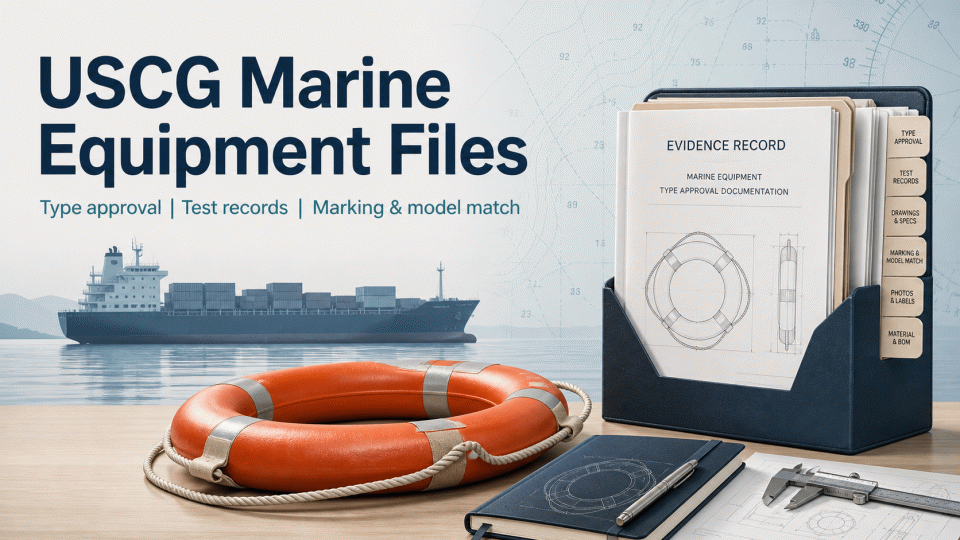
This reference page is for manufacturers, vessel owners, importers, and supply-chain teams checking U.S. Coast Guard (USCG) marine-equipment records. It explains when a product may fall within a USCG approval framework, how to connect a model to its approval record, and which documents support an internal file review. The answer depends on the vessel, route, equipment category, and applicable rule; marine products do not all need one generic “USCG certification.”
1. Where USCG approval can matter
USCG engineering guidance describes type approval for categories including lifesaving and fire-safety equipment. Other marine equipment and materials may also be subject to approval or conformity provisions in their specific rules. The correct starting point is not a universal certificate, but a product-and-vessel map covering the equipment function, the vessel on which it will be carried or installed, the domestic or international route, and the applicable equipment category.
Where SOLAS or a U.S.–European Economic Area mutual-recognition arrangement is relevant, confirm that the exact product category is covered and that the approval body, approval number, and marking meet the applicable conditions. An MRA is not an automatic route for every product.
2. The type-approval evidence chain
USCG explains that type approval generally involves demonstrating compliance with the relevant requirements and tests, completing specified testing, and maintaining any required quality-control or follow-up program. Engineers review the device design and laboratory report. Once approved, the manufacturer must produce under the approval conditions and mark the equipment so it can be identified.
An internal file index should connect at least these records:
Product identity: manufacturer, brand, model, version, critical dimensions or configuration, production lot, and photographs;
Technical basis: applicable 46 CFR Subchapter Q provision, referenced standard, drawings, material list, operations and maintenance information, and marking or labeling plan;
Test record: test items, sample and configuration, laboratory or inspection party, report number, conclusion, and the link to the production model;
Approval record: Certificate of Approval where applicable, approval number, conditions, current status, and the CGMIX search record;
Production control: production inspections, change history, corrective actions, and follow-up arrangements.
3. Checking the model, marking, and database entry
Transcribe the manufacturer, model, approval number, manufacture date or lot, and other marked information from the equipment, packaging, and manual. Then search the USCG Marine Information Exchange (CGMIX) by approval series, approval number, manufacturer, or model. Compare the result with the physical product, approval certificate, and test report. Similar names, the same product family, or a supplier’s statement of equivalence do not automatically establish the same approved model.
If materials, structure, critical components, or manufacturing methods change, review the approval conditions and change-assessment requirements first. USCG’s type-approval guidance notes that a change to an approved item may need evaluation before the item continues to be represented as Coast Guard approved, and additional testing may be required.
4. File checklist before submission
Build a traceable index in this order: record the target vessel and route; identify the applicable rule and approval series; retain confirmed assembly drawings, materials, and specifications; link the test report to the sample configuration, model, and version; prepare the required operations and maintenance information and marking plan; then retain the approval certificate, CGMIX record, and change correspondence. The exact submission format and document set must follow the relevant USCG guidance, regulation, and approval-body instructions.
The legal manufacturer, model, and critical parameters should be consistent across the file. A generic supplier report, an approval certificate for another model, or product photographs without model mapping is not, by itself, evidence that the current product meets a USCG requirement.
5. Sources and wording boundaries
This page is based on the public USCG CG-ENG-4 Equipment Approval, CGMIX Approved Equipment, Lifesaving Equipment, and 46 CFR § 2.95-10. Web content, regulation versions, approval status, and mutual-recognition scope can change; return to the applicable official record before relying on a result.
“USCG approval,” “approved equipment,” compliance with a particular test requirement, and suitability for a specific vessel or route are different claims. Customer-facing copy should describe only the product, approval number, scope, and evidence that were actually checked. File preparation or laboratory testing should not be presented as USCG approval, and a requirement for one equipment category should not be expanded into a market-access conclusion for every product.


