Core Concepts & Scope
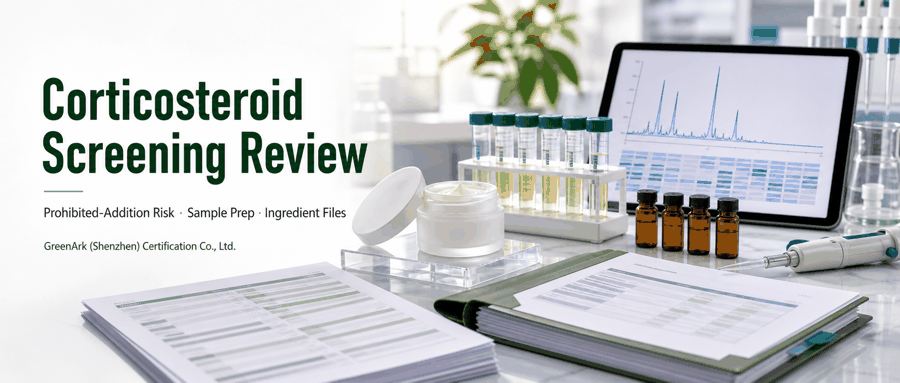
On laboratory procedural fine points, a has verified that LC-MS/MS confirmatory testing demands matrix-adapted sample-preparation workflows. For creams and lotions, HLB solid-phase extraction cleanup is required to eliminate interference from bulk oils and emulsifiers.
For sheet masks, both the sheet fabric and the serum must be extracted and analyzed as a single integrated specimen analyzing only the serum easily misses corticosteroids adsorbed onto the nonwoven fibers. For color cosmetics, a n-hexane defatting step must be introduced to remove lakes, wax bases, and pearlescent pigment matrices.
Each analytical batch must run three concurrent quality-control items: a reagent blank, a matrix-spiked recovery sample, and a duplicate parallel sample. Acceptable recovery sits within the 85 to 112 percent window and relative standard deviation below 10 percent; any out-of-spec QC invalidates the entire batch.
In actual dossier audits, a observes that roughly 15 percent of purportedly compliant reports carry material QC gaps: blank chromatograms missing, recovery outside the validated window, or single-injection analysis without a parallel run. Reports with such omissions, even when concluding not detected, are almost invariably classified as lacking data credibility and rejected during regulator re-testing or platform appeals.
On the August 2026 GB 7916-2026 new national standard, a confirms that the prohibited-ingredient directory incorporates a dynamic-update mechanism: whenever the NMPA issues a public notice adding new prohibited hormone species, the directory updates automatically, and companies must track those notices as a recurring compliance obligation.
The regulatory and standard sources cited for corticosteroid testing throughout this page originate exclusively from official NMPA releases and SAMR-published national standards documents. The prohibited ingredient inventory derives from the Appendix D Prohibited Ingredients table of the Technical Specifications for Cosmetic Safety (2022 Edition) together with the general prohibited-ingredient provisions of Article 37 of the Cosmetics Supervision and Administration Regulation.
Testing method sources include GB/T 24800.2-2009 Determination of 41 Corticosteroids in Cosmetics by HPLC-MS/MS and TLC, GB/T 40145-2021 Determination of 11 Corticosteroids including Desonide in Cosmetics by LC-MS/MS, and the March 2026 exposure draft of the revised GB/T 24800.2 panel expanded to 105 molecules, as published on the National Standard Information Public Service Platform.
Key Rules & Regulatory Points
The supplementary enforcement method is sourced from NMPA 2019 Notice No. 66 Test Methods for Hormone Ingredients in Cosmetics. On the international alignment side, references include EC No 1223/2009 Annex II entry 343 prohibiting corticosteroids in cosmetics and the US FDA 21 CFR 700 Subpart H enforcement stance classifying topical corticosteroids in cosmetics as unapproved new drug ingredients.
Representative enforcement case intelligence is drawn from the 2025 full-year and first-half-2026 national cosmetic surveillance announcements published by the NMPA, covering detected corticosteroid batch alerts across anti-acne and whitening product categories.
When synthesizing these sources, a applies a strict-side reconciliation: any reference to scope size defaults to the expanded 105-item 2026 draft panel as the verification baseline rather than the legacy 41-item list. a refreshes the source reconciliation matrix whenever a new NMPA notice or GB standard amendment is formally adopted to ensure the verification baseline stays current with the enforcement window.
On laboratory qualifications and report-validity sourcing, a summarizes the current landscape as follows. Corticosteroid test reports intended for NMPA registration, surveillance re-checks, or platform appeals must originate from a CMA-accredited laboratory whose CMA certificate appendix explicitly lists corticosteroid determination in cosmetics or the GB/T 24800.2 method identification; a vague general cosmetic physicochemical testing scope is insufficient.
For EU export, the data must be incorporated into the CPSR annex and issued by a laboratory acceptable to the EU Responsible Person, with several Member States additionally requiring ISO/IEC 17025 laboratory accreditation. Rapid-screen modalities colloidal-gold immunostrips, Raman, XRF only qualify for factory internal preliminary screening or strike-force rapid inspection.
Positive rapid-screen findings must be confirmed by the statutory LC-MS/MS method to support enforcement or appeal; a negative rapid-screen report can never substitute for a formal CMA report in registration or platform-compliance settings. a flags a particularly important operational update: under the cosmetic surveillance Sentinel Site mechanism launched by the NMPA in 2025, 41-item corticosteroid panels are a perpetual must-test item, and each prefecture-level city routinely draws no fewer than 10 surveillance batches per month, with anti-acne and whitening facial mask SKUs sampled at more than six times the incidence rate of ordinary facial creams.
a helps clients benchmark their internal sampling cadence against this public surveillance frequency so that risk is identified internally before a government inspector arrives.
Practical Checklist
The applicable client base for corticosteroid testing document review, fully aligned with the a service catalog, breaks down as follows. Chinese domestic cosmetic registrants and notifiers in particular the freckle-whitening and anti-acne repair subsets of the eight special-cosmetic classes, together with ordinary cosmetics carrying claims such as soothing, redness reduction, anti-sensitivity, and fast-acting efficacy form the primary review cohort.
Cross-border e-commerce beauty merchants selling on Amazon, AliExpress, TikTok Shop, Temu, and Shopee all fall within scope whenever the SKU in question sits in the anti-acne, whitening, freckle, or sensitive-skin repair categories, as these are mandatory platform test categories.
Cosmetics OEM and ODM contract manufacturers constitute a dedicated compliance layer and must archive corticosteroid batch screening for every new-prototype and factory-release batch of products carrying anti-acne, whitening, or anti-inflammatory claims.
Cosmetic raw material suppliers especially suppliers of actives, botanical extracts, and traditional-Chinese-medicine compound raw materials complete the upstream cohort and must cooperate with downstream brands on ingredient-level hormone screening to prevent accidental contamination or malicious adulteration by a sub-tier supplier.
Offline beauty salons and professional-line product brands constitute a distinct channel flagged as high priority by a : salon kits have shown a rising corticosteroid detection rate in regulator surprise inspections year over year, mandating a per-batch hormone-report archiving system for this channel.
a observes that the unbranded bulk facial mask segment sold through social-commerce channels suffers the highest adulteration concentration; a recommends that operators in that channel proactively commission the combined 41+11 or expanded 52-item corticosteroid panel before commercialization rather than retroactively defending a consumer complaint.
One prevailing misconception in corticosteroid testing concerns method-panel selection. Many enterprises, to minimize direct cost, request only the most common dozen or so hormones from their laboratory or substitute a rapid immunostrip for the statutory LC-MS/MS method.
Common Pitfalls
When regulators subsequently run a 52-or 105-molecule full-panel surveillance screen, unlisted novel species surface while the in-house report showed a clean outcome. a has handled a concrete instance in which a brand tested only 15 hormones in-house but a surveillance inspection detected halometasone acetate a molecule covered in the 11-item GB/T 40145-2021 panel resulting in an automatic non-compliance classification.
Another recurrent misconception involves sampling boundaries: operators only analyze the bulk contents inside the jar or sachet, neglecting dead-zone material such as jar lid residue, inner-folded mask layers, or tube inner-wall deposit. Regulators routinely use multi-location composite sampling, which can create the asymmetric outcome of self-tested negative versus regulator-tested positive.
A further widespread error is the simplistic syllogism if no hormone is in the raw material then no hormone is in the finished product. In practice, an emulsification kettle that previously produced a topical hormone ointment and was not rigorously cleaned can transfer enough residual carry-over to register a positive corticosteroid finding in the subsequently manufactured cosmetic batch this is the notorious kettle carry-over problem that a has helped multiple contract manufacturers trace and remediate.
Cross-border and e-commerce specific misconceptions are equally material. Some merchants assume the EU and US do not test the Chinese 41-hormone panel, when in reality the EU prohibited-ingredient directory bans the entire corticosteroid family regardless of named species, and the US FDA classifies topical corticosteroids present in cosmetics as unapproved new drugs, with enforcement consequences arguably more severe than the Chinese domestic regime.
Another pattern is submitting the raw material supplier's no-hormone COA as the finished-product compliance proof; platforms uniformly require a finished-goods CMA report and will not accept a raw-material COA in its place. a also encounters a recurrent belief that a hormone-positive batch should be destroyed silently without retaining a report.
In practice, if a positive batch enters the market and is later traced back, the inability to demonstrate proactive investigation and documented destruction triggers escalation under Article 62 of the Cosmetics Supervision and Administration Regulation to a penalty bracket two to three times higher than the scenario where the firm voluntarily documented detection, segregation, and destruction.
a strongly advise clients to retain a positive test report together with written destruction records for every single non-conforming batch, irrespective of how small the incident appears.
Consequences & Tips
On the qualitative boundary around trace-level detections, a explains that no regulatory safety threshold exists: even a finding at the 0.01 microgram-per-gram LOQ triggers a prohibited-ingredient non-compliance classification if the identity is confirmed.
In operational practice, where a LOQ-level finding occurs and the client can present a complete evidence chain demonstrating kettle carry-over or technically unavoidable raw-material impurity noting that natural occurrence of corticosteroids is extremely rare enforcement authorities may occasionally exercise qualitative leniency.
a has to report, however, that such leniency cases remain vanishingly few in domestic enforcement to date. a further clarifies that any individual corticosteroid report binds only the exact sampled batch named in the report; changing a raw material supplier, production equipment, emulsification process, or packaging material automatically terminates the grandfathering of an older clean report.
For multi-shade color cosmetics, different shade codes deploy different lake and pigment systems, so per-shade independent sampling is recommended; red and deep-dark shades represent the highest-risk group for concealed corticosteroid addition intended to mask irritation and redness during the initial few applications.
a underscores that corticosteroid testing only covers illicit topical hormone adulteration; it does not address sex hormones (estrogens, androgens, progestogens), antibiotics (metronidazole, chloramphenicol, lincomycin), or sedative-anesthetic adulterants.
Enterprises seeking a comprehensive prohibited-adulteration risk envelope must combine this screen with a seven-item sex-hormone panel, a six-item antibiotic panel, and a three-item sedative panel into a single integrated prohibited-drug screening bundle.
a can architect this bundled test program for clients upon request.
Not sure which CPF pathway fits your product?
Send us your product category, materials and current certificates. We will review the available certification pathway.