
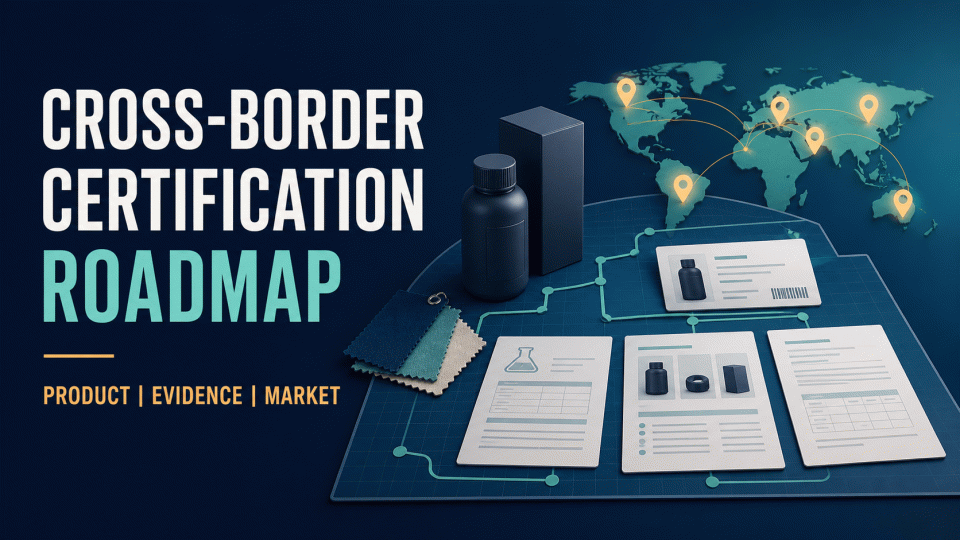
Certification preparation for cross-border e-commerce is not a matter of placing a supplier file into every SKU folder. Start by defining the product, selling market, and responsible entity, then connect applicable requirements with technical files, test records, and page wording. This page offers a reusable starting framework; it does not replace a product-specific legal or platform assessment.
1. Define the product and selling scenario
Create a product master record covering the brand, product name, model or SKU, materials and formulation, capacity or power, packaging version, production site, importer or seller of record, and target market. Do not assume that different models, formulations, materials, packages, or revisions share the same evidence set.
List the applicable rules, label language, responsible roles, platform requests, and buyer requirements separately for each market. An HS code can help with research, but it does not determine every obligation by itself; product function, materials, intended use, and the applicable official text also matter.
2. Map requirements to evidence
Break each requirement into six fields: requirement, product scope, responsible entity, evidence, version, and status. Technical files may include specifications, bills of materials, drawings or formulations, risk assessments, instructions, labels, and packaging artwork. Test or assessment documents should identify the sample, model, method, standard version, laboratory or assessment body, and the original conclusion.
For the EU CE route, the European Commission explains that a manufacturer must identify applicable legislation and harmonised standards, determine whether a notified body is needed, complete the conformity assessment, prepare technical documentation and an EU Declaration of Conformity, and apply the marking where the rules require it. The route varies by product; CE is not a universal certificate. For US children's products, confirm testing, certificate, and record requirements under the applicable CPSC rules.
3. Check entity, scope, and version
Review whether the manufacturer, brand owner, importer, or declaring party on each document matches the current business role. Check that the product model and key parameters cover the SKU, that the tested sample matches the production version, that the file is complete and legible, and that the issuing body’s competence or authorization can be checked through the relevant official directory or document. A supplier file is a source of information, not automatic proof for your product or responsible entity.
Treat a material change, new factory, formulation change, packaging change, software change, label revision, market switch, or regulatory update as a review trigger. Validity, surveillance, and record-retention periods must be confirmed against the specific rule, scheme, or buyer requirement instead of being replaced with one generic timeframe.
4. Keep page wording aligned with evidence
Every material statement in a listing, package, or instruction should point back to a defined product scope and evidence version. Distinguish a completed test or assessment, an applicable declaration route, a file in preparation, and an item still to be confirmed. Do not turn an application, laboratory report, platform submission, or buyer review into a statement of market access, platform approval, or sales performance.
Keep the wording, translation, publication date, owner, evidence link, and review conclusion together. Chinese and English pages should carry the same scope and boundaries, while English should be written independently for the target reader rather than translated line by line.
5. A practical starting checklist
Before starting: lock the product and market; confirm the responsible entity; build a requirement matrix; collect current specifications, BOMs, labels, instructions, and supply-chain records; then decide which items need testing, assessment, a declaration, or an independent audit.
During review: check the model, revision, sample, entity, issuing body, standards basis, scope, and file completeness item by item. Mark unverified items as pending instead of using broad phrases such as “universal certificate,” “globally compliant,” or “guaranteed approval.”
Sources and boundary: The European Commission’s official CE marking guidance for manufacturers and the US CPSC’s official guidance on third-party testing, children’s product certificates, and records support the requirement-to-evidence method described here. Specific obligations still depend on the target market, product category, and current official text. 绿色方舟(深圳)认证有限公司 can help map products, markets, and evidence, but this page does not establish that any particular product is certified, approved, or has achieved a specific result.


