
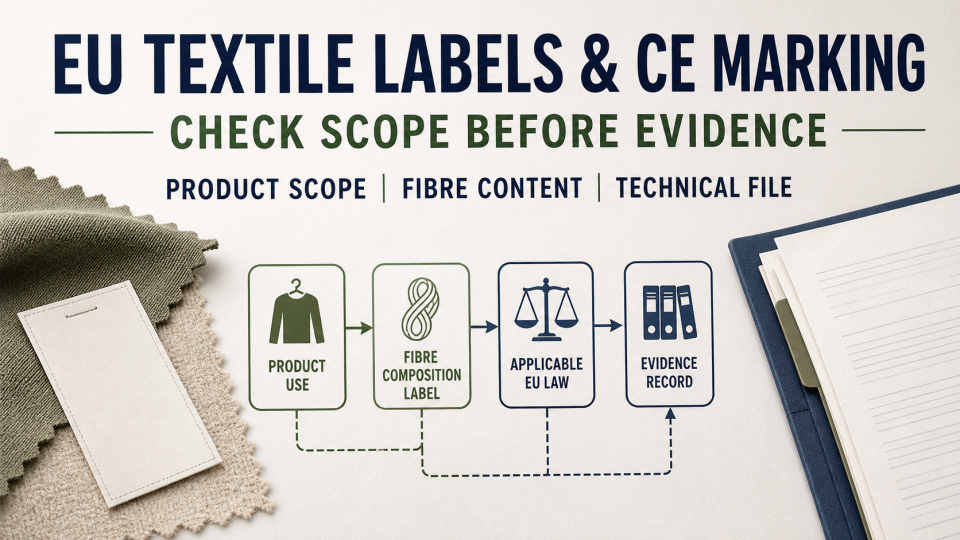
“Textile products need CE marking” is not a complete rule. Before placing a product on the EU market, identify whether its intended use and product features bring it within a specific EU harmonised law that requires CE marking. For ordinary clothing, household textiles, and fabrics, the immediate focus is usually fibre-composition labelling, product safety, and other requirements linked to the product itself. A generic supplier certificate cannot replace product-specific evidence.
1. Start with the scope: does the textile product require CE marking?
The official EU guidance explains that CE marking applies only to products covered by specific harmonised EU rules that require the marking. The European Commission’s textile, clothing, leather and footwear overview likewise explains that textiles do not require CE marking simply because they are textiles. A textile product may still fall under a CE regime when its product function places it within another regulated category, such as personal protective equipment, medical devices, or toys.
Do not turn the phrase “textile”, “CE marking”, and “new regulation” into a universal document list. Build a product record first: product name, intended use, protective or medical function, child-directed use, electrical or other regulated components, sales format, and the responsible economic operator in the EU. This determines whether the main route concerns CE, textile labelling, general product safety, or several requirements together.
2. For ordinary textiles, verify fibre composition and label content
Regulation (EU) No 1007/2011 on textile fibre names and related labelling and marking requires textile products made available on the EU market to provide fibre-composition information. The regulation addresses the permitted fibre names and requires labels or markings to be durable, legible, visible, accessible, and securely attached. Businesses should retain composition support for the actual product and label version rather than relying on a general supplier template that does not identify the SKU.
A practical review asks four questions: are the fibre names used on the label permitted by the regulation; does a mixed-fibre product list its constituent fibres and weight percentages as required; are “100%”, “pure”, or “all” statements supported by the product composition; and do the label, packaging, product page, and technical records agree? Products listed in the regulation’s annexes may have specific exceptions or simplified rules and should be checked separately.
3. If a product is within a CE regime, map the evidence to that law
When a textile product has a regulated protective, medical, toy, or other function, identify the exact legislation and conformity-assessment procedure before assembling documents. The official CE guidance describes the core work as identifying the applicable EU requirements, deciding whether a notified body is required, preparing technical documentation that demonstrates conformity, and drafting and signing the EU Declaration of Conformity. The manufacturer is responsible for the conformity of the product as a whole; the responsibilities of an importer, authorised representative, or distributor depend on the applicable law and the supply-chain role.
A useful evidence structure is:
- Product identity: model, SKU, intended use, key materials, version, and market.
- Technical record: design information, risk analysis, critical materials or components, labels, and instructions.
- Conformity evidence: tests, assessments, or notified-body documents required by the applicable law; do not use the generic label “CE certificate” in place of the actual document type.
- Declaration and marking: the EU Declaration of Conformity, the basis for CE placement and dimensions, and responsible-operator information.
- Change record: reassessment notes after changes to materials, construction, intended use, manufacturer, or applicable law.
4. Keep different compliance purposes separate
Fibre labelling, product safety, CE conformity assessment, environmental claims, platform requests, and buyer audits may appear in the same project, but their legal bases, evidence objects, and responsible parties differ. A fibre label records material composition; a CE law may address product safety or performance; a voluntary environmental label may have its own criteria and licence conditions. Calling one type of report a universal certificate for another requirement creates a scope mismatch.
Add at least “evidence object” and “applicable basis” columns to the working register. For each document, record the model or product family covered, issuer or signatory, materials and version covered, validity or update trigger, and the exact page statement it supports. If the original file does not substantiate a point, mark it for confirmation instead of turning it into a claim that the product has already passed or qualified.
5. Pre-publication review checklist
- Confirm the product function and determine whether a specific CE harmonisation law applies.
- If CE does not apply, organise textile-labelling and other applicable product records without presenting a CE conclusion.
- If CE applies, verify the law, conformity route, technical file, and EU Declaration of Conformity.
- Compare the model, material, label, packaging, instructions, and product-page wording.
- Check that English and other sales languages express the verified facts accurately; do not expand a supplier’s general statement into a product-specific conclusion.
- Keep a review record for changes to materials, construction, intended use, responsible parties, or applicable law.


