
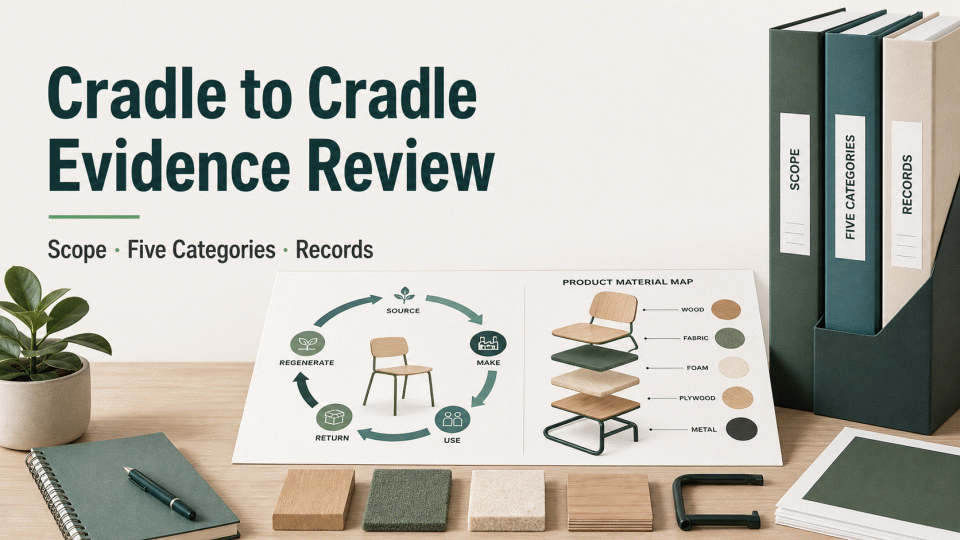
Cradle to Cradle Certified® is a voluntary, third-party, multi-attribute certification framework for materials and products. A practical review starts with the product and the applicable standard version, then maps composition, manufacturing data, supply-chain information, and customer-facing wording to that defined scope. It should not be treated as the same obligation as customs access, marketplace rules, or Amazon Climate Pledge Friendly (CPF).
1. Define the product and project scope
Break the product down to the level that the evidence can actually describe: product name, model or variant, materials and chemicals, manufacturing sites, participating suppliers, and the manufacturing processes included in the assessment. A brand name or a factory’s generic file should not replace the product scope. If variants differ in materials, formulas, processes, or sites, record those differences and confirm whether they belong to one project.
Record the intended standard version, certification type, and boundaries. C2CPII currently presents entry points including Full Scope, Circularity, Material Health, and Listed Facility. Eligibility and evidence requirements should be confirmed with C2CPII or the relevant assessment body before an application. Do not infer a product’s scope, level, or status from marketing copy.
2. Build an evidence index across five categories
C2CPII describes the Full Scope Product Standard as a framework covering five categories. Use the following as an indexing structure, not as a conclusion that a product has met a requirement or achieved a level:
- Material Health: material and chemical inventories, restricted-substance screening, and records needed for material-health assessment.
- Product Circularity: product and process information related to keeping materials in use, disassembly, reuse, or cycling pathways.
- Clean Air & Climate Protection: records for energy, emissions, and manufacturing practices that correspond to the standard requirements.
- Water & Soil Stewardship: water, discharge, site, and related environmental-management information.
- Social Fairness: manufacturing and supply-chain records related to safe, fair, and equitable labor practices and human rights.
For every entry, note the document name, covered product or site, data period where applicable, responsible entity, source location, version, assessment status, and open items. A supplier statement may be a lead, but it should not be treated as project evidence until scope and entity matching are complete.
3. Connect product data to manufacturing data
Create a product–material–supplier–site–evidence map. The specification and BOM should explain each material or component; the chemical inventory should trace back to a material and use; and process records should identify the sites and responsible entities for processing, assembly, finishing, or packaging. When one material appears in several SKUs, check whether the formula, color, treatment, and supplier are genuinely the same.
For certificates, tests, and assessment reports, check the issuer, commissioning entity, product description, model or variant, site, standard version, issue date, status, and limitations. Do not impose a generic validity window or assume that one supplier file covers every product; apply the document’s own terms and the project requirements.
4. Organize records around the official process
The C2CPII process describes steps including checking eligibility, selecting the standard version, selecting a C2C Certified® Conformity Assessment Body, submitting an application and agreement, compiling product and manufacturing-process data with the assessment body, receiving certification if the relevant assessment is completed successfully, and reporting progress or recertifying. Fees, versions, forms, and detailed evidence requirements can change; use the official pages in effect when the application is submitted.
Customer-facing wording should follow the record. During preparation, say that materials and scope are being organized. After assessment, state the exact certification type, version, product scope, and status. Do not turn a material review, a corporate environmental file, a supplier document, or a CPF marketplace display into a claim that the whole product has received Cradle to Cradle Certified®.
5. Pre-submission checklist
- Product name, model, composition, manufacturing sites, and application scope agree.
- Each of the five categories has an owner, document version, and source path.
- Supplier files are matched to the product, site, and legal entity in the project.
- Standard version, certification type, status, and public wording are consistent.
- Preparation, assessment, certification, and marketplace display are kept distinct in both languages.
- Open items, exclusions, and questions for C2CPII or the assessment body are listed separately.
Sources and boundaries
This page is based on the C2C Certified® standard overview, the official certification process, and the official resources page. Product eligibility, standard version, assessment requirements, fees, certification status, and permitted brand naming must be checked against the latest C2CPII documents and formal project records. 绿色方舟(深圳)认证有限公司 can help structure evidence records, but it does not replace C2CPII or an assessment body’s certification decision.


