Core Concepts & Scope
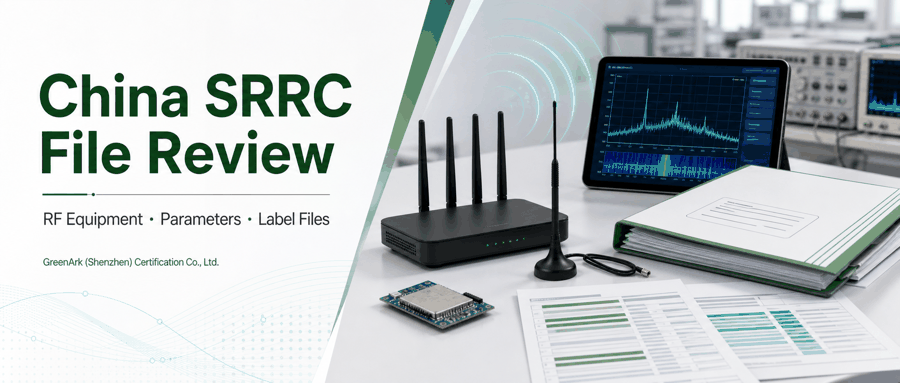
Five 2026 SRRC developments matter for manufacturers. Bluetooth LE Audio (LC3+ codec) and Wi-Fi 7 (802.11be EHT, 320 MHz channels) were added to the SRRC test menu in September 2025; TWS earbuds, routers, laptops and tablets enabling these protocols must add the new items.
5G NR HPUE (Power Class 2 / +26 dBm) must pass an additional dedicated SAR test under IMG-70104 Chapter 4.3. MIIT Wu [2024] No. 118 opens Indoor Access Systems (IAS) and Low-power Indoor devices (LPI) in the 6 GHz band (5925–7125 MHz) for SRRC applications since 4 July 2024, capped at 23 dBm EIRP.
legacy CMII ID certificates issued before 1 January 2019 expired on 31 December 2025; from 1 January 2026 only the new XX-XXXX-XXXXXX format is accepted, and models still holding CMII IDs must replace them in CCC and SRRC are strictly separated and non-substitutable: CCC covers electrical safety and EMC, SRRC covers radio spectrum compliance, and combined products (smartphones, routers, Bluetooth headsets, smartwatches, etc.) must hold both.
Key Rules & Regulatory Points
Since early 2026, a has found Bluetooth headsets and portable Wi-Fi dongles to be the categories most often missing one of the two certificates.
The SRRC pipeline has four stages. The applicant (or agent) submits electronically via the State Radio Regulation (SRRC Bureau) business platform; MIIT entrusts one of 13 qualified labs (TAIR, CMCC, CEPREI, etc.) to perform type approval inspection and the report is reviewed by the SRRC Bureau; on approval, a Radio Transmission Equipment Type Approval Certificate bearing the new XX-XXXX-XXXXXX format is issued; and after grant the enterprise must print the SRRC number conspicuously on three carriers: equipment nameplate, product package and user manual.
Under Article 76 of the Radio Regulation, violations draw fines of RMB 50,000–5,000,000, confiscation of non-compliant equipment in serious cases, and handover to public security where smuggling or criminal leads are present. a adds that AliExpress China warehouses, Temu China seller warehouses and SHEIN China warehouses have since 2026 required radio-category goods (TWS, routers, 4G dongles, etc.) shipped to mainland China to provide an SRRC certificate scan plus an official query screenshot; non-compliant listings are blocked or taken offline.
Practical Checklist
Key sources include: MIIT Order No. 57, Provisions on the Administration of Radio Transmission Equipment (1 March 2023); MIIT Wu [2023] No. 42, SRRC Inspection Protocol; MIIT Wu [2021] No. 129 on 2.4G / 5.1G / 5.8G bands; the August 2025 State Radio Regulation bulletin adding LE Audio and Wi-Fi 7; IMG-70104 Chapter 4.3 on 5G NR HPUE SAR; MIIT Wu [2024] No.
118 opening 6 GHz IAS / LPI; the 2025 MIIT CMII ID replacement notice; Article 76 of the Radio Regulation on penalties; and 2026 AliExpress / Temu / SHEIN China-warehouse SRRC verification rules. The SRRC database of a is refreshed bi-weekly against the latest State Radio Regulation bulletins.
This overview applies to manufacturers, brand owners, importers, cross-border sellers and liable entities that plan to manufacture, import, or sellincluding via e-commerceradio transmission equipment in mainland China. Covered categories include smartphones, routers, TWS headsets, smartwatches, 4G/5G dongles, wireless peripherals, Wi-Fi 7 APs, LE Audio terminals, 6 GHz indoor access devices and high-power 5G NR terminals.
Pure wired products with no transmitter (wired headsets, keyboards, passive speakers, etc.) are outside the SRRC scope. a recommends a SKU-level pre-screen using a single rule: whether the device intentionally emits radio waves above 9 kHz.
Common Pitfalls
Common misconceptions in practice include: assuming an FCC or CE RED report converts directly to SRRC, when Order No. 57 requires testing by one of 13 MIIT-entrusted Chinese laboratories; assuming CCC covers radio compliance, when CCC and SRRC cannot replace each other; assuming legacy CMII IDs stay valid indefinitely, when certificates expired end-2025 and must be replaced from 2026; assuming Wi-Fi 7 / LE Audio upgrades are software-only and need no new samples, when the new test items require a fresh inspection report; assuming 6 GHz gear can reuse a 5.8G SRRC certificate, when MIIT Wu [2024] No.
118 establishes 6 GHz IAS / LPI as an independent channel; and printing the SRRC number only on the master carton while omitting it from the nameplate and user manual. a runs a misconception briefing plus baseline review at every SRRC kick-off.
This article gives general guidance on radio equipment type approval under MIIT Order No. 57 and its inspection protocol. It does not replace case-specific approvals issued by the State Radio Regulation for a given model, nor does it cover other China market-access requirements such as NAL (telecom terminals), CCC electrical safety, entry-exit inspection and quarantine, or customs classification.
Consequences & Tips
It is not legal advice. Special categories including broadcast transmitters, amateur radio and military band devices follow separate rules under the relevant authorities. a states in every contract that the controlling references are the live status on the State Radio Regulation platform and the official bulletins in force.
Before launching SRRC type approval, companies should: build an RF parameter inventory covering frequency band, radio protocol, transmit power and antenna configuration, and flag 2024–2026 cycle adjustments (Wi-Fi 7, LE Audio, 5G NR HPUE SAR, 6 GHz IAS / LPI); confirm if CCC or NAL is also required so multiple certificates run in parallel; select a matching lab from the 13 MIIT-entrusted bodies and reserve a slotusually 2–6 finalised samples per model with full RF interfaces and test fixtures; verify consistency of business licence, applicant–manufacturer documents and nameplate artwork before submission; update SRRC printing on the nameplate, package and manual immediately on certificate issuance; archive the certificate scan plus query screenshot and sync to domestic e-commerce back-offices (AliExpress China warehouses, Temu China seller warehouses, SHEIN warehouses).
a supports the full workflow from parameter structuring, lab liaison and dossier submission to e-commerce verification.
Not sure which CPF pathway fits your product?
Send us your product category, materials and current certificates. We will review the available certification pathway.