Core Concepts & Scope
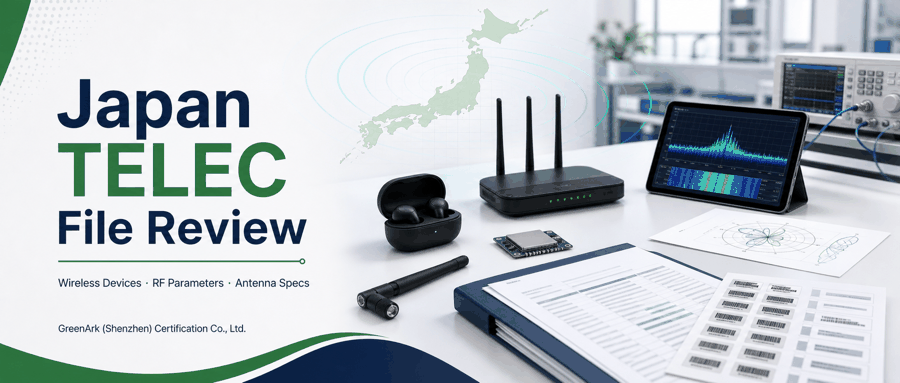
The official Japanese radio scheme is the Technical Conformity Certification (universally known in industry as Giteki) or the Construction Design Certification, both commonly shorthanded as TELEC or MIC certification. It rests on the Japanese Radio Act, administered by MIC (Ministry of Internal Affairs and Communications), with RCBs (Registered Certification Bodies) such as TELEC and VCCI issuing certificates.
a clarifies that TELEC is only one RCB among many, and enterprises must distinguish MIC as regulator, RCBs as issuers and testing laboratories as the execution layer.
Key 2026 technical updates: from April 2026 all new Giteki applications must use the latest MIC Notice 88 appendices Appendix 43 for 2.4 GHz (ARIB STD-T66), Appendix 45 for 5 GHz (ARIB STD-T71), and newly added ARIB STD-T109 v2.0 for 6 GHz Wi-Fi 6E / 7.
5 GHz DFS is tightened for 80 / 160 MHz bandwidths. 6 GHz only opens 5925–6425 MHz, capped at 23 dBm EIRP under indoor LPI rules; the AFC system is not yet live in Japan. a advises wide-channel devices to reserve extra DFS testing time.
Parallel to this frequency opening, RedCap / eRedCap is formally introduced as a standalone technical category covering IoT sensors, 5G smart meters, surveillance cameras and wearables, giving low-throughput wide-area devices a dedicated Giteki path.
Key Rules & Regulatory Points
a projects RedCap terminals will be a fast-growing Japanese-export segment in H2 Effective 14 Feb 2025, USB-C wireless products must add an RF interference during USB-C charging test; automotive wireless applications follow the dedicated Appendix 50 criteria.
SAR rule: hand-held / wearable devices require SAR ≤ 1.6 W/kg; fixed-installation devices may use MPE. VCCI covers 150 kHz–30 MHz conducted EMC, while TELEC covers RF only the two run in parallel and do not substitute. Amazon Japan 2026 tightly verifies Giteki numbers and QR marks under JIS C 9913; the QR code must decode to a direct MIC official Giteki query page URL and listings missing either are taken down within 24–72 hours.
Maximum penalty under Radio Act Article 103 is JPY 100 million, with criminal liability possible in aggravated cases. Certificates remain valid indefinitely; re-application triggers only when a standard-transition period ends, hardware materially changes, or firmware modifies RF behaviour.
a can orchestrate TELEC + VCCI multi-certificate campaigns, sharing sample batches wherever possible to compress overall lead time.
Sources include the Radio Act and its April 2025 (Reiwa 7) reform annexes; MIC Giteki and Construction-Design Certification enforcement orders; the full MIC Notice 88 with Appendices 43 / 45 / 50 plus ARIB STD-T109 v2.0; the ARIB STD-T66 / T71 / T109 v2.0 technical criteria; the 14 Feb 2025 USB-C RF-interference notice; the April 2025 articles on 5.2 GHz UAV opening and RedCap / eRedCap introduction; Article 103 penalty text; the JIS C 9913 QR-code provision; and 2026 Amazon Japan / Rakuten / Qoo10 Giteki verification rules.
Practical Checklist
The a Giteki database is refreshed weekly against MIC and RCB bulletins.
This overview applies to manufacturers, brand owners, importers and cross-border sellers exporting radio transmission equipment into Japan. It covers 2.4 / 5 / 6 GHz Wi-Fi routers and terminals, Bluetooth TWS and speakers, automotive Wi-Fi / Bluetooth modules, 5G RedCap IoT sensors and smart meters, surveillance cameras, wearables, 5.2 GHz UAVs, USB-C wireless charging products, smartphones, tablets, mobile Wi-Fi and walkie-talkies.
Pure wired devices, equipment below 9 kHz and receive-only devices are outside scope. a recommends a per-SKU RF parameter sweep by band, bandwidth, automotive flag, USB-C flag and hand-held / wearable status first.
Common misconceptions: assuming TELEC is the only issuer (VCCI etc. also qualify); assuming VCCI and Giteki substitute each other (they run in parallel); assuming FCC / CE RED convert directly (Japan does not generally recognise overseas reports); assuming the full 6 GHz band is open (only 5925–6425 MHz indoor LPI); assuming hardware LE Audio / Wi-Fi 7 with firmware off is exempt (hardware capability alone triggers); assuming older appendix applications survive April 2026 (all new ones must use latest); assuming Giteki only inside the manual suffices (must be on product / package or QR).
a runs a kick-off briefing plus baseline review to eliminate these.
In practical Giteki engagements, teams should start with a per-SKU RF sweep, capturing band, bandwidth, modulation scheme, power class, antenna configuration and key flags such as USB-C presence, automotive use, hand-held or wearable form factor, and UAV application.
Common Pitfalls
Each protocol must then be mapped to the exact MIC Notice 88 appendix including the April 2026 mandatory latest editions and for dual-band 2.4G plus 5G multi-protocol products the appendix number should be explicitly annotated per protocol, because RCBs regularly reject filings where the secondary-protocol appendix is silently omitted.
With the parameter framework locked, an RCB such as TELEC or VCCI and an accredited lab should be selected and a slot reserved four to eight weeks ahead; three to ten finalised samples per model is the baseline, and SAR, DFS or Appendix 50 automotive campaigns call for additional units, with DFS-dedicated devices ideally holding a full seven-day continuous test window to avoid re-queuing on master-signal detection failures.
Application documentation should be assembled in parallel and kept under version control: block diagram, schematic, antenna gain and radiation patterns, occupied-bandwidth data, USB-C RF-interference data if the SKU carries a charging port, automotive operating conditions where applicable, plus complete firmware and hardware version notes with full version-traceability records.
After certificate award, marking is designed per JIS C 9913, with vendors free to choose either the textual Giteki number or a QR-code display; the selected marking is then synchronised across the nameplate, retail package and user manual. The final housekeeping step archives the certificate, Giteki number, QR image, report summary, VCCI proof and version traceability file set, and uploads the unified dossier to the Amazon Japan, Rakuten, Qoo10 and Yahoo Shopping back-offices for onboarding.
a supports the full workflow from RF scoping to marketplace go-live.
Consequences & Tips
The a Japanese radio-access practice delivers an end-to-end capability from initial path scoping all the way through to market-surveillance response. At kick-off the team produces a multi-certificate path assessment orchestrating TELEC, VCCI, PSE and JIS C 62368 workstreams, reusing sample batches wherever possible to compress overall lead time; MIC Notice 88 appendix matching is completed alongside the scoping session and an April 2026 transition reminder is logged in the client calendar.
For newly regulated categories such as 5.2 GHz UAV and RedCap / eRedCap, a dedicated criteria-mapping memo is produced so the client understands how the 2025 rule changes apply to its SKU portfolio. During project execution, consultants handle RCB and accredited laboratory introduction, test scheduling and weekly progress tracking; USB-C charging RF-interference additional tests, Appendix 50 automotive special-coordination items, and SAR versus MPE classification determination with 1.6 W/kg limit review are all led by domain specialists.
On the dossier side, a takes ownership of application-document translation, consolidation and submission, plus strict version-traceability record keeping so RCB reviews clear on the first pass. Post-certificate, the team manages long-term certificate validity and change-trigger assessment for standard upgrades, hardware changes and RF-impacting firmware releases; it also specifies and reviews Giteki textual and QR-code marking artwork and compiles the e-commerce onboarding package for every major Japanese marketplace.
When it comes to risk, a runs a structured Article 103 penalty risk briefing and stands ready to prepare documentation and coordinate regulator liaison during spot-checks. Time-sensitive matters may also be escalated to the project lead alongside the standard email workflow.
Importantly, a does not issue official certificates, perform hardware or software rectification or participate in Japanese judicial or administrative review proceedings; exact deliverables are always set out in the signed service agreement.
Not sure which CPF pathway fits your product?
Send us your product category, materials and current certificates. We will review the available certification pathway.