Lead-in Three real roadblock stories. Have any of your products been explicitly asked for one of these two labels?
A large Nordic grocery group asked a copier-paper supplier to hold an active Nordic Swan licence. The existing FSC Mix 70 per cent plus CEPI environmental statement was rejected outright. FSC only governs forest sourcing; it does not cover bleaching effluents, organochlorine residuals or mill energy intensity which the Swan standard actually audits.
A dm category manager in Germany asked a hand-sanitiser supplier for Blue Angel. The team submitted EU Ecolabel and were turned away. Blue Angel enforces tighter thresholds on surfactant biodegradability, preservative lists, phosphate caps and post-consumer recycled packaging than EU Ecolabel does for the same product families.
An IKEA office chair fabric supplier showed OEKO-TEX Standard 100 Class II and was pushed back by the IKEA quality team at the Nordic distribution hub. IKEA internal supplier allocation rules grant explicit priority quota to factories that hold an active Nordic Swan licence on equivalent fabric constructions.
Underlying philosophies: Blue Angel is the chemical-criteria enforcer; Nordic Swan is the lifecycle environmental accountant
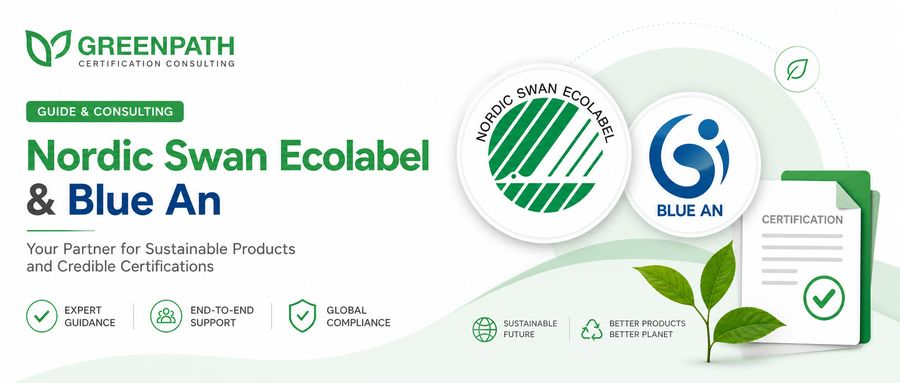
Blauer Engel (Blue Angel, launched 1978) and Nordic Swan Ecolabel (launched 1989) are both voluntary Type I ecolabels under ISO 14024, but the issuing bodies, audit logic and primary use cases diverge materially:
Blue Angel / Der Blaue Engel. Operated jointly by the German Federal Environment Agency (Umweltbundesamt, UBA) and RAL gGmbH (the German quality assurance institute). It is one of the oldest official ecolabels in the world. Its philosophy is to exclude, for a given product function, the chemical families that pose proven high concern to human health or ecosystems while cutting key emissions. The four heavy-weight audit pillars are: high-concern substance lists, VOC emissions, biodegradability ratios and post-consumer recycled packaging shares.
Nordic Swan Ecolabel. Operated under the Nordic Council of Ministers by the environment ministries of Sweden, Norway, Denmark and Finland, with Iceland joining later. Its philosophy is to minimise the combined environmental impact of a product across its full ISO 14040/14044 lifecycle: climate, water, land, resources and chemicals. The five heavy-weight audit pillars are: LCA inventory modelling, renewable and recycled content ratios, energy consumption, wastewater discharge performance and closed-loop waste recovery, with chemical clauses layered on top.
✅ Rule of thumb from a : if the buyer asks concrete parameter questions like is it free of AZO dyes, MIT preservative, what is the VOC emission number, what is the surfactant biodegradability ratio lean towards Blue Angel. If the buyer talks about carbon footprint, packaging circularity, renewable share, water footprint at the product-system level, lean towards Nordic Swan.
The two labels appear side by side most frequently on office furniture, professional cleaning products and printing paper tenders.
Side-by-side scoping and key judgment parameters one table tells you which label to chase for your SKU
| Dimension | Blue Angel (Germany) | Nordic Swan Ecolabel (Nordic) | Issuing / endorsement | German Federal Environment Agency UBA + RAL gGmbH | Nordic Council of Ministers NCM + environment ministries of SWE, NOR, DK, FIN | Strongest acceptance geography | Germany, D-A-CH (Austria, Switzerland), EU public procurement aligned | Sweden, Norway, Denmark, Finland, Iceland; Nordic government tenders | Product groups covered | ~120 product groups: paper, cleaners, textiles, flooring, furniture, electronics, paints, toys | ~66 product groups: paper & print, cleaners, textiles, furniture, IT equipment, building materials | Chemical control methodology | Each product group publishes its own RAL Sign Criteria with explicit banned/restricted substance lists: AZO dyes, MIT/CMIT, 6P phthalates, . | Common Nordic Ecolabel chemical rules plus product-group addenda. CMR/PBT/vPvB excluded; whole-formula Green Screening rather than named-. | LCA / lifecycle scope | Only a few high-consumption groups (paper, large appliances) require minimum energy or recycled content bars. | Mandatory ISO 14040/14044 LCA inventory for every product group, scored on GWP climate, WDP water depletion, AP acidification, EP . | Packaging & circularity clauses | 30-60 per cent recycled packaging required depending on group. single-material preferred. | Miminised-packaging design. 80 per cent+ recyclable or compostable. PCR or recycled pulp preferred. | Audit workflow | Application, lab project-specific testing, dossier review, UBA+RAL licence issue (typically 4-7 months) | Application, LCA modelling + chemical screening, sample testing, on-site audit (mill/factory energy, effluent, waste logs), licence issue (6-. | Validity & surveillance | Usually 3-5 years; annual surveillance via compliance declaration plus annual re-test on critical items | Three-year licence. annual change declaration on formula/process plus key-indicator review. | Typical licence cost range | EUR 6k-12k per SKU group, testing additional EUR 3k-10k | EUR 10k-20k per SKU group, LCA modelling separate EUR 5k-15k, on-site audit billed separately |
|---|
Four high-volume application categories paper, cleaners, textiles, office furniture with true thresholds and common failure points
Category 1 Paper and print (copier paper, tissue, packaging paper, printed publications)
🔹 Blue Angel RAL-UZ 10a copier paper / RAL-UZ 191 printing paper. Elemental chlorine free (ECF) or totally chlorine free (TCF) bleaching only; optical brightening agents (OBA) forbidden; min 70 per cent recovered pulp on copier paper; heavy metals forbidden in offset inks; VOC emission cap at 500 μg/m³. Common failure: recovered pulp landing at 68 per cent, two percentage points under bar.
🔹 Nordic Swan paper and board group. Mandatory LCA inventory model where tonne-of-paper water consumption, electricity, thermal energy and sludge treatment are scored against Nordic mill benchmark curves. Either min 75 per cent recycled pulp or FSC 100 per cent virgin pulp. Wastewater COD, BOD, total nitrogen and total phosphorus must meet Nordic BAT reference values. Common failure: domestic Chinese mills running 25 per cent higher specific energy than Nordic reference mills drag LCA scores below the pass bar.
⚠️ Copier tender trap. Inside Nordic government office copier-paper tenders, active Nordic Swan licence holder is a weighted gate and explicitly requires three consecutive years of factory-level licence before a prior-year quota letter is accepted. Buying a licensed agent route through a trading company is not accepted.
a experience: Nordic copier paper suppliers typically need their Swan dossier submitted a minimum of six months before the tender cut-off date.
Category 2 Cleaning products & detergents (hand soap, laundry detergent, dish soap, hard-surface cleaners)
🔹 Blue Angel RAL-UZ 177 hand soap / RAL-UZ 21 laundry / RAL-UZ 130 hard surface. Surfactants must meet OECD 301B or 310 aerobic biodegradability of ≥60 per cent, plus anaerobic ≥20 per cent. MIT, CMIT, BIT and Bronopol formaldehyde-donor biocides forbidden; DMDMH capped at 0.1 per cent; phenoxyethanol capped at 0.5 per cent. Phosphate + aluminosilicate sum ≤0.5 per cent. APEO and NPEO explicitly forbidden. PCR in packaging ≥50 per cent.
🔹 Nordic Swan cleaning products group. Biodegradability and chemical lists aligned with Blue Angel in most respects, with mandatory LCA modelling layered on top: in-formula water footprint, raw material transport carbon, packaging recovery, and eutrophication impact (EP) of the treated wastewater stream entering the receiving water body must fall inside the top 50 per cent of the Nordic Swan database.
Category 3 Textiles (bedding, towels, workwear, apparel, seating fabrics)
🔹 Blue Angel RAL-UZ 92 textiles. 22 banned AZO disperse/basic dyes; carcinogenic/sensitising disperse dyes banned; antimony ≤30 ppm; APEO ≤100 ppm; PFAS family below limits of detection; plastic microbeads forbidden; packaging recycled content ≥50 per cent; production water and energy scored against OECD best-available mill benchmarks.
🔹 Nordic Swan textile group. Chemical controls are largely aligned with OEKO-TEX Standard 100 and the Swan scheme directly accepts in-date OEKO-TEX chemical reports as the chemical pillar evidence. The additional heavy lift is process LCA: spinning, weaving, dyeing and finishing stages all feed specific water, steam and COD discharge figures per tonne of fabric, plus the renewable fibre share (organic cotton, linen, recycled polyester etc) into the aggregate score.
Category 4 Office furniture and IT (chairs, desks, seating fabrics, printing equipment)
🔹 Blue Angel RAL-UZ 160 office chairs / RAL-UZ 122 office furniture / RAL-UZ 182 IT. Wood-based panels formaldehyde release ≤0.05 ppm, stricter than Chinese E0. Foam and adhesive TVOC emission ≤500 μg/m³ and carcinogenic VOC ≤50 μg/m³. Recycled metal content ≥80 per cent. Electronic variants must meet RoHS 2.0 plus six phthalates plus PFOS/PFOA exclusion. Packaging 80 per cent+ recyclable.
🔹 Nordic Swan furniture and IT groups. Chemical pillars mirror Blue Angel, with mandatory LCA plus product durability testing (office chairs must survive 150,000 cycle fatigue tests) and end-of-life dismantlability (≥90 per cent of components separable for sorted recycling).
How to reuse certificates you already hold three pathways to avoid re-testing the same items
The most expensive pitfall with ecolabels is assuming each new label needs a brand-new testing campaign. Both Blue Angel and Nordic Swan publish formal recognition clauses for other schemes. In practice these clauses cut duplicate lab spend by 70 per cent or more when applied correctly:
🔹 FSC / PEFC. For Nordic Swan paper and wooden furniture categories, FSC 100 per cent or FSC Mix Credit ≥70 per cent supply chains have their material sustainability pillar recognised directly; no separate timber sourcing re-audit is required. Blue Angel recognises FSC identically.
🔹 OEKO-TEX Standard 100, bluesign, ZDHC MRSL. Nordic Swan textiles directly recognises in-date (six months) OEKO-TEX Class I/II reports for the full chemical pillar. Blue Angel RAL-UZ 92 grants a ~50 per cent chemical re-test reduction for bluesign-approved mills submitting their APEO, AZO and PFAS datasets.
🔹 GRS / RCS recycled content claims. Nordic Swan textile and packaging categories directly recognise GRS ≥50 per cent PCR traceability evidence; their LCA model auto-awards circularity bonus points without running a second traceability audit.
🔹 ISO 14001 / EU EMAS environmental management systems. Both labels accept ISO 14001 or EMAS-registered site annual energy, water and wastewater figures as the operational data source, skipping a separate third-party environmental monitoring audit.
The real channel acceptance difference why some tenders say Swan is a gate while others say Blue Angel is veto
The operational decision that matters most is not the label logo itself, but the buyer country and buyer type combination:
Nordic central and municipal public procurement schools, hospitals, municipal offices. Tender documents explicitly state supplier must hold a Nordic Swan licence on the corresponding product group because the Swan is directly endorsed by the Nordic environment ministries inside government framework agreements.
German federal and Länder-level public procurement. Copy paper, office furniture and cleaning products show explicit Blue Angel preference because UBA is a federal agency. Many large corporates Deutsche Bank, BMW, Siemens mirror the federal procurement rules internally.
Nordic big grocery ICA, Coop, Axfood, Kesko. Private label cleaners, paper and textiles expect core SKUs to carry one of Swan or Blue Angel, with Swan being the preferred option.
German drugstore chains dm, Rossmann, Müller. Private label cleaners and personal care lines default to Blue Angel. dm's Alverde natural cosmetic line writes Blue Angel cosmetic mark (RAL-UZ 196) into the hard gate.
IKEA supply chain. Paper packaging and office chair fabrics prefer Nordic Swan alongside the IWAY standard; cleaners accept Blue Angel and EU Ecolabel on parity.
💡 Practical tip from a : when a buyer has not yet named a label, do not commit to a full Nordic Swan licence costing 2-3x Blue Angel with LCA and on-site audit bundled. Send the buyer a one-page recognition matrix If they accept EU Ecolabel or the OEKO-TEX + FSC combination, commit that first and only upgrade to Swan or Blue Angel once the buyer explicitly names it.
This prevents sunk spend on unused licences.
Closing these labels are not stickers you buy; they are third-party attestations of how well you manage chemicals and environmental performance end-to-end
Many suppliers approach a Swan or Blue Angel application as buying a logo sticker for the package. The surveillance and sample re-test reality is substantially stricter than ordinary third-party reports. Nordic Swan demands annual refreshed LCA data plus any formula or process change declaration.
Blue Angel samples VOC release and critical banned-substance parameters on a rolling basis. Fabricated or inconsistent data can trigger licence revocation plus registration inside the Nordic environmental agency and UBA blacklists, making future licences for any SKU extremely difficult.
The right posture is: build genuine chemical management and production environmental performance then use the ecolabel as the independent third-party attestation of that work.
a provides end-to-end delivery for both labels: pathway design matching tender or channel requirements to the correct label, existing-certificate recognition mapping so every FSC/GRS/OEKO-TEX/EU Ecolabel data point that can be reused gets reused, chemical screening and reformulation scoping, ISO 14040/44 LCA inventory modelling prepared for direct Nordic Ecolabelling submission, RAL Sign Criteria hard-gate clause checklists, on-site audit preparation coaching and the annual renewal dossier package.
a has supported 70+ SKUs across paper, cleaners, textiles and office furniture through successful Nordic Swan or Blue Angel reviews, with a first-application pass rate above 94 per cent over the last 18 months and a 100 per cent three-year renewal pass rate on all licences we have supported.
a maintains ready-to-use mapping templates for RAL-UZ 177 cleaners, RAL-UZ 92 textiles and Nordic Swan paper groups; dropping them into your dossier cuts self-drafting workload by 40 per cent or more. a also runs a combined FSC/GRS/OEKO-TEX + Swan/Angel reuse scoping service that typically reduces total programme cost by 40 to 60 per cent and compresses the time-to-licence by one to three months.