Core Concepts & Scope
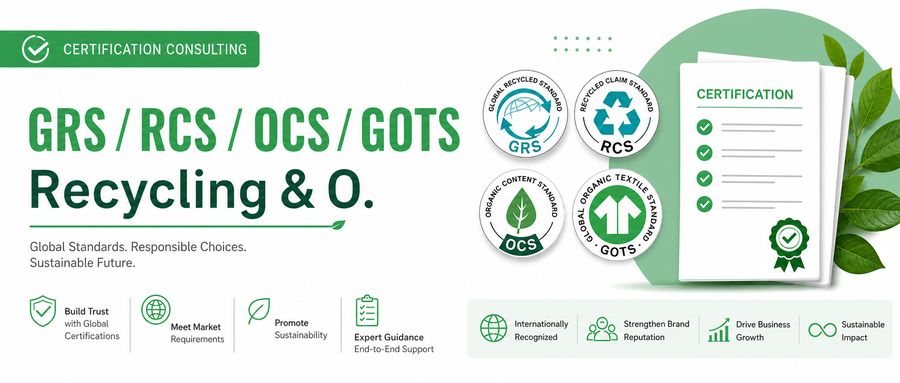
GRS ≥ 50% RCS ≥ 5% GOTS ≥ 70% OCS ≥ 5% CPF Acceptance
Executive note. Sellers are most often confused about three things: which of the four standards actually enable an Amazon CPF badge, what recycled/organic wording is lawful on the listing page, and how many transaction-certificate segments the trace chain must cover.
This concise comparison answers those three questions without flooding the page. Prepared by a , valid August 2026 through June 2027.
GRS 4.0 (Global Recycled Standard), published by Textile Exchange, requires at least 50 % recycled content in the final product and audits four simultaneous chapters: recycled-content chain of custody, environmental management system equivalent to ISO 14001, social responsibility aligned to SA8000-type checks on child/forced labour, remuneration, hours, freedom of association and non-discrimination, and chemical input restrictions aligned to ZDHC MRSL or OEKO-recognised restricted lists.
Amazon CPF accepts GRS as the primary recycled-content track.
RCS 2.0 (Recycled Claim Standard), also under Textile Exchange, drops the bar to a minimum of 5 % recycled content and only audits two items: content percentage calculation and TC issuance. It does not require a standalone social review, does not force the factory EMS, and does not run the ZDHC-level chemical chapter.
Key Rules & Regulatory Points
Because of the lower threshold, RCS is not a strong acceptance CPF track on its own. It supports hangtag content claims, but applications built only on RCS rarely pass CPF directly. In Q2 2026 cases handled by a , the pure-RCS CPF success rate stood at roughly 23 %.
GOTS 7.0 (Global Organic Textile Standard), maintained jointly by IFOAM and OTI, requires 70 % organic fibre and prohibits GMO seeds. The audit goes from organic farming → fibre → yarn → fabric → garment end to end, and overlays a tighter restricted-input chemical list than OEKO-TEX Annex 4 together with social and EMS chapters.
GOTS sits in the CPF accepted catalogue as the primary organic-content track, but the declared SKU must actually match the covered fibre (cotton / linen / silk / wool) and content percentage; a fabric-only GOTS cannot justify whole product 100 % organic.
OCS 1.0 (Organic Content Standard), also by Textile Exchange, requires 5 % organic fibre and only covers organic-content chain of custody and TC issuance. OCS does not audit the GOTS-level planting side, does not impose standalone social or EMS checks, and does not enter CPF as a strong standalone acceptance source.
Applications using only OCS usually need GOTS or another accepted track as the main evidence.
All four standards share one non-negotiable rule: every physical ownership transfer between seller and buyer must have its own Transaction Certificate, and the TC must name the correct supplier, buyer, product description, content percentage, batch number and shipping date.
Practical Checklist
This guide merges four authoritative sources:
GOTS 7.0 official text published by IFOAM/OTI in 2023 and the GOTS Logo Usage Guide v3.2 of 2025.
Amazon Seller Central help page GKQ2X9KZ9EU7AK53, Climate Pledge Friendly programme help, catalogue updates of March 2026 and June 2026.
EU Green Claims Directive (EU) 2024/1326 transposition documents on recycled/organic content granularity; US FTC Green Guides 2026 revision on percentage labelling.
Acceptance reminder. The CPF catalogue refreshes roughly every six months. If a client holds a different edition number than the ones listed above, have the provider cross-check the latest backend version before submitting. a prints the edition number and help-page ID on the cover of every pre-review package so claims are always tied to a dated source.
The most frequent misconception is treating a fabric-level GRS scope as a licence to write 100 % recycled finished garment. GRS 50 % is a whole-product threshold, but page copy must still distinguish shell fabric percentage from overall product content.
The safer sentence pairs the main fabric percentage with the overall product percentage and names the certificate number and issuer; this simultaneously satisfies the logo-usage rules from Textile Exchange and the granularity requirements of the FTC and EU Green Claims.
Common Pitfalls
A second recurring mistake is assuming RCS / OCS alone enjoy the same CPF standing as GRS / GOTS. RCS and OCS are hangtag content standards, not full-system eco standards. They sit well as supplementary evidence in the backend but do not have a strong standalone CPF acceptance entry.
Clients holding only RCS / OCS normally either upgrade the key SKUs to GRS / GOTS, or stack another accepted track such as Compact by Design alongside them.
OEKO-TEX ecological testing is occasionally written online as organic proof. OEKO measures harmful substances on the finished article; it does not prove the raw material comes from organic farming or recycled sources. Combining GOTS and OEKO on the same listing while calling OEKO organic is a logo misuse that both the OEKO Association and CPF auditors flag back.
many factories believe one TC issued to the garment maker is enough. For complex chains such as bottle-flake → fibre → weaving → dyeing → garment → trading company, both GRS and GOTS expect one TC per ownership transfer; a missing segment breaks the trace chain and can trigger scope suspension or withdrawal.
In a pre-reviews, missing TC segments account for roughly 37 % of all remediation items.
after certification some sellers append generic green phrases like 100 % eco or fully recyclable next to the logos. All four logo-use guides require the percentage, certificate number and issuer name to appear adjacent to the logo. Unquantified generic wording triggers delisting risk on EU marketplaces once Green Claims enforcement ramps up.
Consequences & Tips
Start with a fabric BOM split across every ASIN: shell fabric percentage, accessories, fill, hangtags and packaging grouped by recycled or organic track. Pick the standard that matches the supplier base. If the upstream chain already has GRS-certified fibre mills and weavers, GRS is usually the cheaper lift.
If organic cotton or linen sourcing is already mature, GOTS makes more sense. For sellers still testing appetite, put hero SKUs on GRS / GOTS use RCS / OCS hangtags for the long tail, then follow the CPF results before a full catalogue upgrade.
Do not wait for a remediation notice to fix the TC chain. Collect each TC within 45 days of the shipment date, archive it by batch and write the TC number back into the ERP alongside the shipment reference. a runs a one-time twelve-month TC gap audit at project kick-off, so gaps are closed centrally rather than chased reactively per Amazon notice.
Lock the page copy centrally. One owner or one provider should control all green wording across storefronts. Publish a reusable A+ template, bullet template and title keyword allow-list, and route every future edit back to the certificate and TC review loop.
This prevents Logo misuse, percentage misquotes and over-reach wording from being added piecemeal by different operations staff.
Not sure which CPF pathway fits your product?
Send us your product category, materials and current certificates. We will review the available certification pathway.