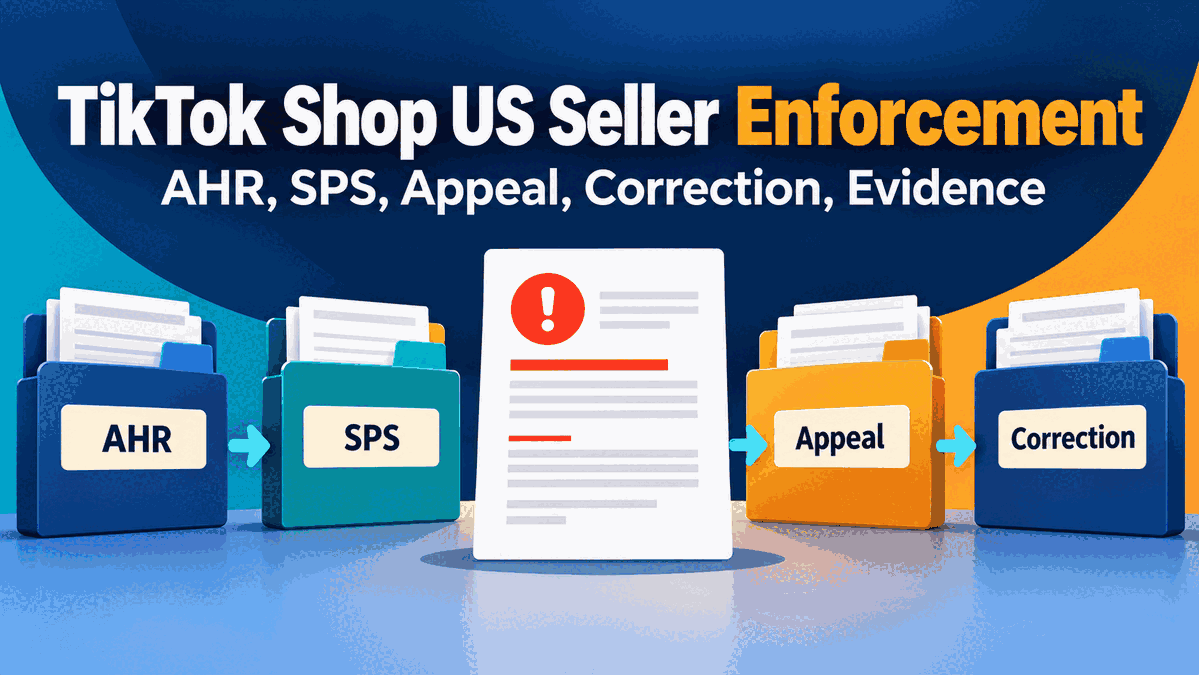
Page summary: For TikTok Shop sellers in the United States, Seller Enforcement is not a single low-score event. The practical decision is to connect the specific violation, its Account Health Rating (AHR) impact, possible effects on listings, shop functions, funds and connected accounts, and the exact Correction or Appeal window shown in Seller Center.
Scope and source dates
This article is for TikTok Shop sellers on the United States platform. It is based on TikTok Shop’s Seller Enforcement Policy dated October 9, 2026, Account Health Rating (AHR) Requirements dated June 29, 2026, Understanding Connected Account Risks dated June 29, 2026, and How to Correct Seller Violations dated June 26, 2026. Policy pages and individual violation tickets may change. For a live case, the current Seller Center notice, status, and deadline control.
The central judgment: a score is not the whole enforcement decision
When a seller receives a violation notice, five questions matter:
1. What event was recorded: a policy violation, a fulfillment or performance issue, an account-management issue, a connected-account issue, or a Buyer PII issue?
2. What can be affected: one listing, shop functions, AHR, orders, campaigns or affiliate access, funds, or withdrawal rights?
3. Could the event create an AHR milestone action or extend enforcement to connected accounts?
4. Does the current ticket offer Correction or Appeal?
5. Is the relevant window the 12–72 hours shown for some immediate actions, or the general 30-day/15-day Appeal sequence?
Violation or performance event → violation record and AHR impact → listing/account/fulfillment/campaign/fund consequences → connected-account scope → Correction or Appeal within the ticket’s window.
AHR and SPS are different systems
AHR is the compliance-oriented account health measure
AHR ranges from 0 to 1,000 and reflects account activity over the previous 180 days. Sellers start at 200 points. Points can be earned through successful fulfillment and policy quizzes, while policy breaches or failure to meet performance standards may reduce the score. Points generally reset 180 days after they are earned or deducted; points returned after a successful Appeal or Correction are treated separately under the AHR guidance.
TikTok Shop may take milestone enforcement action when AHR reaches 150, 100, 50, or 0. The published examples include:
| AHR milestone | Published example | Boundary |
|---|---|---|
| 150 | New mega-campaign enrollment and new-listing creation may be restricted for 7 days | A possible milestone action, not a universal result |
| 100 | The same permissions may be restricted for 14 days | Check the account page for the actual state |
| 50 | The same permissions may be restricted for 28 days | Other violations and account conditions still matter |
| 0 | The seller account may be permanently deactivated | Reactivation is at TikTok Shop’s discretion |
These milestones do not mean that every listing is automatically removed when a score crosses a threshold. The Seller Enforcement Policy also allows actions based on the nature, severity, and frequency of non-compliance.
SPS is a performance and rewards score
Shop Performance Score ranges from 0 to 5 and tracks product satisfaction, order fulfillment, and customer service over the previous 90 days. A higher SPS generally unlocks more rewards and benefits. The AHR page expressly distinguishes the systems: TikTok Shop does not take enforcement action against a shop merely because its SPS is low, while low AHR may trigger compliance-focused milestone actions. The October 16–17 SPS discussions therefore do not answer today’s enforcement question.
What Seller Enforcement can reach
The Seller Enforcement Policy says that actions can vary with the nature, severity, and frequency of non-compliance. The published examples include warning messages; temporary restrictions on account features; removal or freezing of listings; restrictions on campaigns, user-growth events, affiliate programs, and other benefits; temporary limits on creating new listings; reduced visibility; Seller Shipping restrictions; Order Volume Limits up to suspension of new orders; re-verification; deferred settlement; temporary or permanent restrictions on withdrawals; deductions from the seller balance; legal action; and reports to relevant authorities.
If a shop is deactivated or its Order Volume Limit reaches zero, the e-commerce permissions of associated Official Accounts or Marketing Accounts may be blocked at the same time. If the seller’s permissions are restored, those creator-account permissions may be restored accordingly.
Funds are a separate risk layer
The policy states that funds may be temporarily withheld for 45, 90, or 365 days when the seller violates a policy or the Seller Terms of Service. At the end of the withholding period, TikTok Shop may offset inventory-removal costs, guarantee-program obligations, negative balances, fees, chargebacks, refunds, undelivered items, or other losses before disbursing any remaining funds.
If the account is found to have engaged in deceptive, abusive, fraudulent, or illegal activity, TikTok Shop reserves the right to permanently withhold some or all funds, including platform-funded incentives provided during the previous 365 days. These are possible policy outcomes, not a universal settlement schedule for every violation.
Connected accounts: combined signals can widen the scope
TikTok Shop may consider accounts connected when their information, use, management, or operations show a relationship. Signals can include contact and payment information; owners, operators, managers, or anyone with access; devices, systems, tools, browsers and network environments; and inventory, fulfillment, suppliers, products and other commercial resources.
Accounts do not have to match in every respect. Accounts registered under different people or legal entities may still be connected if they are used, managed, or operated in a related way. If one seller account is enforced, TikTok Shop reserves the right to take corresponding action against connected accounts, including restricting their withdrawals.
Third-party operation does not remove seller responsibility. Sellers remain responsible for the registration, management, and operation of shops under their accounts. A useful appeal explains the actual relationship, dates, and separation steps rather than relying only on “different legal entities.” Opening another shop to continue the same business after a restriction may be viewed as an attempt to bypass the earlier enforcement.
Buyer PII should not be handled as an ordinary listing issue
Buyer Personally Identifiable Information may include a buyer’s full name, phone number, email, delivery address, social-media handle, payment information, national identification number, tax identifier, or order details that could re-identify the buyer when combined with public information. High-risk conduct includes redirecting buyers off-platform, sharing personal contact details or URLs in seller-to-buyer communications, listings, or fulfillment materials, and soliciting buyer PII through chats, listings, packaging inserts, or post-purchase communications unless TikTok Shop authorizes it for fulfillment. Violations involving Buyer PII may receive more severe enforcement, including account suspension and permanent deactivation.
Correction versus Appeal: identify the stage before the deadline
Correction
Correction is available only for selected fixable issues, generally where a seller can update a listing before enforcement takes effect. Go to Seller Center > Account Health > Shop Health > Violation Records and open the relevant violation ticket. Make the listing correction live first, then submit proof in images or PDF. The current page controls accepted file types, size, and other requirements; the guide identifies JPEG/PNG for image files. Submitting without actually updating the listing may produce “submission incomplete.” A Correction can be approved, fail, or remain under review; if it fails and an Appeal option remains available, the seller may still Appeal.
Correction windows vary by violation. Some immediate-action or correction situations may require action within 12–72 hours of notification. The ticket’s displayed window controls.
Appeal
Under the general seller Appeal sequence, a seller may have up to two Appeals for a violation: the first within 30 days of the violation notification, and the second within 15 days after the first Appeal is rejected. Some immediate actions have a shorter 12–72-hour window, so the 30-day rule must not be applied mechanically. TikTok Shop states that submitting an Appeal does not guarantee approval; the platform may review evidence, account history, and risk profile.
A practical response sequence
1. Preserve the original window. Save the email and Seller Center Inbox notice, violation ID, affected listing or SKU, AHR state, current enforcement, and the deadline displayed in the ticket.
2. Identify the affected object. Separate a single listing issue from an AHR milestone, shop-function restriction, fulfillment restriction, campaign or affiliate restriction, connected-account action, or fund/withdrawal restriction.
3. Select the available route. If Correction is offered, read the live-listing and proof requirements. If the seller disputes the facts or enforcement, identify the Appeal stage, remaining attempts, and deadline.
4. Match every document to a fact. Answer which record, which account relationship, which date, and which action has been completed. Keep the submission receipt and status; submission is not the same as reversal.
Conclusion
The practical unit of judgment in TikTok Shop US Seller Enforcement is a responsibility chain, not an isolated score. AHR is the compliance-oriented health system; SPS is a rewards-oriented performance score, and low SPS alone does not trigger enforcement. Connected-account signals and third-party operation can change who is affected. Listings, campaigns, fulfillment, funds, withdrawals, and legal or reporting consequences may all sit on the same enforcement path.
When a notice arrives, return to the current Seller Center record. Confirm the exact fact, the affected object, the available route, and the deadline. Do not replace the current ticket with an older page, another shop’s experience, or a broad “30-day” assumption.
Official sources
Seller Enforcement Policy (October 9, 2026; United States)
Account Health Rating (AHR) Requirements (June 29, 2026; United States)
Understanding Connected Account Risks Best Practices and Appeal FAQs (June 29, 2026; United States)
How to Correct Seller Violations (June 26, 2026; United States)
Evidence details that change the decision
A score is only one signal. Before choosing a route, preserve the event type, affected object, current page state, relationship scope, and the exact deadline. A violation can concern a listing, fulfillment or performance, account management, a connected account, or Buyer PII; the evidence package should identify which of these is actually in the notice.
| Signal layer | Examples | What to verify |
|---|---|---|
| Contact and payment | Phone numbers, email addresses, addresses, payment information, bank accounts | Who used each detail, and when |
| Ownership and people | Owners, operators, managers, or anyone with access or control | Access records, role changes, cooperation arrangements |
| Devices and systems | Devices, systems, tools, browsers and network environments | Device, browser, network and handover history |
| Business resources | Inventory, fulfillment, suppliers, products, warehouses and logistics | Shared commercial resources and actual operating links |
For a listing issue: identify the SKU or listing, show what changed, confirm the live state, and provide evidence that can verify the correction.
For a connected-account issue: explain ownership, historical agencies or partnerships, access handover, device/network/address/supply-chain overlap, and completed separation steps.
For fulfillment or fund issues: organize records around the orders, dates, logistics events, balances, or notices actually identified in the case.
For Buyer PII: first identify whether the notice concerns off-platform redirection, solicitation, use, or retention. “No malicious intent” is not a substitute for explaining the underlying conduct.