
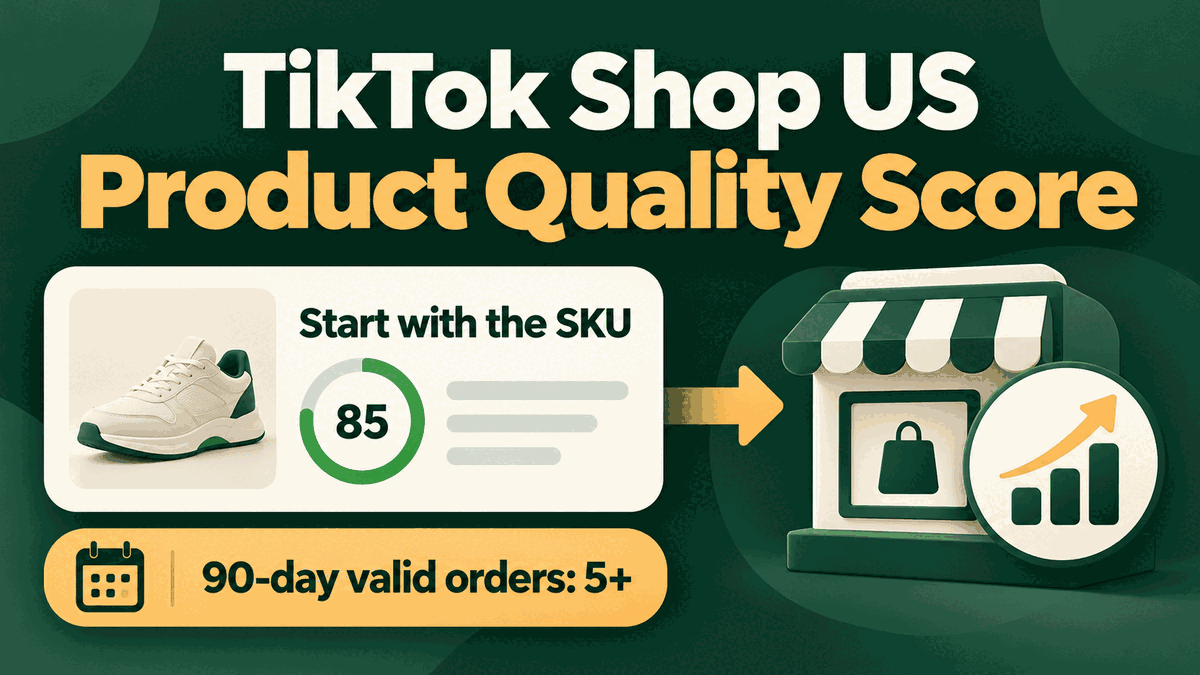
TikTok Shop’s US Shop Performance Score (SPS) is moving Product Satisfaction further down to the individual-product level. The current Product Quality Score and SPS New Version pages are dated 16 October 2026. The new version began trial operation on 21 September; during the trial, the preview did not affect current benefits, and the official launch date is 16 October 2026. Account access and appeal availability remain subject to the current Seller Center page.
This article explains the public platform materials for the United States Shop Experience context. Product Quality Score is a platform scoring mechanism. It is not a product certification, a test result, a government requirement or a legal-market-access determination.
The important change is the order of calculation
Under the previous Product Satisfaction approach, the shop’s orders were aggregated first and shop-level Negative Review Rate (NRR) and Non-Buyer Fault Return & Refund Rate (NBFR) were calculated from that shop-wide view.
Under the new approach, TikTok Shop first calculates a Product Quality Score for each product. It then aggregates those product scores into shop-level Product Satisfaction using each product’s share of shop orders. In practical terms, the seller has to answer two different questions: how is this product performing, and how much of the shop’s order volume does this product represent?
Prioritising a high-order-share product that is marked Poor or Needs Improvement is an operational interpretation of that weighting structure and the official feature guidance. It is not a promise that a particular SKU will reduce a shop score by a specified amount.
Trial timing does not mean every account has switched at once
The official trial guide says that the new version is preview-only during the trial period. It does not affect merchants’ current benefits; scores and benefits remain based on the existing version during the trial. The preview is rolled out in batches, so different sellers may see the entry at different times, and only sellers meeting the SPS eligibility threshold can access the preview page.
The dates therefore describe three different things that should not be collapsed: the publication date of the official guidance, the preview window, and the account-level availability of the new interface. The planned launch date is 15 October 2026; it is not a guarantee that every account will display the same view or receive the same benefit treatment at the same time.
When does a product receive a score?
A product needs at least five cumulative valid orders in the previous 90 days to enter product-level scoring. Fake orders, sample orders and gift orders are excluded. If a product has fewer than five valid orders, the official status is that no product score is calculated for now. That should not be rewritten as a low score.
The official material also describes small-order-volume protection. With a denominator of five to ten orders, the default score for each of NRR and NBFR is 3.5. With more than ten and up to thirty orders and no more than one problem order, the metric is calculated normally but subject to a 3.5-point floor. These are conditional calculation rules, not a guarantee that every small SKU will retain a particular score.
What the product metrics mean
NRR is the share of a product’s delivered orders in the previous 90 days whose review status is one or two stars. The current official page says the system uses the latest review status within 15 days after delivery rather than simply the first review, and excludes negative reviews caused by FBT or 4PL logistics issues. The denominator is the product’s delivered orders, not all orders in the shop.
NBFR is the share of a product’s delivered, non-cancelled orders in the previous 90 days where a seller- or logistics-partner-caused problem led to a return or refund request. It is not the same as the product’s total return or refund volume. The responsibility condition matters before the number is interpreted.
The initial Product Quality Score is calculated from the NRR score and the NBFR score using their applicable metric weights. The public material explains the relationship, but a seller should not invent a universal weight table or a complete category threshold table where the official page or Seller Center has not provided one.
Positive feedback is a high-score gate, not a third equal formula term
Positive Feedback Rate does not enter the initial formula as a third equally weighted metric. It is checked when the initial product score reaches 4.5 or higher. The official trial guide defines the rate as the share of four-star and five-star reviews among all reviews for the product in the previous 90 days, and gives a high-score standard of at least 90%. If the product does not meet that standard, the final product score is capped at 4.4.
This means that an initial score of 4.5 or above is not by itself enough to describe the final score. The high-score gate must be checked separately.
Why category and price band matter
Metric values are converted into scores using the product’s actual category. TikTok Shop says the third-level category is normally used; if there are too few products in that category, the second- or first-level category may be referenced.
The conversion also compares products within their own category–price-band group. Two products with the same raw NRR value may therefore receive different metric scores if they belong to different category or price-band groups. “Price band” here is part of the platform’s scoring segmentation, not a universal price range that a seller can safely create from memory. The relevant grouping and thresholds should be checked in the official Seller Center information.
A useful SKU-level review
The most useful next step is not to ask how to guarantee a score or obtain traffic. Start with products that have a high order share or are shown as Poor or Needs Improvement, then record the product ID or SKU, valid delivered orders in the previous 90 days, NRR, NBFR, Positive Feedback Rate, actual category and price-band group, the responsibility determination for returns or refunds, the current product-page version, and the relationship between the product, packaging and instructions.
This is an operational record, not a TikTok Shop mandatory form. Product-page, physical-product, packaging and instruction consistency are not additional fields in the published Product Quality Score formula. They are useful evidence for explaining customer experience data and separating a product issue from a responsibility-classification or version-mapping issue.
Sellers whose primary shop category is Pre-owned are a specific exception in the official material: the new version continues to use the old shop-level overall calculation method for that case. The general product-level formula should not be applied to every second-hand-product scenario.
Keep the boundary clear
Product Quality Score is a US TikTok Shop platform-performance mechanism. It is not a certification, a laboratory conclusion, a government rule or proof of market access. The official materials mention product-level benefits or traffic incentives, but their exact thresholds and levels are subject to the official launch information. This article does not promise traffic, ranking, sales, an appeal outcome or shop recovery.
Official sources: SPS: Introduction to Product Quality Score and Introduction to Shop Performance Score New Version (US), current page date 16 October 2026. The trial began on 21 September, and the official launch date is 16 October 2026; account-level access, thresholds and appeals follow the current Seller Center page.
绿色方舟(深圳)认证有限公司


