
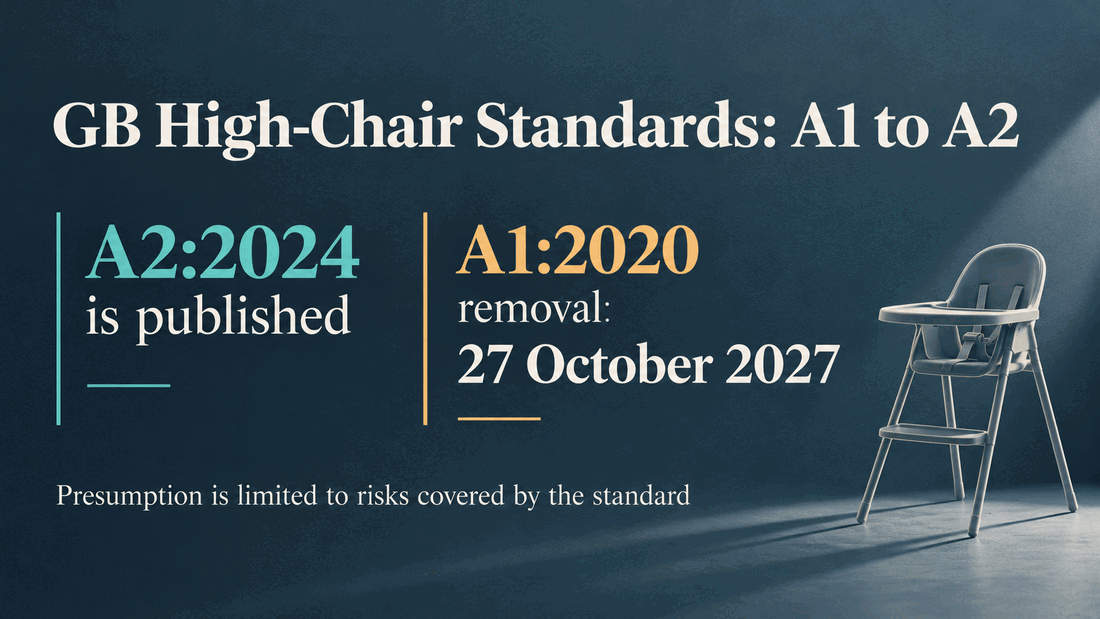
A supplier has a test report citing EN 14988:2017+A1:2020. A new UK government notice, dated 8 October 2026, lists EN 14988:2017+A2:2024. Does the earlier report suddenly become unusable, and must every model be retested? The notice does not support either blanket conclusion. It changes the published reference to a standard, while giving the earlier reference a specified removal date. Whether a particular report remains relevant to a particular chair is a separate product and evidence question.
The notice has a Great Britain scope
The government's Standards: general product safety page identifies the references as being for regulation 6 of the General Product Safety Regulations 2005. It states that the publication applies to England, Scotland and Wales. The OPSS Great Britain guidance distinguishes the Northern Ireland regime. A commercial file labelled simply “UK” therefore does not establish that this GB notice is the applicable reference route for every destination.
The product entry in the notice is “Children's high chairs – Requirements and test methods”. The product category matters. The OPSS guidance gives a high chair used by a restaurant customer as an example of consumer use, so the discussion is not confined to chairs sold for private homes. That example does not turn every commercial or children's seat into a high chair within EN 14988.
Read Annex I and Annex II together
Part 1 of Annex I to the 8 October 2026 notice moves EN 14988:2017+A1:2020 to Annex II and replaces its published reference with EN 14988:2017+A2:2024. Annex I Part 2, row 36, lists A2:2024. Annex II Part 2, row 3, lists A1:2020 with a removal date of 27 October 2027. The April 2025 notice previously listed A1:2020, confirming that this is a real change in the published version.
The 2026 notice says that references in Annex II continue to confer a presumption of conformity until their removal date. On and after that date, the removed reference no longer gives rise to that presumption. In practical terms, A1:2020 did not lose that status the day A2:2024 appeared. Equally, the removal date is not a blanket permission to sell any A1-tested product until 27 October 2027, nor a statutory statement that every older chair becomes unlawful that morning. It marks the end of a particular reference-based presumption.
A presumption is limited to risks covered by the standard
OPSS explains that the regulation 6 presumption concerns only the risks or categories of risk covered by the referenced standard. Producers, including UK importers, must still ensure the safety of products before placing them on the GB market. Distributors have duties of care and traceability. Those obligations continue during the transition and after the older reference is removed.
This distinction stops a date from doing the work of a product assessment. A report title may show which edition was used, but it does not by itself show that the tested sample is the current production model, that changes in components or structure are covered, or that all relevant risks have been addressed. Conversely, loss of the A1 reference-based presumption on the removal date is not, on its own, proof that a given product is unsafe. The evidence available for that product must be assessed under the applicable rules.
The notice publishes standard references; it does not set out the technical clause-by-clause differences between A1:2020 and A2:2024. Without the full standards, the complete report and the product file, one cannot infer a newly required test, pronounce an existing report sufficient, or instruct every supplier to run a complete retest.
How to review an existing A1 report
For purchasing or compliance teams, a useful starting record links five things: the destination market; the chair's actual model and design revision; the batches being supplied; the full standard edition and tested sample described in the report; and the risks the report addresses. Compare the edition cited in product literature or supplier statements with the evidence actually held. If the chair changed after testing, investigate that change rather than assuming the same product name guarantees the same evidence.
Then decide whether further assessment, updated testing or other evidence is needed, using the full standards and product documentation. This is a suggested due diligence sequence, not an additional procedure imposed by the notice. Planning for the 2027 removal date should focus on the evidence route for each model after that boundary, while maintaining product safety throughout.
Sources and limits: GOV.UK publication page (updated 8 October 2026); 2026 notice (opening explanation, Annex I and Annex II); OPSS guidance for Great Britain. This article explains the published-reference transition. It does not assess any specific model, report or Northern Ireland supply route.
Prepared by 绿色方舟(深圳)认证有限公司.


