
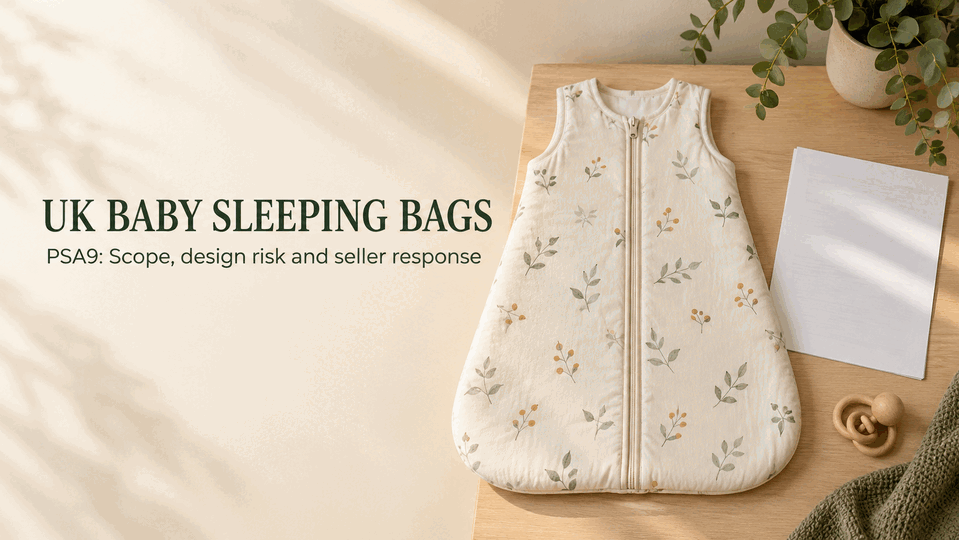
The UK's Office for Product Safety and Standards (OPSS) issued Product Safety Alert PSA9 on 1 October 2026. For a business selling infant sleep products in the UK, the useful starting question is not whether an item carries the words “sleeping bag”. It is whether the product is marketed or intended as a bag for a baby to sleep in without supervision in a cot or crib. If it is, the presence of armholes and the absence of a hood become central product checks.
The scope is tied to use
PSA9 does not cover every warm garment or wrap for a baby. It excludes items designed to be worn in a pram, such as a pramsuit or muff, and products designed specifically to swaddle a baby. A marketplace category may therefore be misleading in either direction. Product photographs, instructions, packaging and the actual design should be read together with the listing's suggested sleep setting.
The alert identifies two dangerous features for the sleeping bags within its scope: a lack of armholes or the inclusion of a hood. Without armholes, a baby can slip down into the bag and material can cover the nose and mouth. A hood can move over the face. Heat-retaining material or an enclosed head can also contribute to overheating. OPSS says it has published nearly 50 recalls or product safety reports involving dangerous baby sleeping bags since 2023. That number describes the wider safety concern; it does not mean that every individual listing has been recalled.
What the business response requires
Under PSA9, businesses must meet their duties under the General Product Safety Regulations 2005 to place only safe products on the market. Products marketed or intended for unsupervised baby sleep in a bag must have armholes and must not have a hood. Products that do not comply must be removed from sale and corrective action taken. Replacing “unsupervised sleep” in a title cannot resolve a dangerous design while the same product remains on sale.
A practical review should map each UK listing to its current physical version, supplier specification and stock batch. Variants or redesigned batches should be checked individually. The sales page, warehouse status and records for previously sold units need to describe the same affected products. The exact corrective and consumer response should be determined from the facts and applicable duties rather than inferred from an article.
OPSS also recommends that retailers and importers consider supplying only sleeping bags that meet voluntary standard BS EN 16781:2018. The alert says it does not apply to bags meeting that standard. This recommendation should not be presented as a universal mandatory certification for all infant textiles. Any test evidence must still be matched to the current model and construction.
The resulting decision order is straightforward: establish the intended sleep setting, check armholes and hood on the actual product, then address affected sales and records. Products outside PSA9's defined scope still need their own safety assessment; they simply should not be classified by stretching this alert's wording.
Source: OPSS, Product Safety Alert: Baby Sleeping Bags (PSA9), published 1 October 2026; checked 5 October 2026.
绿色方舟(深圳)认证有限公司


