Audience: Amazon NA Christmas String / Curtain / Icicle / Net / Smart RGB decorative-light sellers; Etsy/Wayfair independent holiday-light sellers; Yiwu/Chaozhou/Zhongshan light-factory QC managers.
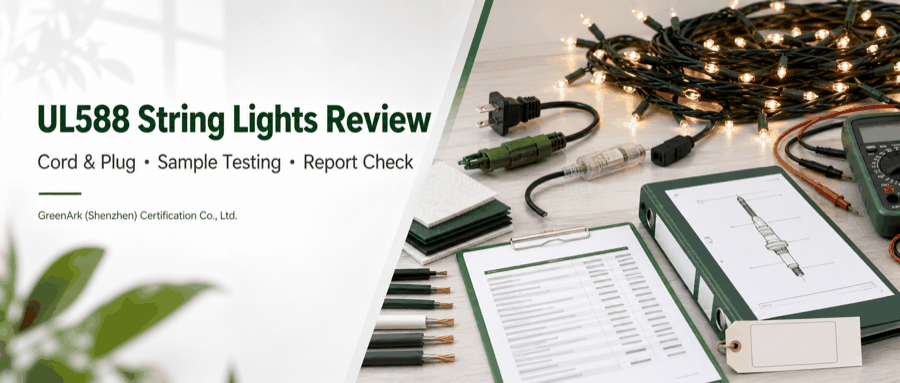
Executive summary: UL588 is the US product standard for Seasonal & Decorative Lighting Products (plug-powered & battery-powered). Q4 Sep–Jan is the peak CPSC+CBP tri-agency enforcement window. Report/Label on unit / NEMA 5-15P Plug three-leg consistency is the #1 cause of 2025 Q4 detentions (+41% YoY). We decompose Scope-of-Applicability / 5-Layer CCL / System Fail Tests / 3-Leg Label Enforcement. 5-step tonight closes.
🔹 Trap 1: Report uses Class II supply but goods ship with a different Class 2 driver → Report does NOT cover.
🔹 Trap 2: NEMA 5-15P plug has its own UL file but plug file# is NOT in the whole-string CCL — 3-leg mismatch FAIL.
🔹 Trap 3: Retail installation instructions lack the mandated Read-Follow-All / Unplug-Not-in-Use / Do-Not-Mount-on-Sleep-Tube statements — retail open-box fail.
I. Scope Decision Tree: Is Your String REALLY UL588 (not every decorative lamp is)
| Product Form | Appropriate Standard | Key discriminator |
|---|
| Incandescent/LED Christmas string lights (plug 120VAC/60Hz, SPT-1/SPT-2 parallel wire) | UL 588 | Plug directly to 120V mains; multi-light series; typical Xmas tree/curtain/icicle/net. |
| Curtain / Icicle / Net lights (bus+branches on SPT) | UL 588 | Single SPT-1/SPT-2 main bus splits into branches; 120V rated. |
| Battery-Operated LED string lights | UL 588 Appendix B + UL 2054 (if battery pack ≥ 2S) | Battery supply; battery 2S+ or 100Wh+ ADDITIONALLY UL2054 + 1455. |
| Rope Lights (round/square LED strip) | UL 2388 + UL 588 where applicable | Encapsulated rope/strip decorative; mains plug direct → UL588; LV + separate LVPS → UL2108 low-voltage + UL8750 LED. |
| Smart Wi-Fi/BT RGB strings (APP/Voice) | UL 588 + FCC Part 15B (EMC) + FCC ID if intentional radiator | Control module adds RF function; any 2.4G module needs FCC ID (Batch1 ID4). |
| Recessed downlight / Panel / Track (general illumination) | UL 1598 / UL153 / UL 8750 | NOT seasonal/decorative lighting — falls under general luminaire standards. |
II. 5-Layer Evidence Chain: Entry-Power → Wire Conductors → LED/Controller → Structure → Label & Package — every layer holds veto power
2.1 Entry Power (Plug/PS): NEMA 5-15P polarity & Class-2 driver interoperability
| # | Item | UL588 § | Greenark 100% pass bar | Self-check tonight |
|---|
| 1 | NEMA 5-15P Plug UL File + Polarity | §12.1 | Plug has UL File E-XXXXXX; N/L/G correct (N=long-slot; L=short-slot; G=round) | Pull plug; read UL file → iQ Active; multimeter continuity on N/L/G 50 pcs random sample — any reverse → production SOP rewrite. |
| 2 | Class 2 Power Supply (LED driver) UL File | §7.2 Energy Limiting; NEC Class 2 | Driver has standalone UL CCN QMLQ8/ZMFZ8; output strictly Class 2 (≤100W/≤60Vdc/≤5A); driver model must appear 100% on CCL. | Driver UL # + model vs CCL on report; Class 2 mark present; mismatch → swap or PC. |
| 3 | Polarity 100% no-reverse | §20 Dielectric / §22 Polarity | 100% NO L/N reverse; wire colors N=White / L=Black-Red / G=Green correct. | 50 pcs continuity; reverse → line retrain. |
| 4 | SPT-1 / SPT-2 / SVT AWG gauge | §42.1 Conductor Size | ≤6A → 18AWG; >6A to 10A → 16AWG; total run >50 ft → upgrade one gauge. | Caliper measure bare Cu vs AWG table; 18AWG ≥ 0.823 mm² / 16AWG ≥ 1.31 mm². |
| 5 | Cord Strain Relief (entry anti-pull) | §52 | 25 lbs 1 min pull; 10 lbs 1 min torque; conductor shift ≤ 2 mm; no solder detachment. | Hand-pull; loose → add PVC dip or SR clamp tonight. |
| 6 | Power-supply OCP | §7.3 | Class-2 limits strictly: 60Vdc/5A/100W; 1.25× rated no-trip / 1.5× rated trip ≤ 60s. | Electronic load step; trip time matches report. |
2.4 Label/Plug/Package Three-Leg Consistency (CPSC 2025 Q4 special focus)
The 2025 Q4 CPSC enforcement spotlight is Report / Plug / Permanent-Label three-leg consistency. One out of 10 containers is seized on this alone. Definition: Plug UL# on plug engraving MUST appear on whole-string UL588 CCL; permanent label on unit MUST match UL588 approved marking drawing word-for-word; retail carton/package displays the required warning sentences. ANY missing/mismatch = container rejection.
| 3-leg match point | Section | Greenark bar | Self-check tonight |
|---|
| Permanent Label on unit | §61 Marking | (a) UL Listed mark + whole-string File#/CCN; (b) Model; (c) Ratings: 120V 60Hz 0.XXA / Class 2; (d) Made in China; (e) Manufacturer + file holder. | Take 3 unit labels vs approved drawing word-for-word; any letter/font/position off → re-tooling tonight. |
| Plug engraving UL File | UL817/UL498 | Plug-body engraved UL# must 100% appear in whole-string CCL list. | Read engraving → compare report CCL line; missing → C1PC add or swap plug. |
| Retail box/packaging statements | CPSC 16 CFR Part 1212 + FTC labeling | (i) 'Read and Follow All Instructions'; (ii) 'Unplug When Not In Use'; (iii) 'Do Not Mount on Crib, Bed, or Sleep Tube' (xmas lights); (iv) Indoor/Outdoor; (v) Class 2 Power Supply if applicable. | Scan all 4 retail faces/manual; any missing sentence → printer make-ready revision tonight — one week delay beats 45-day CET detention 100-to-1. |
Case study (Nov 2025 · LGB Port, LA): Yiwu seller shipped a 40HQ Christmas curtain-light container (12,000 sets, FOB $230,000). CPSC Q4 special: (1) Unit perm label printed UL file E-158674 while actual whole-string UL588 file was E-178869 (supplier sent wrong make-ready — old print not exhausted); (2) Plug engraving UL E-212234, but CCL on the whole-string report listed E-151200 (factory changed plug vendor without C1PC). Two legs mismatched → §2.803 improper marking → whole container to CET → chose return to Yantian → all-in cost (freight roundtrip + demurrage + port op + return fee) $68,000. 3-leg match takes 10 min tonight — saves $68,000 and 45 days.
III. 5 top 2025 Q4 enforcement failure points + 5-step tonight list
| Rank | Fail point | Enforcement basis | 2025 Q4 share | Tonight action |
|---|
| 1 | 3-leg mismatch (report/label/plug CCL/model/file) | §2.803 | 31% | 3-leg comparison table tonight; any mismatch → hold ship / revise plates. |
| 2 | N/L polarity reverse (L/N crossed) | §22 Polarity | 27% | 50 pcs multimeter; any reverse → line retrain. |
| 3 | Class 2 driver not on CCL / out-of-spec output | §7.2 Energy Limit | 18% | Electronic load Class 2 test; driver model not on CCL → C1PC or swap. |
| 4 | Package / Manual missing 8 mandatory sentences (Sleep Tube/Unplug/Read Instructions) | CPSC 16 CFR 1212 | 14% | Side-by-side; any missing → re-print tonight. |
| 5 | Solder joints lack conformal coating (Outdoor IP44 missing O-ring seal) | §39 / §Outdoor IP | 10% | Open housing; indoor = conformal coat Humiseal/Dymax; outdoor IP44 = silicone O-ring seal ≥ 1 mm Shore 50-60A. |
🟢 5-step tonight list (5 min each)
1️⃣ Build 3-leg comparison board: Print the UL588 approved marking drawing × 3 unit physical labels × plug engraving UL# × report CCL. Paste side by side; all match = OK; any mismatch → hold.
2️⃣ 50 pcs Polarity & AWG check: 100% polarity correct + wire gauge meets standard; any fail → retrain line.
3️⃣ CCL 5 big items: Plug/Driver/LED PCB/Fuse/LED resistor UL matches report; any mismatch → PC.
4️⃣ 8 mandatory sentences on packaging & manual: All present; any missing → press room revise.
5️⃣ Solder coating & seal: Outdoor = O-ring; Indoor = conformal coating. Missing = add station tonight.