High and low temperature testing is an environmental test that evaluates the performance stability, reliability, and endurance of materials, components, or finished products under extreme temperature conditions (high temperature, low temperature, and temperature cycling). It is one of the core items in reliability testing. Its purpose is to simulate the extreme temperature conditions a product may encounter during storage, transportation, and use, verifying whether it experiences functional failure, performance degradation, or physical damage, thereby guiding product design optimization, quality control, and service life assessment.

Core Objectives

  1. Verify Extreme Environment Adaptability: Determine whether a product can function normally under high temperatures (e.g., summer sun exposure, inadequate equipment heat dissipation) or low temperatures (e.g., frigid regions, high-altitude environments) — such as electronic device startup and mechanical component operation.

  2. Expose Latent Defects: Use thermal stress to accelerate the aging and degradation of materials or structures (e.g., plastic cracking, rubber hardening, solder joint detachment, electrolyte leakage), identifying design or process defects early.

  3. Assess Long-Term Reliability: Simulate natural environments with temperature alternation through cyclic high/low temperature exposure to predict product service life (e.g., durability of automotive components in regions with large day-night temperature differences).

Common Test Types and Applicable Scenarios

Depending on the test objective and temperature conditions, high and low temperature testing can be classified as follows:

1. High Temperature Test

  • Definition: Place the specimen in a specified high-temperature environment for a defined period and observe changes in its performance.

  • Core Focus: Thermal stability of materials (e.g., plastic softening, metal oxidation), high-temperature endurance of components (e.g., capacitor leakage, chip overheating failure), and chemical property changes (e.g., coating peeling, adhesive failure).

  • Typical Temperature Ranges:

    • Consumer products: 40°C–85°C (e.g., consumer electronics);

    • Industrial / automotive products: 85°C–150°C (e.g., engine compartment components);

    • Special applications: 150°C–300°C (e.g., aerospace equipment).

  • Test Duration: Ranges from as short as 1 hour (rapid screening) to thousands of hours (long-term aging test).

2. Low Temperature Test

  • Definition: Place the specimen in a specified low-temperature environment for a defined period to evaluate its endurance capability.

  • Core Focus: Low-temperature embrittlement of materials (e.g., plastic and rubber hardening/cracking), low-temperature failure of components (e.g., sharp drop in battery capacity, lubricant solidification, display frosting), and contraction stress in mechanical structures (e.g., enlarged gaps, part jamming).

  • Typical Temperature Ranges:

    • Consumer products: -20°C–0°C (e.g., home appliances);

    • Industrial / outdoor products: -40°C–-20°C (e.g., outdoor telecom equipment, automotive);

    • Extreme environments: -65°C–-40°C (e.g., polar research equipment, aerospace).

  • Test Duration: Typically corresponding to high-temperature tests; sufficient time is needed for the specimen temperature to stabilize (e.g., 2–4 hours preconditioning, followed by holding for several to hundreds of hours).

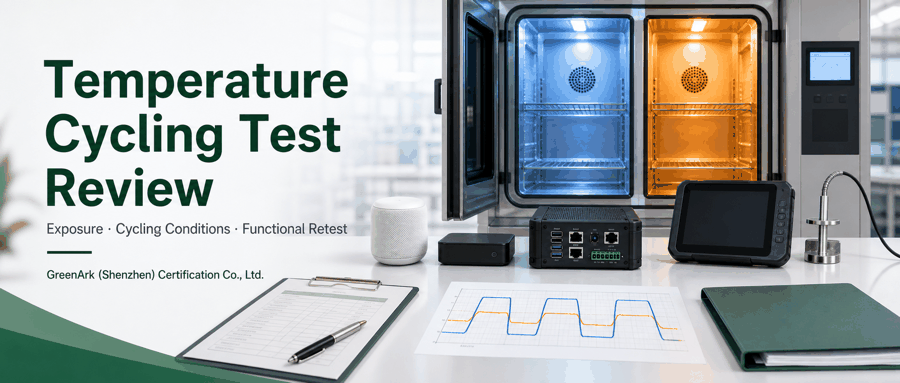
3. Temperature Cycle Test

  • Definition: The specimen is repeatedly exposed alternately to high and low temperatures, simulating temperature alternation environments such as day-night temperature differences and seasonal changes.

  • Core Focus: Fatigue failure caused by alternating stresses from thermal expansion and contraction of materials (e.g., solder joint cracking, coating delamination, seal aging), and structural stability (e.g., enclosure deformation, connector loosening).

  • Key Parameters:

    • Number of cycles: Typically 10–1,000 cycles (depending on product lifetime requirements, e.g., automotive parts require ≥100 cycles);

    • Temperature change rate: Slow (≤5°C/min, simulating natural environments) or rapid (5–20°C/min, accelerated stress testing);

    • Dwell time at high/low temperatures: Ensure the specimen temperature reaches stabilization (typically 30 min–2 h).

4. Rapid Temperature Change Test

  • Definition: An intensified version of temperature cycle testing, with a faster temperature change rate (typically ≥10°C/min, even up to 50°C/min), more rigorously simulating severe temperature fluctuations (e.g., cabin temperature changes during aircraft takeoff and landing).

  • Applicable Scenarios: High-end equipment (aerospace, military products), primarily evaluating the thermal shock resistance of materials and structures.

5. Temperature-Humidity Test

  • Definition: Combines high/low temperature with humidity (e.g., high temperature/high humidity, low temperature/low humidity), simulating hot-humid environments (e.g., southern China's plum rain season) or cold-dry environments (e.g., northern China winters).

  • Core Focus: Effects of moisture on products (e.g., metal corrosion, circuit short-circuiting, insulation degradation), and synergistic material deterioration from humidity and temperature (e.g., wood mold, plastic hydrolysis).

Key Test Parameters

The test protocol must establish the following parameters based on product standards or actual use scenarios:


  • Temperature Range: Based on the product's intended geographic region (e.g., frigid, tropical) or industry standards (e.g., automotive parts must withstand -40°C–125°C);

  • Exposure Time: Holding time at high/low temperature (must ensure the specimen reaches "temperature stabilization," i.e., the core temperature matches the environment);

  • Temperature Change Rate: The speed of heating/cooling (affects stress magnitude; the faster the rate, the greater the stress);

  • Number of Cycles: The number of temperature alternations (simulating total temperature fluctuations over the product's service life);

  • Humidity Conditions: If a damp heat test is involved, relative humidity must be specified (e.g., 30%–95% RH);

  • Specimen State: Whether powered/operating during the test ("operational state" testing, evaluating function) or unpowered ("storage state" testing, evaluating storage endurance).

Applicable Products and Industries

High and low temperature testing covers virtually all industrial products, with typical scenarios including:


  • Electronics and Electrical: Mobile phones, computers, sensors (evaluating startup, operation, and battery life under high/low temperature);

  • Automotive Components: Tires (low-temperature hardening), batteries (high-temperature swelling), ECUs (Electronic Control Units);

  • Aerospace: Satellite components, engine parts (extreme temperature differential environments);

  • Medical Devices: In-vitro diagnostic equipment (laboratory temperature fluctuations), implantable devices (constant body temperature but must withstand sterilization high temperatures);

  • Materials: Plastics (thermal deformation resistance), rubber (low-temperature embrittlement), coatings (high-temperature oxidation).

Key Testing Standards

Testing must follow international or industry standards to ensure traceability and comparability of results:


  • General Standards: GB/T 2423 (corresponding to IEC 60068) series (e.g., GB/T 2423.1 – Low Temperature Test, GB/T 2423.2 – High Temperature Test, GB/T 2423.3 – Damp Heat Steady State Test);

  • Electronics Industry: JEDEC JESD22-A104 (High Temperature Storage), JESD22-A103 (Low Temperature Storage);

  • Automotive Industry: ISO 16750 (Environmental Conditions for Electrical and Electronic Equipment of Road Vehicles), SAE J1211 (Temperature Cycling of Automotive Components);

  • Aerospace: RTCA DO-160 (Environmental Conditions for Airborne Equipment), MIL-STD-883 (Microelectronic Device Testing).

Test Result Evaluation Criteria

Product conformance is determined based on the following observations:


  1. Functional Failure: Such as inability to power on, signal interruption, parameter out-of-tolerance (e.g., abnormal resistance, voltage);

  2. Physical Damage: Cracking, deformation, discoloration, coating peeling, component loosening/detachment;

  3. Performance Degradation: Such as battery capacity drop exceeding allowable limits, mechanical component operation stuttering;

  4. Safety Issues: Such as short circuit, fire, electrolyte leakage (batteries), toxic gas release.


The core of high and low temperature testing is to "simulate extremes and expose risks." Through scientifically designed test protocols, product reliability in complex environments can be effectively improved. For test protocol design tailored to specific products (e.g., lithium batteries, plastic components), further details on the scenario can be provided to refine the parameters.