Audience: All US consumer-product importers (IOR), overseas export factories, Amazon/Walmart/DTC brand owners, customs brokers / CBP entry operators.
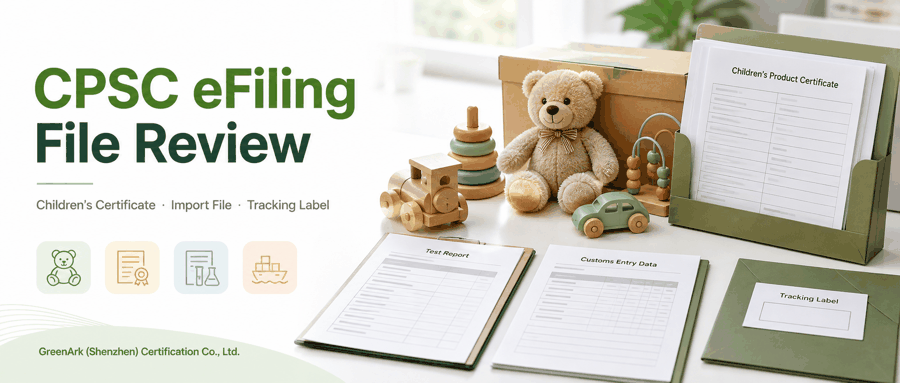
Executive summary: CPSC eFiling (Electronic Import Certification Filing System) is the single largest US import rule change of H2 2026, covering ~15,000 HTSUS codes of every consumer product category (toys, electronics, apparel, jewelry, furniture, bicycles, chemicals, batteries etc.). Starting 8 July 2026, every CPSC-governed consumer-goods import entry (Entry Type 01/11/12/51 …) must electronically transmit certification data + supporting evidence ALONG WITH their ACE/CBP entry, and paper certificates are no longer accepted. FTZ Foreign-Trade Zone admissions follow starting 8 Jan 2027. Greenark, in conjunction with ACE Beta Test XSD Schema v2026.3.0 final (CBP ACE + CPSC eGateway), breaks this rule into 5 layers: Obligor/Population / XSD 3-Block 70-Field Structure / CBP Two-Way 7-Field Core Match / Enforcement Consequences / Tonight readiness. Closes with a 5-step tonight list.
🔹 Trap 1: Model number in eFiling does NOT match 7501 line-item description EXACTLY (case / hyphen / spacing). Two-Way Match FAIL.
🔹 Trap 2: CPSC Lab Reg (CPSC-XXXXXX) filled — but status Expired on cpsc.gov/Laboratories profile; system auto-reject.
🔹 Trap 3: CPC Certifier EIN vs 7501 Block 26 IOR EIN mismatch (trading-company EIN vs US-subsidiary EIN). Certifier Entity-Check FAIL.
I. Legal Positions: THE US IMPORTER OF RECORD (IOR) BEARS 100% DUTY. Not factory, not FF, not broker.
| Role | 16 CFR §1110 citation | eFiling duty |
|---|
| US Importer of Record (IOR entity on 7501 Block 26) | §1110.3 LEGAL OBLIGOR | 100% legal accountability. Must complete eFiling BEFORE release, within 24h of entry file date. Must retain digital cert + ALL evidence (reports / tracking-label images / scope / URLs) for SEVEN years. Any willful falsification = 15 USC §2068 penalty (up to $100,801 civil per violation; willful = criminal prosecution). |
| Foreign Manufacturer / Export Factory | §1110.4(c) Data Provider Role | Assistance role only: provides IOR with accurate 1:1 fields (model-specific batch data, tracking label, CCL, etc). No US legal liability on factory, but IOR may indemnify. |
| Licensed US Customs Broker | §1110.5 Filing Agent | Can act as IOR's POA-authorized filer on ACE; but data truthfulness remains IOR's. Customs broker MUST run 7-field Core Check (Section III.1) before Entry Submit. |
| Freight Forwarder / NVOCC | Indirect Role | May only consolidate documents / data; cannot independently submit eFiling (requires IOR or broker-held POA). |
| 3PL / Amazon FBA Prep Provider | Indirect Role | May help prepare batch labels, stick tracking labels; legal accountability stays IOR's. |
Which HTSUS codes? 15 category buckets = ~15,000 ten-digit lines — your SKU 99% is in scope
eFiling covers every CPSC consumer-goods HTSUS code. Grouped 15:
| Bucket | Category | Example HTSUS chapters |
|---|
| 1 | Child Products (≤12, CPC): Toys, Child Apparel, Strollers, Juvenile Furniture, Child Products | HTSUS 95 Toys, 61/62 apparel by size, 94 Furniture juvenile |
| 2 | General GCC (non-child): Small appliances, tools, furniture, garden, homeware | 84/85 Electrical, 94 Furniture, 82 Tools, 96 Stationery |
| 3 | EE Products (PSU, Charger, Power Bank, LED, Home Appliance) | 85.04 PSU, 85.17 Lamps, 85.25 Microwave, 85.36/85.37 Charger, 85.41/85.42 LED, 85.07/85.08 Battery |
| 4 | Bicycle / Skateboard / Scooter / e-bike & PPE | 87.12 Bicycle, 87.16 Motorcycles incl. e-bike, 95.06 skate/helmet |
| 5 | Apparel / Footwear / Accessories / Masks / Sunglasses / Jewelry / Watch | 61 Knit / 62 Woven Apparel, 64 Footwear, 71 Jewelry, 90.04 Optical, 91 Watches, 63 Textiles |
| 6 | Kitchenware / Food Contact / Cookware / Appliance / Kettle / Bakeware | 39 Plastic kitchenware, 73 Steel, 85.09/85.16 Kitchen Appliance, 69 Ceramic tableware, 70 Glass drinkware |
| 7 | Mattress / Bedding / Upholstery / Sofa / Crib (Flammability 16CFR1632/1633) | 94.04 Mattress, 94.01 Seating, 94.03 Baby/Infant |
| 8 | Fireworks / Matches / Lighters (16CFR1210) | 36.04 Fireworks, 36.05 Matches, 96.13 Lighters |
| 9 | Household chemicals, cleaner, air freshener, detergent, aerosols | 34 Soap/Cleaner, 38.08 Perfumery/Cosmetics |
| 10 | Household chemicals, paint thinner / stains / coatings | 32.08–32.14 Paints / coatings |
| 11 | Carpets / Area rugs / floor textiles (16CFR1630 surface flammability) | 57 Carpets, 63.08 Floor coverings |
| 12 | Christmas / seasonal decorative (incl. UL588 strings) | 95.05 Christmas Articles |
| 13 | Eyewear / readers / OTC sunglasses (CPSC jurisdiction even non-Rx) | 90.01 / 90.03 / 90.04 Optical |
| 14 | Chemical mixtures / Aerosol sprays (16CFR1700 child-resistant closures) | 38.08/38.14/38.24 chemicals, 84.13 aerosols |
| 15 | Batteries / packs / power banks / ESS (16CFR1455 + UN38.3) | 85.06 dry cells, 85.07 storage batteries, 85.42 packs/Power Banks |
Greenark rule of thumb on borderline SKUs: If it is a consumer product falling under CPSC 15 categories (not FDA meat/drug, not USDA, not NHTSA auto, not TSA aviation) → assume it is in scope and prepare first. Better over-prepare than 8-July Entry Refused.
II. Data structure: 3 blocks × ~70 mandatory fields — any blank field = automatic Rejection
Under CPSC eGateway 2026.3.0 XSD schema, the eFiling XML/JSON message splits into THREE blocks totaling ~70 required fields. Every field has strict XSD validation (regex/enum/date format/codelist match); after 8 Jul 2026 live operation CBP-CPSC Two-Way Match runs automatically:
2.1 Block A: Certificate Information (CPC/GCC) — 35 fields (9 core + M-25-01 + Certifier Entity + URL + Advanced)
| # | Field (XSD name) | Type / Validation | §Ref | Tonight prep action |
|---|
| 1 | certificateType | Enum: CPC / GCC / FS-GCC | §1110.12 | Child ≤12 → CPC; Adult → GCC; Foreign supplier held → FS-GCC; add explicit type column to existing template. |
| 2 | certificateId | ≤20 chars unique internal ID | Internal | Assign unique IOR CPC/GCC IDs today (e.g. BRAND-CPC-2607-XXXXXX); increment per batch with 3-digit suffix. |
| 3 | certifierName | ≤150 chars exact entity | §1110.12(a)(3) | Entity name EXACTLY 7501 Block 26 IOR name character-by-character. Match tonight; any mismatch = edit CPC/GCC template. |
| 4 | certifierEin | Format XX-XXXXXXX (regex-enforced) | §1110.12(a)(3) vs 7501 B26 | EIN must match 7501 Block 26 EXACTLY (incl hyphens). Two-Way Match hard fail if off. |
| 5 | certifierAddressUS | Full US 10-line address (Street1/2 / City / State / Zip-5 / Country) | §1110.12(a)(3) | Certifier address MUST be US real street. PO Box / UPS Store mailbox = fail. Run USPS Delivery Point Validation tonight. |
| 6 | certificateIssueDate | YYYY-MM-DD ≤ Entry Date | §1110.12 | Issue date must be ≤ 7501 Entry File Date; every batch updates date; write an Excel formula to auto-update tomorrow. |
| 7 | productFamilyDescription | ≤300 chars, NLP ≥80% match vs 7501 Block 30 description | §1110.12(a)(1) | If 7501 says Portable Charger 12800mAh but CPC says Portable Charger (≥80% semantic = OK); completely different = unify description tonight. |
| 8 | productIdentifiers | Set: Model / SKU / ASIN / UPC / GTIN-14 (min 1, recommend all) | §1110.12(a)(1) | Build Product-ID Crosswalk table: ASIN/SKU/Model/UPC/GTIN/Batch/Lot 1:1 aligned, EXACT() pairwise tonight. |
| 9 | applicableStandards | Set: CFR Standard + edition (e.g. ASTM F963-23, 16 CFR 1501, 16CFR1307) | §1110.12(a)(2) | Every standard + edition 100% matches test report cover word-for-word. Diff = edit CPC/GCC. |
| 10 | testLabRegNumber | Format CPSC-XXXXXX | §1110.12(a)(7) + cpsc.gov/Laboratories | Lab registration status MUST be Active on cpsc.gov/Laboratories. Any Inactive/Expired = change lab tonight. |
| 11 | testDate | YYYY-MM-DD | §1110.12(a)(6) | Match Date Issued on test report cover. Match cover page today. |
| 12 | manufactureDate | YYYY-MM / YYYY-MM-DD | §1110.12(a)(5) | Month precision minimum. CPC/GCC Field 5 unified to ISO format. |
| 13 | manufactureLocation | Full factory address (Country/Province/City) | §1110.12(a)(5) | Full address of LAST substantial transformation factory. Confirm with ops team tonight. |
| 14 | recordKeeperContact | Living person: Name/Title/Direct Phone/Direct Email/US Address | §1110.12(a)(4) | Real living person! Call phone now + send test email. Dead line / forwarder email = FAIL. |
| 15 | trackingLabel | ≤500 chars (5-element description) OR Binary attachment JPG | 16CFR Part 1401 | Take high-resolution image of PERMANENT tracking label on finished unit TODAY; prepare attachment; 5 elements in text description: Factory/Prod Month/ Lot / Origin / Trace Code. |
| 16 | batchLotNumber | ≤60 chars; match tracking label / 7501 / invoice / packing list 1:1 (M-25-01 hard de facto) | M-25-01 (Jul 2025) | Use Excel EXACT() 5-doc crosscheck: CPC / Label / Invoice / Packing list / 7501. Any mismatch tonight edit all docs. |
| 17 | permanentCertificateUrl | https://≤255 chars; PUBLIC plain no-auth HTTPS (no S3 presigned / SharePoint / WeChat) | M-25-01 | Host every CPC/GCC PDF on compliance subdomain of your REAL brand domain (e.g. compliance.brand.com/certificates/xxx.pdf). Incognito browser loads in <5s = OK. Not ephemeral links. Any others = swap NOW. |
| 18 | childProductDetermination | Enum: Yes/No/Unknown. Yes → ageGradeMonths required | ADG 2020 4-factor | ≤12 = Yes; ≥13 = No; Unknown raises manual exam. Avoid Unknown. Run 4-factor tonight on every SKU. |
| 19 | ageGradeMonths | Numeric 0 – 144 (if Yes) | ADG 2020 | Fill real grade. Any mis-grade between ≤12 / 14+ = Red List. Fill this column tonight. |
| 20-35 | 16 Advanced fields: 3rd-party Country-of-Origin / 10-digit HTSUS / UL File Number / FCC ID / ASTM specific / CPSC Business ID / Agent of Process / extra URLs / Multiple Listing / PC number / Warning label / Prop 65 flag / Battery Chem / UN383 Ref No / Prop 65 / 1455 Appendix A flag | Advanced validation (UL file match on iQ, FCC ID on FCC EA, etc.) | 16 CFR Advanced Optional Fields | PRE-FILL 16 advanced fields per SKU template tonight. 8 Jul 2026 = submit one-click; don't search at customs time. |
2.2 Block B: Product Level (25 fields per SKU/batch) + 2.3 Block C (Evidence 10-validator)
Block A = certificate (one CPC covers many SKUs). Block B = product level, a separate Product node for every SKU / every batch submitted. Critical fields in Block B (5 out of 25): productBatchId (unique per batch), serialNumbersRange (if serialized), quantityReported (SKU count equals 7501 line), productValueUSD (equals 7501 line $), attachments (CPC PDF, full-test PDFs, label JPG, warning JPG, manual PDF, each ≤50MB; total ≤500MB).
Block C = Evidence-level validators on every attachment. CPSC system automatically performs these 10 checks on EVERY uploaded PDF/JPG/URL:
① PDF NOT encrypted; ② signed Issue-Date + Certifier e-signature; ③ filesize ≤50MB; ④ any https URL auto-Http HEAD ping; ⑤ Lab Reg # cpsc.gov-lookup; ⑥ FCC ID apps.fcc.gov lookup; ⑦ UL File Number UL iQ lookup; ⑧ Standard# CPSC Standard Library match; ⑨ All dates ≤ Entry Date; ⑩ Non-2XX URL response = rejected.
III. CBP Two-Way 7-Field Core Match (broker MUST run BEFORE CBP Entry Submit) + Top 10 High-Fail Fields
After CBP broker submits ACE entry but BEFORE release, the CBP engine performs 7-field Core Two-Way Match with eFiling data. Any 1 mismatch = Entry Status changes to Pending Exam → CET 100% Exam + later penalties:
| Core Field | 7501 vs eFiling Block A/B mapping | Validation rule |
|---|
| 1 | CPC Certifier EIN vs 7501 B26 IOR EIN | EXACT() string match incl hyphen; half-width vs full-width diff also fails. |
| 2 | HTSUS 10-digit vs Block A harmonizedTariffNo | 10-digit 1-1; multi-line → separate eFiling product nodes per SKU-HS |
| 3 | Product Description NLP vs productFamilyDescription | Semantic similarity (CBP BERT model) ≥80%; totally different category = fail. |
| 4 | Entry Value USD vs Block B (qty × unit price) | $ absolute difference ≤ ±0.5% of line value. |
| 5 | Batch/Lot vs Block B productBatchId | Character 1-1 match, including whitespace/case. |
| 6 | Country of Origin (7501 B14) vs Block A manufactureLocation.country | ISO 3166-1 alpha-2 2-letter codes match (CN / VN / TH etc). |
| 7 | Entry Date vs Issue/Test/Manufacture Dates | Issue Date ≤ Entry Date; Test ≤ Issue; Manufacture within 18 months before Issue. |
From Greenark Beta Test FAIL logs, top 10 highest-Fail fields (>5% fail rate = high frequency):
① certifierEin wrong format (13.2% — forgot hyphen: 123456789 vs 12-3456789).
② permanentCertificateUrl HTTP 404 / auth-wall (11.8%).
③ testLabRegNumber Expired on CPSC directory (10.6%).
④ batchLotNumber vs 7501/invoice mismatch (9.4%).
⑤ productFamilyDescription vs 7501 Description NLP similarity <80% (8.3%).
⑥ UL File Number Inactive / Not Found on iQ (7.9%).
⑦ FCC ID format wrong — no hyphen ABC123 vs ABC-123 (6.8%).
⑧ certificateIssueDate chronologically > Entry Date (6.5%).
⑨ childProductDetermination = Yes but ageGradeMonths empty (5.8%).
⑩ PDF attachments encrypted (passworded CPC PDF) (5.2%).
IV. Six Non/Mis-Submission Legal Consequences (lightest → heaviest) + 5-step tonight list
| Level | Consequence | Legal basis | Trigger / avoidance |
|---|
| 1 | Entry Reject (returned to broker for correction) | §1110.10(a) | Any missing required field / Core-Match fail. No fines, but delays schedule + wharf/detention/drayage. Pre-fill template to avoid. |
| 2 | CET 100% Exam + lab sampling | 15 USC §2071; 19 CFR §151.13 | Two-Way Match FAIL + HTS high-risk category (toys/child/lithium large). 14-45 day exam + 60-90 day lab; cost: IOR pays exam+warehouse+detention ($2k-$25k/container). In Beta 15,000 samples, certifier EIN errors → 48% CET rate. |
| 3 | Refusal of Admission (return or destruction) | 15 USC §2063(e)(1) | ① CPC/GCC/eFiling completely missing AND product non-conforming; ② Evidence non-compliant with standard; ③ Willful 3x falsification. Procedure: 30-day notice → return; 60-day non-compliance action → destroy. Costs: round-trip ocean + doc processing $6k-$15k/40HQ; destruction $3k-$8k/40HQ. |
| 4 | CBP Red List (every future entry auto-100% exam 12 months) | 19 CFR 151.200(c) | ≥ 3x Refusal-of-Admission within 12 months for same IOR. 12-month duration. Almost impossible to clear peak-season shipments. Release = $50k-$150k independent audit + CBP Petition 6-12 months. |
| 5 | Civil Penalty ($/event/day/piece) | 15 USC §2068; 2026 Staff Penalty Chart | ① Willful false data; ② Certifier entity falsified; ③ ≥ 2 refusals to submit eFiling in 14-day window. 2026 penalty chart: per §2068(a)(1) False Certificate up to $100,801 per product unit; per §2068(a)(5) Failure-to-report up to $25,200 per day. No upper cap on multi-violation; past single IOR fines exceeded $14M. |
| 6 | Criminal prosecution (federal prison + fine) | 15 USC §2070 | ① Willful conduct + substantial economic gain (> $1M/SKU); ② consumer death/injury caused (e.g. child CPC falsification); ③ transnational RICO; penalties: up to 5y personal federal sentence + $250k personal fine + $50M entity fine + asset forfeiture (RICO). |
🟢 5-step tonight list (5 min each)
1️⃣ IOR Entity + EIN double check: CPC/GCC certifier name & XX-XXXXXXX format EIN = 7501 Block 26. Exact tonight. Any mismatch = edit CPC/GCC.
2️⃣ CPSC Lab status sweep: cpsc.gov/Laboratories every lab number; Inactive/Expired = lab contact tonight for renewal or swap.
3️⃣ Dry-run 7-field Core Two-Way Match simulation: EIN / HTS / Description / Value / Batch / Country / Date. All match = pass; any fail = template correct tonight.
4️⃣ Product Crosswalk table complete: ASIN/SKU/Model/UPC/GTIN/Batch/Lot aligned EXACT. Any diff = unify 5 master docs tonight.
5️⃣ ALL CPC PDFs uploaded to permanent HTTPS domain: compliance.brand.com/certificates/xxx.pdf — incognito <5s loads = OK; any ephemeral link = domain change tonight.